6.5 Riding on wet surfaces
WARNING: Rain tends to make roads, paths and trails slippery and increases the braking distance for you as well as for other users you may encounter. Visibility is
generally negatively affected. The risk of accident is substantially increased on wet surfaces.
As mentioned earlier, wet surfaces tend to be very slippery, resulting in a substantial loss of maneuverability and braking power. To be sure to safely stop on a wet surface, you must
diminish your speed and you must brake earlier and more progressively than normal. In fact, you would not want your wheels to lock up and start skidding. Refer to section 7.3.1 for more
details.
6.6 Extreme and competitive use
If you intend to participate in competitions or if you practice downhill, you accept that you are taking greater risks that could cause serious injury or even death. In downhill, you risk reaching
speeds as high as those attained by off-road motorcycles and you are then exposed to a similar level of danger. Always wear complete safety equipment including full-face helmet, full finger
gloves and a body armor that fully protects your back. Make sure your bike and equipment are in order by having them inspected by your authorized Devinci dealer. Ask the expert riders
and the trail managers for information regarding the conditions and the required materials. It is your responsibility to check that you have the correct equipment, including your bike and that
it is in working perfect order
WARNING: Downhill biking can result in serious accidents. Always wear the proper safety equipment and make sure your bike is in perfect working order. In downhill, even
the best protection cannot prevent serious injury or even death. Learn how your suspension and braking systems work and respond before attempting downhill
or extreme off-road.
07
In order to increase your performance, your safety as well as your fun, it is essential that you understand thoroughly how your bike and its components work. Even if you are an expert rider, the
new generation bikes have so many innovations and new technology that you could end up surprised. It is, therefore, strongly recommended you go through this section no matter how much
experience you have. For more information, always refer to your authorized Devinci dealer.
7.1 Wheels
7.1.1 Assembly and disassembly
WARNING: Using a bike with quick releases that are not tightened enough means you risk losing the wheels, resulting in damage to bike and leading potentially to serious
injury or even death. It is, therefore, essential that you:
1. Ask your authorized Devinci dealer to explain how the wheels quick releases work so that you can assemble and disassemble them safely;
2. Learn how to safely use a quick release so that you can apply this knowledge;
3. Make sure your wheels are properly clamped before every ride.
A. Adjusting the quick release system
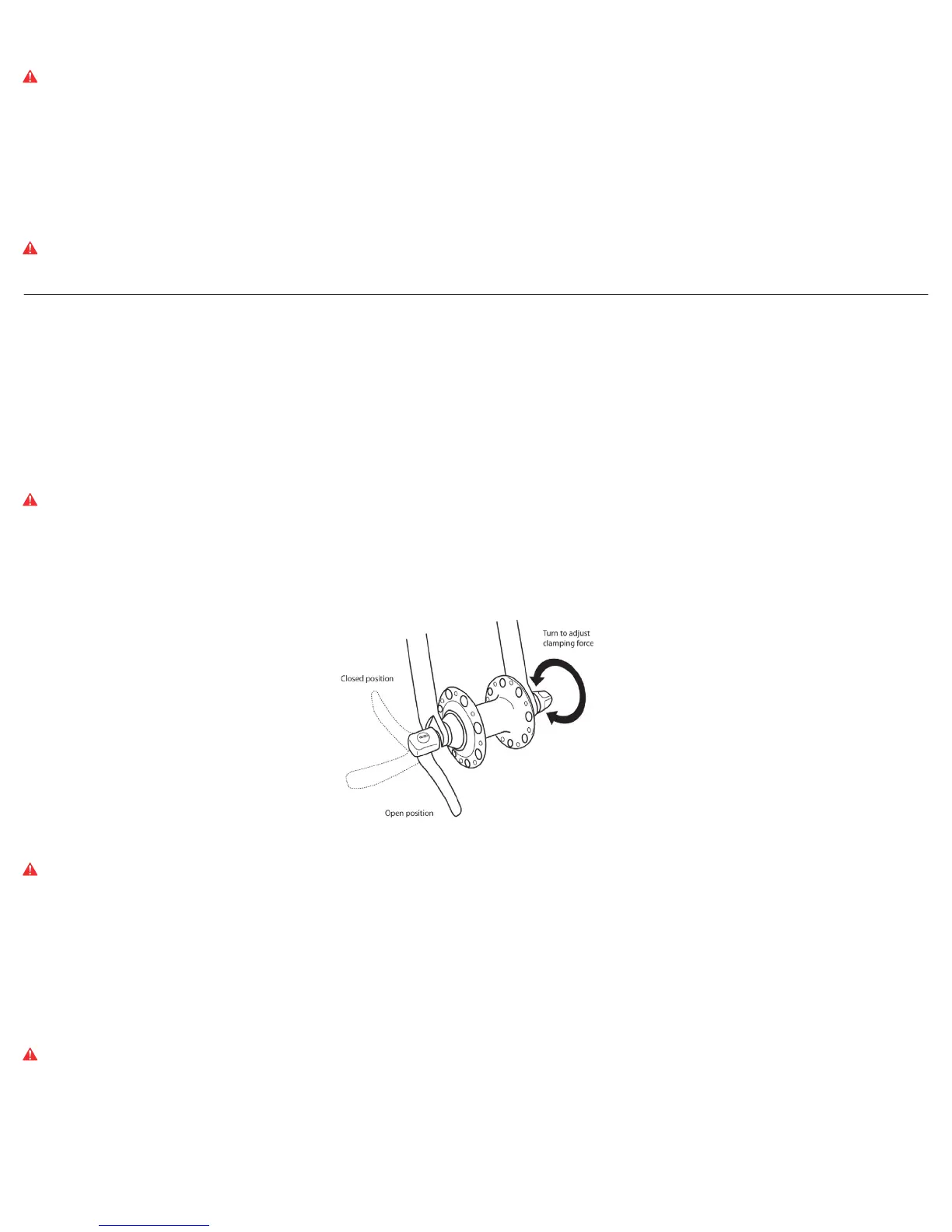
The quick release uses a cam mechanism to exert a significant force on the wheel hub when placed in the closed position and a small force in the open position. Since it is adjustable, you need
to learn how to operate it to ensure optimal use and a safe binding.
Figure 11
WARNING: You need to use the cam mechanism when clamping your wheel with a quick release to achieve proper binding force, by switching the lever from the opened to the
closed position. If you hold the level with one hand and you screw the nut to clamp the wheel, it will never be safely tightened. Instead, you need to switch the lever
from the opened to the closed position with a very significant restriction force. The nut helps you adjust the amplitude of that force by screwing or unscrewing it.
It is the power of the cam that maintains the wheel in place. It squeezes the wheel hub in between the fork arm ends or dropouts when switching the lever from the opened to the closed
position. The tightening force depends on the torque applied on the adjusting nut. To increase the tightening force, you need to turn the adjusting nut clockwise while holding the lever with the
other hand. To reduce it, turn the adjusting nut counterclockwise again holding the lever. Less than half a turn can make the difference between a safe and an unsafe tightening. Refer to
figure 11.
Notice: The quick release mechanism is installed on the wheel hub by its manufacturer. Never remove the mechanism from the wheel hub unless you need to repair it. Consult your authorized
Devinci dealer for the repair of a wheel hub.
B. Front wheel alternative devices
On many models, the front fork is equipped with an alternative retention device that prevents the wheel from disengaging in case of poor quick release installation. This device, integrated
directly to the fork by the processes of machining or casting, shall not replace, under any circumstances, the prescribed adjustment of the quick release.
WARNING: It is very dangerous to use a bike with a modified or removed auxiliary retention device. The modification or the removal of this device could result in serious injury
or even death. This could also lead to the annulment of your warranty.
C. Disassembly and assembly of a wheel equipped with a quick release
a. Front wheel disassembly
i. If your bike has v-brakes, spread the brake calipers as elaborated in section 7.3;
ii. Switch the quick release from the closed to the opened position;
iii.Loosen the adjusting nut of the quick release until the wheel can be adequately removed;
iv.Lift the front of the bike a few centimeters and hit the wheel downward with your hand to disengage it from the fork.
TECHNICAL INFORMATION



 To Next Page
 Loading...