Caliper brake adjusting barrel Brake lever adjusting barrel
Figure 20 Figure 21
Another factor that affects the braking force is the load on your wheel. Indeed, normal force is directly proportional to the friction force you can reach. As a matter of fact, a wheel with a
heavy load on it will allow a higher braking force, while a wheel with a lighter load on it will lock up much sooner. Therefore, you should back up to the rear of your bike when braking with
more intensity. This will increase the weight on the rear wheel while decreasing the weight on the front one, it will also shift your center of gravity. This will help reduce the risk on being
thrown over your bike. Simultaneously , you should use the front brake with more strength than the rear one. This technique is even more important when riding down steep terrain.
In order to master braking techniques, it is important to practice in a safe place away from traffic, obstacles or any other danger. Make sure you master the lock up limits of your wheels and
the weight transfer linked to emergency braking.
When riding your bike on wet surfaces, in rainy weather or on light and running soil, your bike response changes. The tire adherence decreases quickly and your maneuverability is
negatively affected. Often, a smaller braking pressure is all it takes to lock up the wheels completely. Furthermore, water and humidity make the brake pads less efficient. In wet weather,
make sure you reduce your speed in order to better control your bike.
7.3.2 Brake tuning
If your bike is equipped with hydraulic disc brakes and you suspect something abnormal at your safety mechanical inspection, have it immediately checked by your authorized Devinci dealer.
On the other hand, if your bike is equipped with cable brakes and it fails the safety mechanical inspection, you can try adjusting their strokes by turning their tuning barrel counter-clockwise.
Make sure you screw back the lock nut after the adjustment. If the problem persists, ask your authorized Devinci dealer for assistance. Refer to figures 20 and 21 for visual support.
7.4 Drive train
Your bike is equipped with a mechanism of chain and sprockets, also known as a drive train that allows changing the pedaling ratios and optimizes your pedalling power.
Shifting gears will allow you to increase your physical benefits. Using your gears, you can pedal with a higher cadency and a lower resistance, which will help improve your endurance and
power. On the other hand, exerting huge forces on your pedals with a low cadency will obtain poor results for your health and your fitness. The numerous gears your bike possesses help
you target the optimal cadency in a variety of situations and geographical conditions. The optimal cadency is generally ranged between 60 and 90 turns per minute, depending on your age
and your fitness.
7.4.1 Drive train functioning
The drive train mechanism of your bike is divided into:
• A rear derailleur;
• A front derailleur (most of the time);
• A freewheel cassette;
• One to three chainrings;
• A chain;
• One or two shifters.
To calculate the number of speeds available on a bike, just multiply the number of chainrings with the number of rear sprockets on your freewheel cassette. For example, a bike with three
chainrings and nine sprockets on your freewheel cassette has twenty-seven speeds.
A. Shifting gears
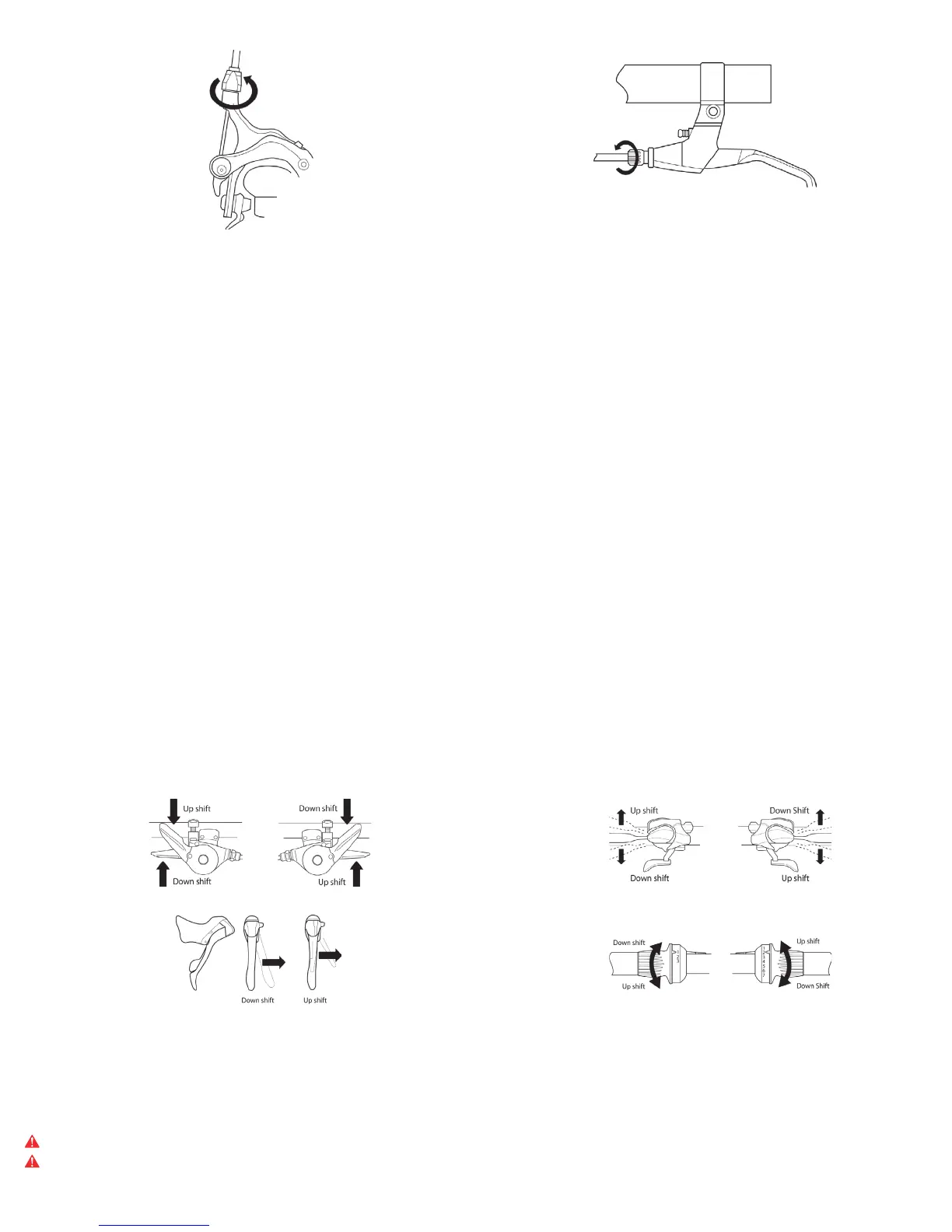
Many shifter models are available on the market. Devinci has selected shifters to better meet your criteria in terms of ergonomics, performance and price. The figures 22 to 25 illustrate the
way the different models work. Check the type of shifters your bike is equipped with before continuing.
Figure 22
Figure 23
Figure 24 Figure 25
The vocabulary for gear shifting might seem a bit confusing at first. To go to a shorter gear ratio or to a slower gear is designated as a downshift while upshifting refers to the action of going
at a longer gear ratio or a faster gear. A slower gear requires less strength than a faster gear. To make that even more complex, the actions on your rear derailleur are opposite to those on
your front derailleur. Indeed, the action of down shifting can be achieved in two different ways; lowering the chain on a smaller chainring or raising the chain on a larger sprocket on the
freewheel cassette. Refer to sections B and C for more details.
A little trick to help you memorize this is to note that the chain must be closer to the frame in order to down shift and climb a hill or further away to upshift and go faster.
To shift gears, the chain must be tight and rotate in the normal direction. The derailleur works only when pedaling forward.
CAUTION: Never activate your shifters when pedaling backwards and never pedal backwards after having shifted gears. The gears could jam and damage your bike.
WARNING: Never send the chain on the larger or the smaller sprocket of the freewheel cassette if your derailleur is not properly adjusted. The chain could jam and result in
a fall and serious injury. This also applies to the front derailleur.


 To Next Page
 Loading...