Need help?
Do you have a question about the DeWalt DC500 and is the answer not in the manual?
Covers general safety rules for tool operation, including workspace, personal protection, and tool checks.
Specific safety guidelines for tools powered by mains electricity, focusing on extension cables.
Instructions for safely removing the battery pack when the tool is not in use or during servicing.
Specific safety advice relevant to users in Australia and New Zealand regarding supervision and cord damage.
Specific safety precautions for operating vacuum cleaner functions, including splashproof rating and prohibited substances.
Step-by-step guide on how to correctly insert the battery pack into the tool.
Advice on ensuring the battery pack is charged and how to handle it.
Instructions for connecting the hose to the vacuum inlet or blow outlet.
Guide on how to turn the tool on and off using the main switch.
Explanation of how the tool operates using either mains or battery power automatically.
Specific instructions for operating the tool when connected to mains power.
Specific instructions for operating the tool using a battery pack.
Steps for using the tool effectively in vacuum mode.
Steps for using the tool effectively in blowing mode.
Lists and describes the accessories that are supplied with the tool.
Information on consulting dealers for additional compatible accessories.
General guidance on maintaining the tool for continuous satisfactory operation.
Procedure for emptying the tank when it contains dry materials.
Procedure for emptying the tank when it contains wet materials.
Steps for cleaning the vacuum cleaner's tank after use.
Instructions on how to clean the main dust filter correctly.
How to clean the filter located at the suction opening.
Guidance on what to do when the tool's automatic shut-off feature engages.
Details on how to obtain repair and service for DEWALT power tools.
Details of the one-year warranty covering defects in materials and workmanship.
Information on the complimentary one-year service contract including free labour on repairs.
Details of the 30-day no-risk satisfaction guarantee for product returns.
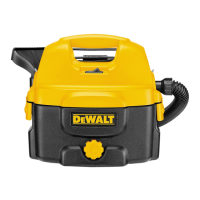
The DEWALT DC500 is a versatile cordless/corded vacuum cleaner designed for professional applications, capable of vacuuming both dry and wet substances. Its dual power source allows it to operate on mains (corded) power or battery (cordless) power, making it suitable for both indoor and outdoor use. For cordless operation, the tool is compatible with DEWALT NiCd and NiMH battery packs ranging from 12 to 18 V. Beyond its primary function as a vacuum, the DC500 can also be used as a blower to clear debris from workplaces and dry damp surfaces.
The DC500 operates by creating a powerful suction or blow force, depending on the selected mode. In vacuum mode, air and debris are drawn into the tank through the vacuum inlet. The tool is equipped with a dust filter that should always be in place during operation to ensure proper filtration. If the tool is accidentally used without the dust filter in wet vacuuming, a shut-off feature will activate when the liquid level in the tank reaches its maximum, causing a float valve to block the suction opening, stopping suction, and increasing motor speed. This mechanism prevents liquids from entering the motor housing. In blow mode, air is expelled through the blow outlet, allowing users to clear debris or dry surfaces. The tool features an on/off switch for easy operation and latches to secure the power head to the tank. A drain plug is provided for convenient emptying of liquids.
To operate the DC500, users should first ensure the work area is clean, well-lit, and free from flammable liquids or gases. Children, visitors, and animals should be kept away from the work area. Proper attire, including safety glasses, a face or dust mask (if dust or flying particles are present), heat-resistant apron (if particles are hot), ear protection, and a safety helmet, is recommended. The tool should always be used in an upright position to prevent liquids from entering the motor housing.
For vacuuming, the tank should be emptied and cleaned before use. The hose is connected to the vacuum inlet and secured by turning it clockwise. The appropriate accessory, such as the wide nozzle or crevice tool, is then attached to the hose nozzle. It is recommended not to mix wet and dry substances; if switching between them, the tank should be emptied and cleaned first. The DC500 can also function as a dust collector for power tools. The supplied dust extraction adaptor facilitates connecting a power tool to the hose nozzle for efficient dust and debris collection.
For blowing, the tank should be emptied and cleaned before use. The hose is connected to the blow outlet and secured by turning it clockwise. The desired accessory is then attached.
The tool automatically switches between AC (mains) and DC (battery) power. When using mains power, the cable should be fully unwound and connected to an outlet before switching on the tool. For battery power, a charged battery pack should be inserted into the battery compartment, ensuring it is fully seated. The battery compartment cover is then closed. Always switch off the tool before inserting or removing the battery pack.
Regular maintenance is crucial for the DC500's long-term performance and safety. The tool should be kept clean and in good condition. After each use, or when switching between wet and dry substances, the tank (3) should be emptied and cleaned with mild soap and a damp cloth, then carefully dried.
The dust filter (19) should also be cleaned after each use. To clean, remove the dust filter by turning it counter-clockwise from the suction opening (20). Excess dust can be shaken off by tapping the filter into a waste container. Depending on its condition, the outside of the filter can be rinsed under lukewarm running water. It is important not to wash the inside of the filter and to let it dry thoroughly if it becomes wet. A brush should not be used to clean the filter. Once clean and dry, the filter is secured back over the suction opening by turning it clockwise.
If the tool is operated without the dust filter, the suction opening filter needs cleaning. To do this, remove the filter from the suction opening (20), keeping the float valve (21) out of the way. Rinse the filter under lukewarm running water and dry it before re-installing. The float valve (21) should also be cleaned with a damp cloth.
If the shut-off feature engages, the tool should be switched off immediately, the tank emptied, and the suction opening filter cleaned. Always remember to put the dust filter back in place before resuming work.
For battery packs, ensure they are fully charged. If a battery pack no longer produces sufficient power, it should be recharged according to the charger's instructions. At the end of its technical life, battery packs should be run down completely, removed from the tool, and taken to a dealer or local recycling station for proper disposal, as NiCd and NiMH cells are recyclable.
Any repairs should be carried out by an authorised DEWALT repair agent using original spare parts to ensure safety and maintain the tool's compliance with safety regulations. Users should never attempt repairs themselves. Extension cables should be inspected for damage before use, and only outdoor-rated extension cables should be used when working outdoors.
 General
| Product color | Black, Yellow |
|---|---|
| Dust container type | - |
| Cleaning type | Dry&wet |
| Wet & Dry | Yes |
| Charging time | - h |
| Battery voltage | 18 V |
| AC input voltage | 230 V |
| Power consumption (typical) | 300 W |
| Batteries included | No |
 Weight and Dimensions
| Depth | 390 mm |
|---|---|
| Width | 225 mm |
| Height | 360 mm |
| Weight | 4600 g |

 To Next Page