AGE Reader mu Instructions for use
User Manual
7
6.2 Main screen
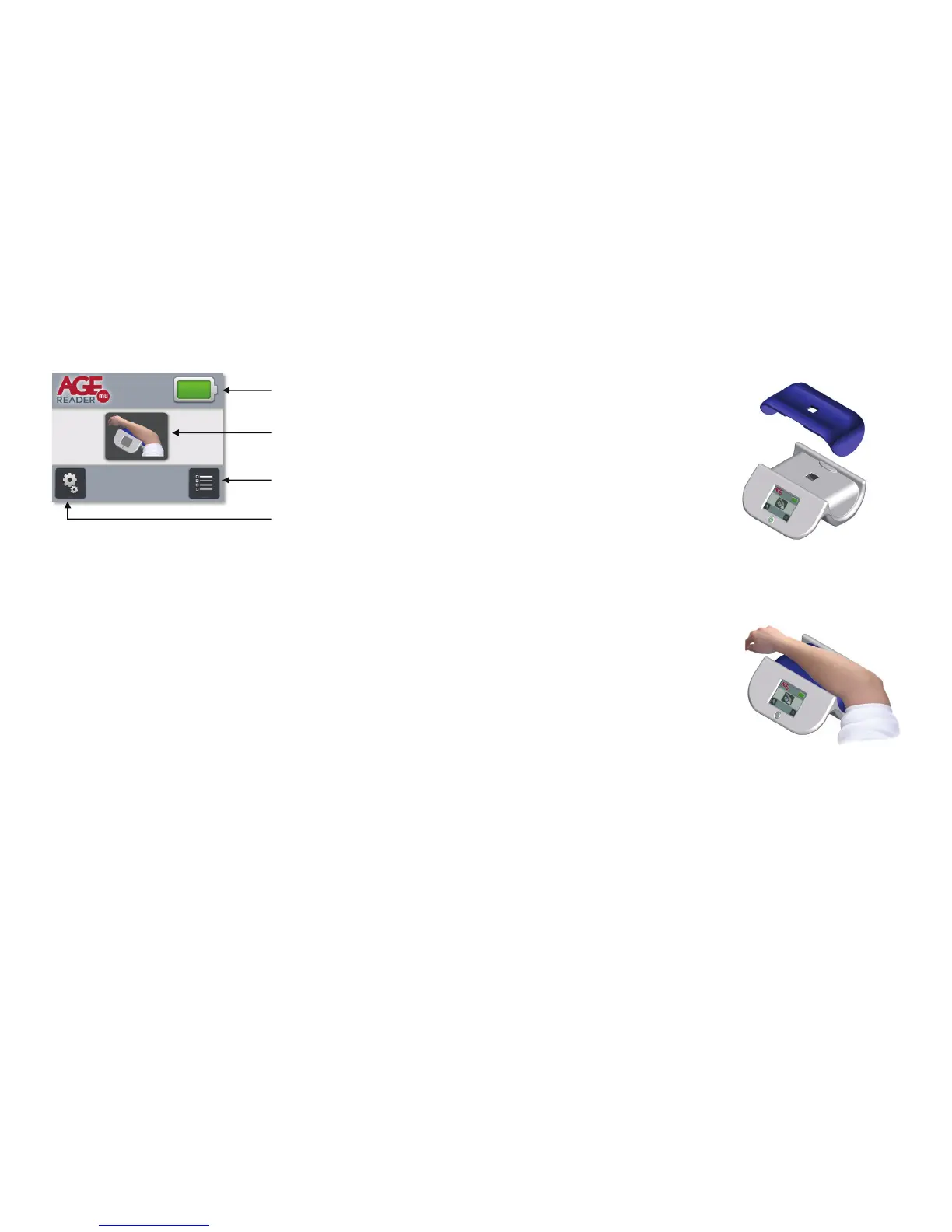
Figure 4. Main screen
The figure above shows the Main screen which appears when the AGE Reader has
initialized successfully. The top section of the Main screen shows the AGE Reader
mu logo and the Battery charge indicator.
Prominently present at the centre of the screen is the Start measurement button
which, when pressed, starts an AGE Reader measurement (see section 6.3.3).
The last twenty measurement results are stored by the AGE Reader mu. A list of
these measurement is available on the Measurement Results Screen. This screen
is accessible by pressing the Measurement Results button at the bottom-right
corner of the Main screen. If no measurement results are available yet, the
Measurement Results button will be shown in inactive state.
In the bottom-left corner of the Main screen the Settings button is located. By
pressing this button the user can navigate to the Settings screen. For more
information see section 6.4 Settings screen.
Battery charge indicator
Start measurement button
Settings button
Measurement Results button
AGE Reader mu Instructions for use
User Manual
8
6.3 Measurement
6.3.1 Prepare for measurement
Check if the measurement window of the AGE
Reader mu is clean, if not clean the
measurement window first.
See chapter 8 for instructions.
Ensure that the silicon mat is positioned
properly. The silicon mat has a symmetrical
shape to ease positioning on the AGE
Reader mu.
The two notches on both side of the top
surface align the mat with the measurement
window of the AGE Reader mu (figure 5).
Make sure that the mat touches the top
surface of the AGE Reader mu everywhere by
mildly pressing the mat.
Figure 5. Silicon mat positioning
The patient’s dominant forearm should be
placed on the AGE Reader mu as
indicated in figure 6. Ensure that the arm
lies in a relaxed position to avoid arm
movements during the measurement.
Measurements are preferably performed on
the inner side of the dominant lower forearm
on healthy undamaged skin without
birthmarks, excessive hair growth or tattoos
(see chapter 2).
Figure 6. Patient arm position


 To Next Page