AGE Reader mu Instructions for use
User Manual
13
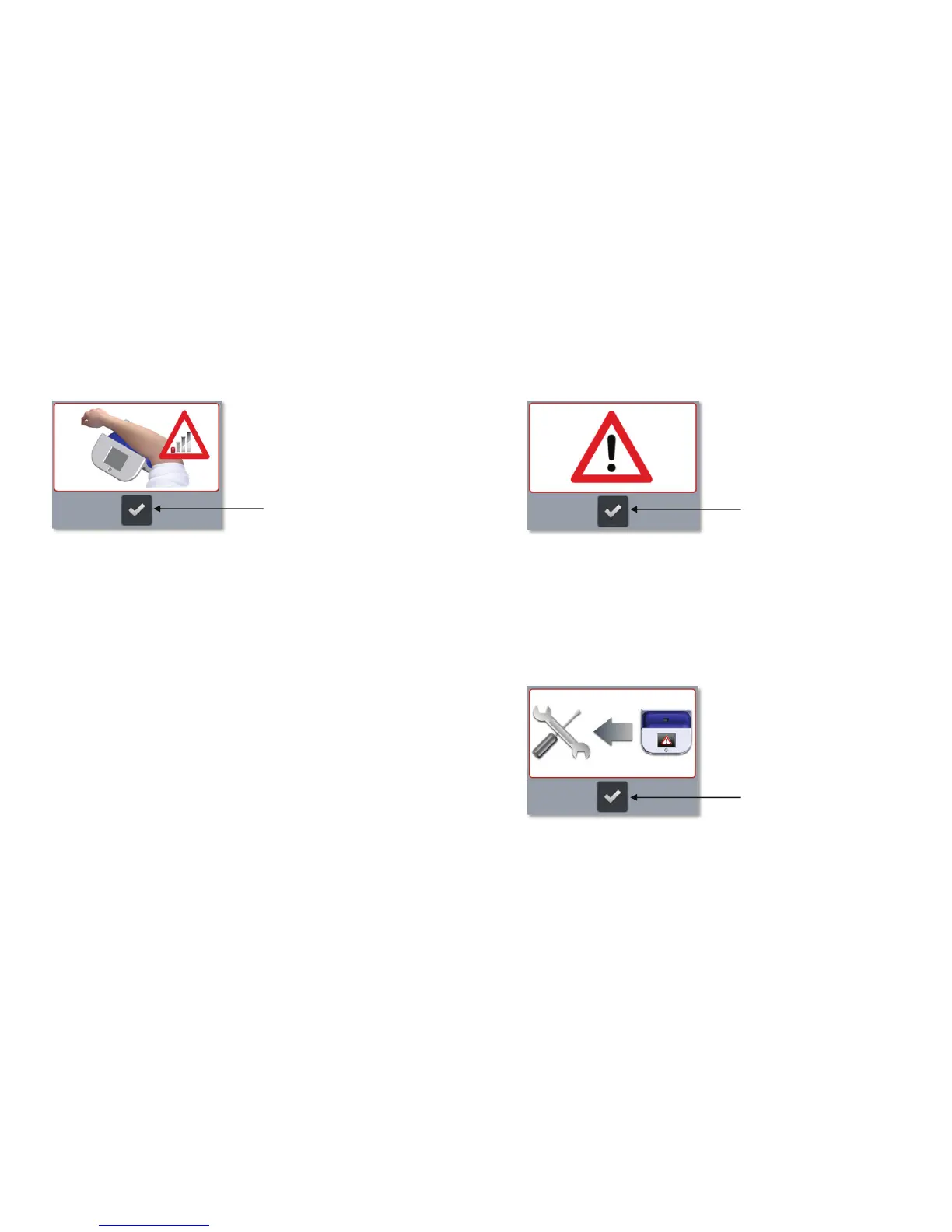
Low-signal error indication
If the measured fluorescence signal from the arm is too low, the AGE Reader mu is
unable to perform a reliable measurement. It will then abort the measurement and
raise a low-signal error (figure 15).
Figure 15. Low-signal error indication
In general a low-signal error results from a patient’s arm skin that has too much
dark pigment. This in turn might be caused e.g. by birth marks, freckles or tinted
skin.
See section 6.3.1 Prepare for measurement for instructions on how to position the
patient’s arm before retrying the measurement. Press the Confirm button to return
to the Main screen from where a new measurement can be started. If the problem
persists conclude that the patient’s arm has too much pigment, a measurement with
the AGE Reader mu is not possible.
Confirm button
AGE Reader mu Instructions for use
User Manual
14
External error indication
The External error indication is shown (figure 16) when any of the measurement
parameters has an out of bound value that cannot be directly related to the use of
the AGE Reader mu.
Figure 16. External error indication
Press the Confirm button to return to the Main screen from where a new
measurement can be started. If the Internal error indication remains see section 9.2.
Internal error indication
The Internal error indication is shown (figure 17) in case of an internal system
failure that cannot be directly be solved by the user. The device must be returned to
the manufacturer, see section 12.1 for contact details.
Figure 17. Internal error indication
Press the Confirm button to return to the Main screen.
Confirm button
Confirm button


 To Next Page