16.7. Type of Work Considerations
Dierent types of work (applications) present varying risk of CO exposure.
The highest risk is associated with types of work that require slow move-
ment, such as oor stripping or polishing. Due to slow movement,
the activity and engine exhaust is concentrated to a relatively small area
which results in higher CO levels for the operator. Types of work that
require high movement, such as burnishing, will naturally stir the
air and diuse the engine exhaust and result in lower CO levels for the
operator.
The term “Eective Operating Zone” is used to visualize this concept. The
Eective Operating Zone can be dened by the amount of area covered
during a given time frame. Small Eective Operating Zones result the
greatest risk of CO Exposure.
When using equipment over a large area in a short time, as in most bur-
nishing applications, your Eective Operating Zone is large. When activity
is concentrated to a smaller area as in stripping applications, the
Eective Operating Zone is small and stirring or CO mixing MUST be
forced by the use of fans to increase the Eective Operating Zone and
reduce high concentrations of CO. The Eective Operating Zone can be
dened as the area covered in a given time.
WARNING: When the Eective Operating Zone is small, fans
must be used to force the mixing/ stirring of air and reduce high
concentrations of CO.
WARNING: Proper ventilation must be combined with air mixing/
stirring to reduce CO to a safe level.
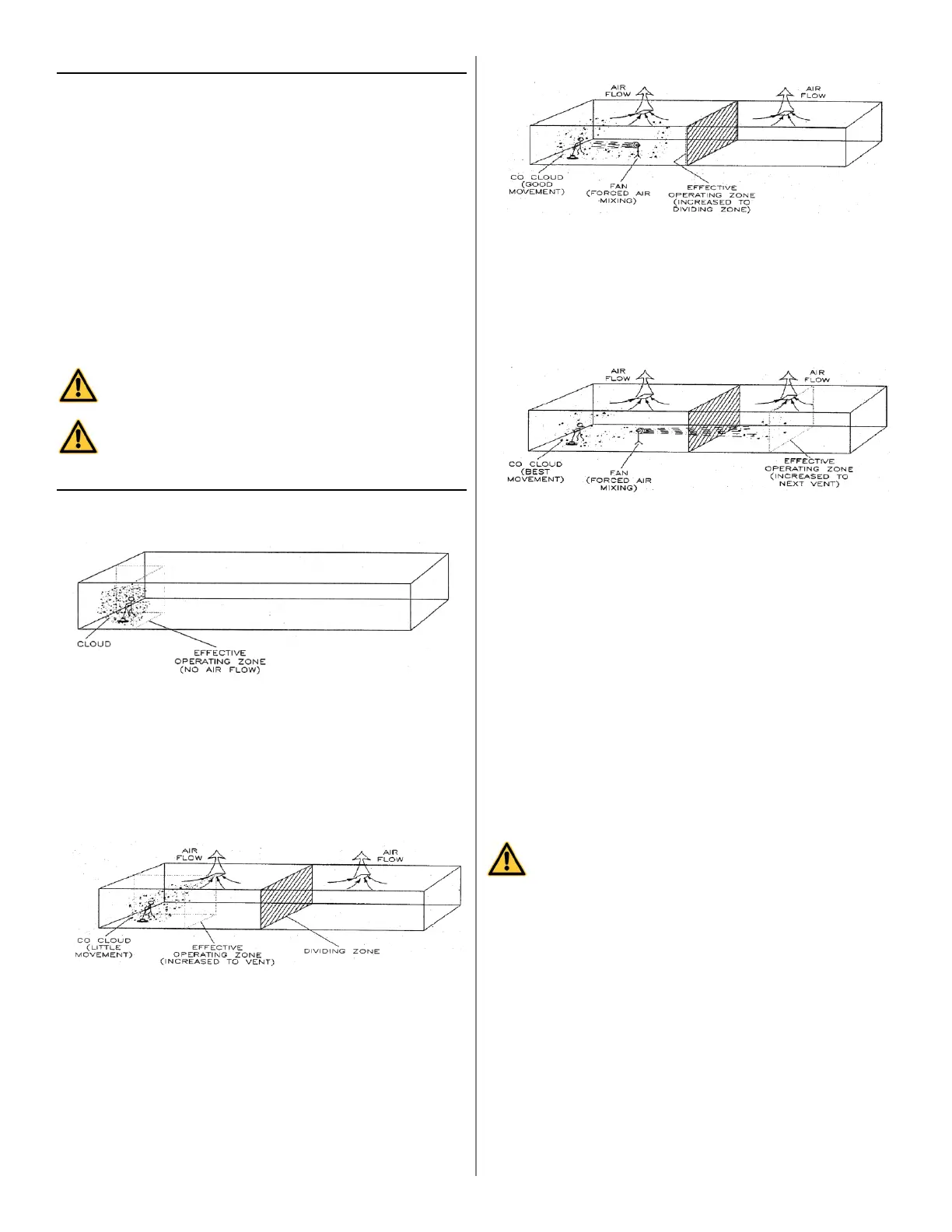
MODEL 1: Worst Case CO Management
Model 1 illustrates the worst case of CO management for several reasons:
• The room is not properly ventilated
• The air in the room is not mixed/stirred with any fans
• The type of work shown (stripping) requires low speed movement and
results in a smaller “Eective Operating Zone”.
Note: Even though the room is large, due to these worst practices, the
engine exhaust is concentrated near the operator, resulting in high CO
exposure.
MODEL 2: Poor CO Management
Model 2 illustrates a slightly improved case of CO management, compared
with Model 1, because air ventilation is introduced. As a result, the Eec-
tive Operating Zone is slightly increased and slightly lower levels
of CO concentration would be expected. However, because air is not
mixed/stirred, and because the type of work shown (stripping) requires low
speed movement, there is still a potential risk of high CO exposure.
The CO cloud is still concentrated in a small area. Note the “Dividing
Zone” shown above, this is the line where airow changes direction.
Because all of the CO exists on one side of the dividing zone, only half of
the room’s ventilation is eectively evacuating CO.
16.8. Examples of Management in Spaces
MODEL 3: Better CO Management
Model 3 illustrates an even more improved case of CO management,
compared with Model 2, because the air is being mixed/stirred with fan(s).
Notice the CO concentration and the Eective Operating Zone (Expanded
to the Dividing zone) due to the forced air mixing. The CO cloud is still
concentrated on one side of the Dividing zone. As in Model 2, because all
of the CO exists on one side of the dividing zone, only half of the room’s
ventilation is eectively evacuating CO.
MODEL 4: Best CO Management
Model 4 illustrates the best case of CO management, because the forced
mixing/stirring of air causes the diusion of CO across the Dividing zones,
and maximizes the Eective Operating Zone. This method maximizes
the amount of diusion and maximizes the amount of CO that will be
eectively evacuated by the room’s ventilation, and thus minimizes the
operator’s potential exposure to CO.
Maintenance of Equipment
There are several components and systems on the propane engine of this
equipment that ensure minimal CO output:
Catalytic Muer: A three-way type catalytic converter to scrub CO, Hydro
Carbons (HC), and Nitrous Oxide (NOx) from the engine exhaust providing
the lowest possible emissions.
Propane Fuel System: The regulator/carburetor of this engine (the fuel
system) are specically calibrated for the engine to run with a very “lean”
air/fuel ratio which minimizes the production of carbon monoxide.
Air Cleaner: The engine is equipped with an air-cleaner that lters dust
and contaminates from the air used for combustion, resulting in a full and
clean burn during engine ignition.
WARNING: The proper maintenance of equipment is vital to safe
operation. LPG engines are dependent on engine tune up, and air
lter replacement. CO concentration (production) skyrockets when
the air to fuel ratio becomes fuel rich. Follow the recommended
Maintenance found in the Engine Operator Manual as well as in
this Operator Manual.


 To Next Page
 Loading...