- Check the size of the tyres installed and the ply number
to ensure they are inated to the correct pressure.
- To ensure maximum efficiency do not use tyres with
more than 80% of tyre tread wear.
- ATTENTION -
Inating or working on tyres can be dangerous.
Whenever possible, have specialised personnel interve-
ne on or install tyres. To prevent serious or mortal inju-
ry, follow the safety precautions described below.
- Vehicle tyres are very heavy. Handle with care and ensu-
re that, once stored, they cannot fall and injure anyone.
- Never attempt to repair a tyre on a public road or motorway.
- Make sure that the car jack is positioned on a solid, at
surface.
- Make sure that the jack is suitable to support the weight
of the vehicle.
- Use jack tripods or other locking devices suitable for
supporting the vehicle while repairing tyres.
- Never place any part of your body under the vehicle.
- Never start up the vehicle while it is on the jack.
- Never hit a tyre with a rim or hammer.
- Make sure that the rim is clean, and that there is no rust
or damage. Do not weld, braze, repair or use a damaged
rim in any way.
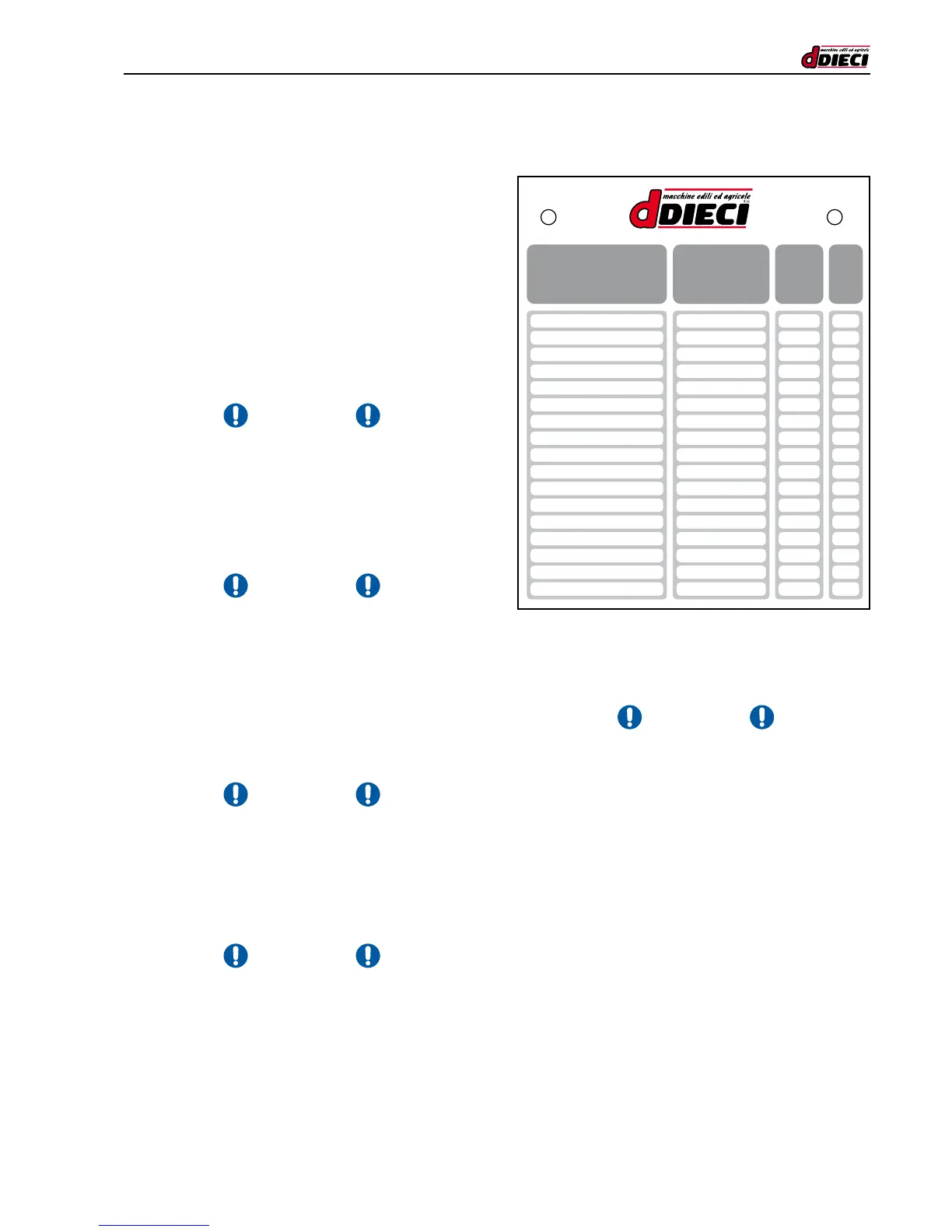
Tyre pressure table
TIGHTENING WHEEL NUTS
- Tighten nuts in accordance with the schedule provided in
the maintenance table
- When tightening the wheel nuts, torque should be as follows:
Wheel stud 18 kgm 50
Wheel stud 22 kgm 60
- Always tighten the nuts positioned opposite each other,
not consecutively.
- After having remounted the wheel, tighten the nuts
between the wheel and axles. Check that nuts are tighte-
ned each day until torque has stablised.
- ATTENTION -
THE NUMBER OF AXLE STUDS MUST CORRESPOND
TO THE NUMBER OF TIGHTENED NUTS.THEREFORE
ALL NUTS MUST BE MOUNTED IN ON EACH TYRE;
OTHERWISE THE VEHICLE WILL NOT OPERATE.
- In the event of tyre replacement, the vehicle or the lif-
ted side can be set back on the ground only with tyres
mounted and properly tightened.
- ATTENTION -
NUT TIGHTENING MUST BE CARRIED OUT FIRST WITH THE
VEHICLE, OR PARTS OF IT, LIFTED FROM THE GROUND,
AND THEN WITH THE VEHICLE ON THE GROUND.
- Only use original DIECI nuts to tighten the wheels.
Should even just a single nut be lost, contact the DIECI
service centre.
TYRES
- ATTENTION -
UPON RECEIPT OF THE VEHICLE,
CHECK TYRE AIR PRESSURE.
- Check tyre pressure every 100 hours and every two we-
eks. Pressure should be checked when the tyres are cold.
- Before each use, verify that the sides of the tyres are not
damaged.
- ATTENTION -
TYRES THAT ARE TORN OR ARE EXCESSIVELY WORN
SHOULD BE REPLACED IMMEDIATELY.
- Keep all oils, grease and corrosive liquids far from the
tyres to prevent any damage to the rubber.
- Tyre pressure must be kept at the level indicated in the
table. The tyre pressure given corresponds to the re-
commendations of the manufacturer, and should there-
fore be respected as far as possible.


 To Next Page