4
Checklist
• Has a calculation of the cooling load been made?
• Is the cooling capacity of the device sufficient for the room to be cooled?
• Are the operating limits sufficient for the purpose for which the air conditioner is intended?
• Are the walls or the foundation for the installation of the outdoor unit strong enough?
• The indoor unit should be installed in a position where it ensures uniform cooling.
• Minimum clearances must be observed.
• Planning the installation of the outdoor unit:
consider noise emission and free air circulation,
avoid direct sunlight,
ensure unimpeded access to the component,
installation at locations without access by general public.
• Is a wall bracket required for the outdoor unit?
• Plan the power cable and connection; ensure adequate fuse protection.
• Check the maximum length and feasibility of the refrigerant pipes.
• Refrigerant pipes should be as straight and short as possible.
• When routing the refrigerant pipes, it is essential to maintain a bend radius of 3.5 x pipe diameter.
• Excess piping should be wound up at a downward angle to the outdoor unit
in order to avoid displacement of refrigerant oil.
• Take the height difference between indoor and outdoor unit into account.
• If the outdoor unit is installed higher than the indoor unit: provide an oil siphon every 3 vertical meters.
• Plan condensate drainage. If the condensate hose on the indoor unit cannot be routed with a downward slope,
a condensate pump must be provided. The condensate is always formed at the
“
cold
”
side of the air conditioner;
this means for cooling in the inner component and for heating in the outdoor unit.
• Is an approval by the local utility company required?
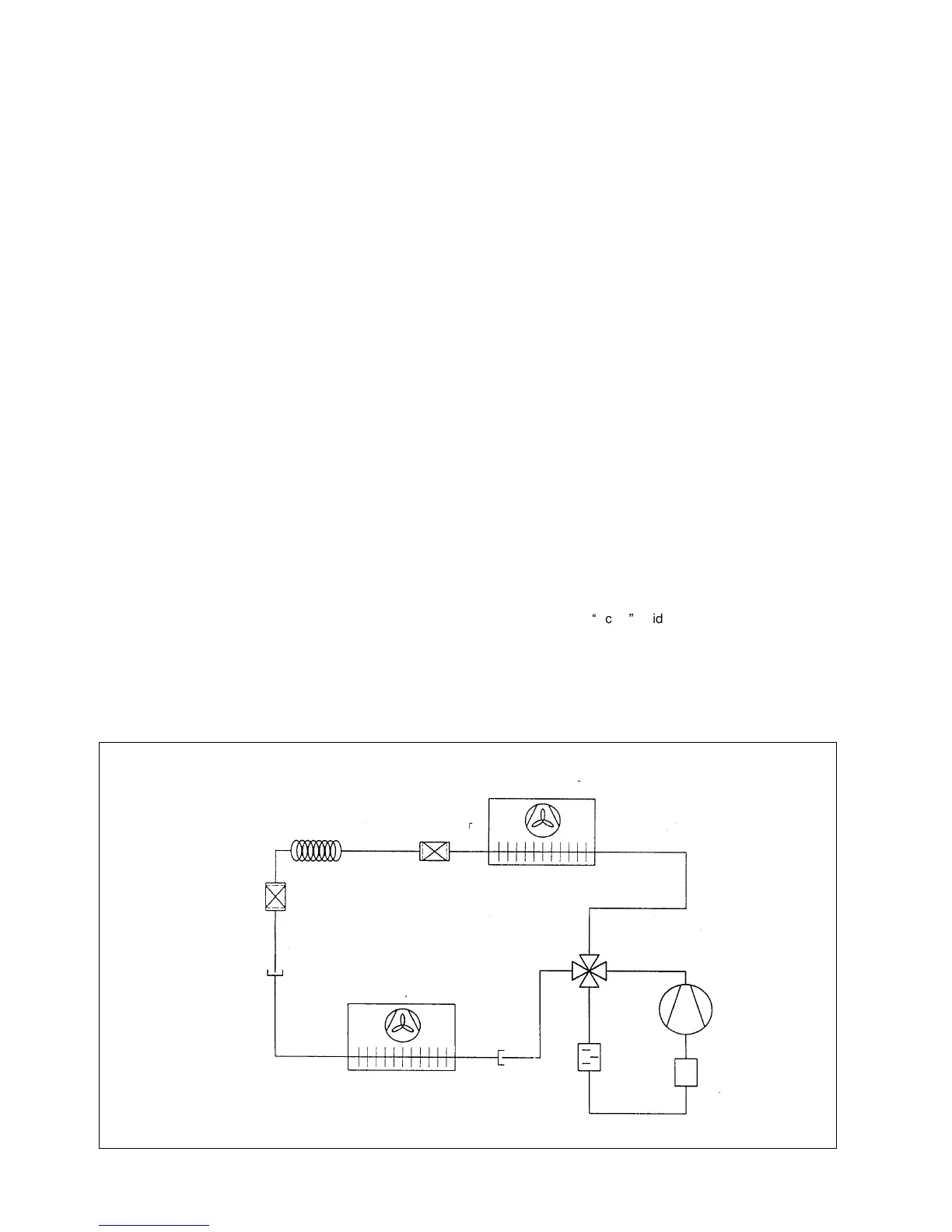
Refrigeration plan
Capillary
Collector
Damper
Compressor
4-way valve
Evaporator
Coupling
Condenser
Filter dryer
Filter dryer
Coupling



 To Next Page