Need help?
Do you have a question about the DINGLI BA22ERT and is the answer not in the manual?
Describes proper and safe practices for major machine usage.
Explains safety alert symbols and signal words used in the manual.
Details safety precautions for operators, including training and inspection.
Operator training requirements and knowledge for safe operation.
Safety measures and inspections for the work area.
Procedures for inspecting the machine before operation.
Guidelines for operating the machine safely.
General safe operation practices for the machine.
Identifies and provides precautions for trip and fall hazards.
Details electrocution hazards and minimum approach distances.
Addresses tipping hazards and precautions during operation.
Discusses hazards related to crushing and collisions.
Guidelines for towing, lifting, and hauling the machine.
Additional safety considerations and hazards.
Detailed specifications for the machine models.
Performance parameters and capabilities of the machine.
Specifications for the machine's hydraulic system.
Specifications related to the machine's battery.
Torque specifications for various bolts used on the machine.
Importance of trained personnel for machine operation and maintenance.
Details operator training requirements and knowledge for safe operation.
Covers supervision aspects of operator training for competence.
Outlines operator responsibilities for machine safety and operation.
Information on preparing and inspecting the machine before use.
General guidance on machine preparation, inspection, and maintenance.
Steps for preparing the machine before putting it into operation.
Procedures for delivery and frequent inspections of the machine.
Step-by-step guide for daily walk-around inspection of the machine.
Detailed checklist for performing a walk-around inspection of the machine.
Procedures for testing functions at the ground control station.
Detailed functional tests for the ground control station.
Procedures for testing functions at the platform control station.
Procedure for testing the oscillating axle lockout system.
General information about machine controls and indicators.
Details the various controls and indicators on the machine.
Describes controls and indicators at the ground control station.
Overview of the platform control console panel.
Information on the analysis panel and its main interface.
Description of icons on the analysis panel's main interface.
Details of data displayed on the motor interface.
Details of data displayed on the vehicle condition interface.
Describes how to use the setting interface for configurations.
Explains the automatic alarm/warning interface for system faults.
Explanation of various indicator icons and their meanings.
Details the tilt sensor, alarm triggers, and operational limitations.
Explains the function and safety of the footswitch/enable indicator.
Information about the machine's battery chargers.
Guidance on replacing and locating placards and decals.
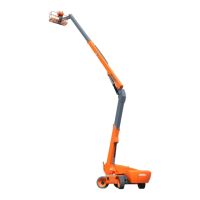
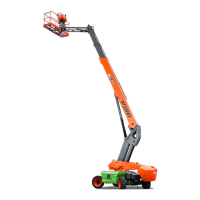
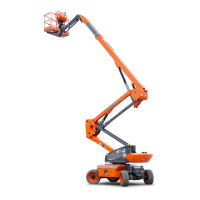
General description of the self-propelled hydraulic lift and its operation.
Covers capacities, stability, and operating limitations of the machine.
Guidelines for safe traveling and driving operations.
Instructions for operating the steering controls.
Procedures for platform leveling and rotation.
Safety warnings and procedures for turret swinging.
Instructions for raising, lowering, and telescoping booms.
Information and procedures for operating the auxiliary pump.
Instructions for operating the jib from ground and platform controls.
Procedure for testing the oscillating axle lockout system.
Procedures for safely shutting down and parking the machine.
Guidelines for lifting and tie-down operations.
Safety warnings and procedures for towing the machine.
Steps to complete before towing the machine.
General information on emergency procedures.
Procedures for emergency towing of the machine.
Identifies emergency controls and their locations on the machine.
Details the power and emergency stop switches.
Location and function of ground control station.
Location and function of auxiliary power switches.
Information on the bypass switches for emergency operation.
General guidelines for emergency operation of the machine.
How to use ground controls in an emergency.
Procedures when the operator is unable to control the machine.
Actions if the platform or boom is caught overhead.
Steps for inspection and repair after an incident.
Procedures for emergency stowing of the machine.
Procedures for notifying Dingli Machinery of any incidents.
General information on maintenance tasks.
Specifications for lubricants used in the machine.
Diagram showing lubrication points on the machine.
Maintenance tasks to be performed by the operator.
Maintenance procedures for the machine's axles.
Instructions for lubricating oscillation bushes.
Procedure for checking the oil level in wheel reduction gears.
Procedure for changing the oil in wheel reduction gears.
Procedure for checking the oil level in differentials.
Procedure for changing the oil in differentials.
Instructions for lubricating steering elements.
Lubrication of slew ring and rotation reduction gears.
Specifics of lubricating the rotation slew ring gear.
Procedure for checking the oil level in the rotation reduction gear.
Procedure for checking and tightening slew ring gear bolts.
Procedure for changing the rotation reduction gear oil.
Procedure for checking slew ring gear bearings for wear.
Importance of checking and replacing hydraulic fluid.
Procedure for checking the hydraulic system oil level.
Procedure for replacing hydraulic oil.
Procedures for replacing hydraulic fluid filters.
Step-by-step guide to replace the suction filter element.
Step-by-step guide to replace the PLFA filter element.
Procedure for replacing the return filter element.
Safety warnings and procedures for battery maintenance.
Information on tire damage and replacement recommendations.
Guidance on replacing wheels, considering size changes.
Critical steps for proper wheel installation and torque.
Procedures for checking and calibrating the overload sensor.
How the overload sensor works and how to check it.
Termly calibration procedure for the overload sensor.
Procedure for checking telescopic boom sliding blocks.
Steps for checking sliding blocks, including lubrication.
Procedure for adjusting the play of telescopic boom sliding blocks.
Introduction to schematics for troubleshooting.
General advice and focus areas for troubleshooting.
Guidance on analyzing hydraulic circuits for problems.
Provides hydraulic schematics for the machine.
Provides electric schematics for the machine's systems.
A log for recording inspection and repair dates and comments.
 General
| Max Load Capacity / Platform Capacity | 250 kg |
|---|---|
| Platform Width | 0.76 m |
| Drive Type | 4 x 4 |
| Overall Width | 2.49 m |
| Gradeability | 45% |
| Power Source | Diesel |
| Engine Power | 55 kW |
| Platform Size | 1.83 m x 0.76 m |

 To Next Page