8.4 Initial Configuration
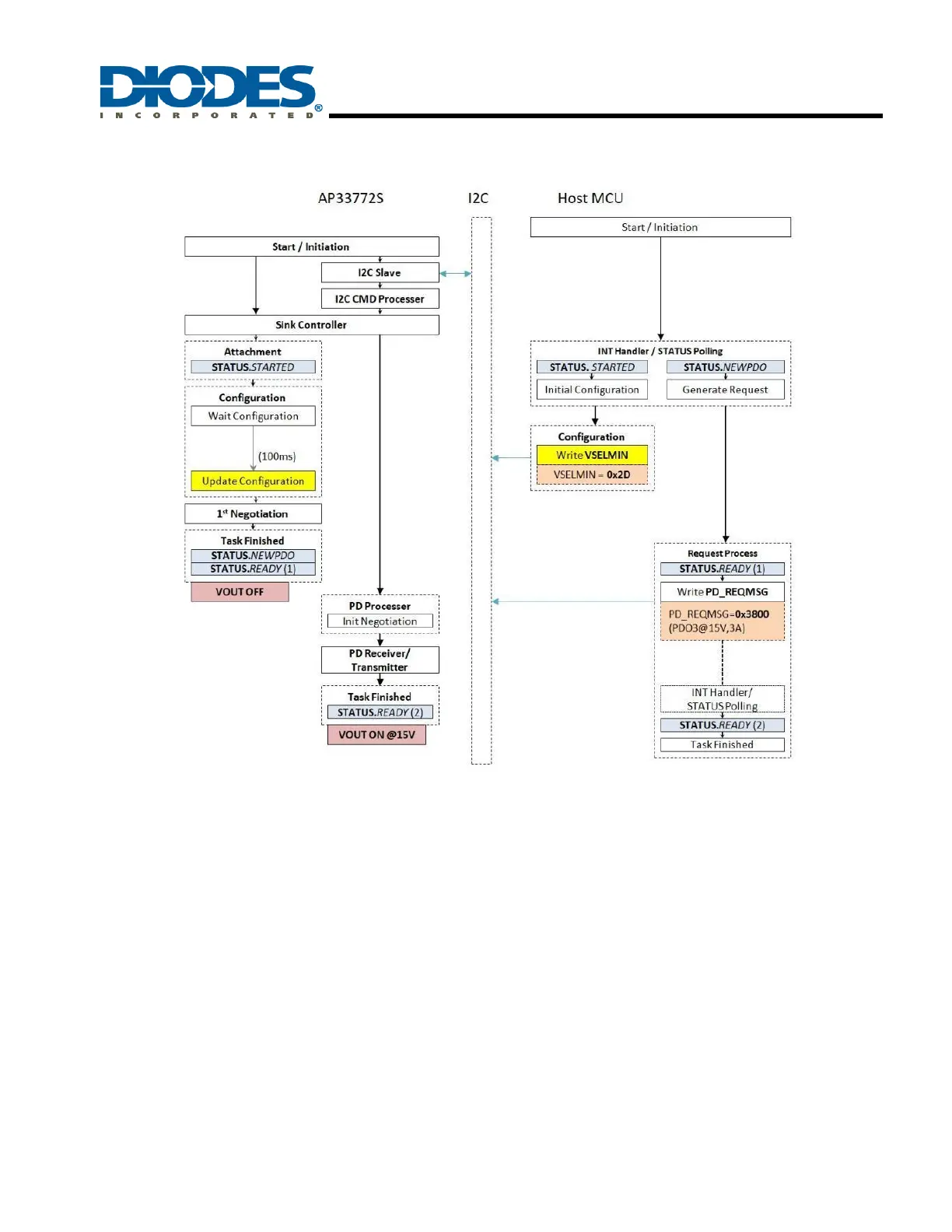
Continuing the example from the previous section, the battery-powered host appliance requires the VOUT voltage to be higher than 9V to
protect the circuit, and requests 45W power at 15V@3A for charging.
The power-on value of the VSELMIN is 19h (5000mV). Under the default configuration, if the VREQ voltage is more than or equal to 5000mV,
the AP33772S enables the VOUT MOS switches. During the 1
st
negotiation, the AP33772S requests the default PDO1@5V and the VREQ
voltage is set to 5V. Since VREQ voltage is equal to VSELMIN voltage, the VOUT MOS switches turn “ON” and then the VBUS is connected to
VOUT. Therefore, the default output of the AP33772S is 5V when connected to the PD source, which may damage this host appliance.
Once the AP33772S is started (STARTED=1), the host MCU can change the power-on values of the configurable registers and the initial
configurations will be updated accordingly after 100ms. For this custom application, the host MCU sets VSELMIN to 2Dh (9000mV) during
configuration. After the 1
st
negotiation is completed, the VOUT MOS switches are turned “OFF” since VREQ voltage (5V) is less than VSELMIN
voltage (9V).
Then the host MCU writes PD_REQMSG to 3800h to request 45W power at 15V@3A. After successful negotiation, the VOUT MOS switches
are turned “ON” since VREQ voltage (15V) is more than VSELMIN voltage (9V). By modifying the initial configuration, the host appliance can
ensure that VOUT voltage is always greater than 9V.



 To Next Page