EasyManua.ls Logo

Distech Controls ECB-300 Series - User Manual

Distech Controls ECB-300 Series
20 pages
Print Icon
To Next Page IconTo Next Page
Loading...
ECB Series BACnet
®
Controllers
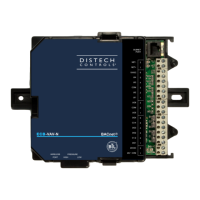
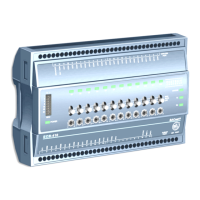
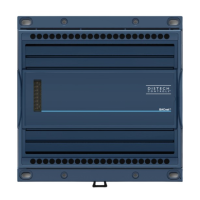
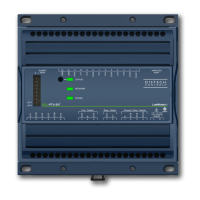
Figure1: From left to right: ECB-650 with operator interface, ECB-410 with HOA, ECB-203
Product Description
This document describes the hardware installation procedures for the ECB Series BACnet controllers.
The Distech Controls ECB Series controllers are designed to control and monitor various HVAC equipment such as roof top units, air handling units as
well as chillers, boilers, and central plant applications. Moreover, these controllers are suitable for any lighting control and power measurement applica-
tions. This product line includes the following controllers: ECB‑203, ECB‑300, ECB‑400 Series, ECB‑600 Series.
For controllers equipped with an operator interface (ECB-x50 models), refer to the ECL‑x50 and ECB‑x50 Series Controller User Guide for how to use
the this interface.
The ECB‑600 Series are compatible with the IO Extension Module product line, which includes the following modules: ECx‑400, ECx‑410, and ECx-420
(refer to the ECx‑400 series IO Extension Module Hardware Installation Guide).
Each controller uses the BACnet
®
MS/TP LAN communication protocol.
This document describes the hardware installation procedures for the following controllers: ECB‑203, ECB‑300, ECB‑400 Series, and ECB‑600 Series
controllers only.
£ These controllers are all built on a similar platform, but have different numbers of inputs and outputs. Moreover,
each individual model has different amounts of digital and/or universal outputs. For more information on the
specific layout and functionality of each controller, please refer to their individual datasheets.
£ The following controllers are housed in small enclosures: ECB‑203 Series and ECB‑300 Series.
£ The following controllers are housed in large enclosures: ECB‑400 Series and ECB‑600 Series.
General Installation Requirements
For proper installation and subsequent operation of the device, pay special attention to the following recommendations:
£ It is recommended that the controller(s) be kept at room temperature for at least 24 hours before installation to allow any condensation that may
have accumulated due to low temperature during shipping/storage to evaporate.
£ Upon unpacking, inspect the contents of the carton for shipping damages.
Do not install a damaged device.
£ The device is designed to operate under environmental conditions that are specified in its datasheet.
£ Ensure proper ventilation of the device and avoid areas where corroding, deteriorating or explosive vapors, fumes or gases may be present.
£ Allow for proper clearance around the device’s enclosure and wiring terminals to provide easy access for hardware configuration and maintenance.
£ When installing in an enclosure, select one that provides sufficient surface area to dissipate any heat generated by the device and by any other de-
vices installed in the enclosure. A metal enclosure is preferred. If necessary, provide active cooling for the enclosure.
£ Orient the controller with the ventilation slots and power supply/output terminal block connectors towards the top to permit proper heat dissipation.
£ The device’s plastic enclosure has a back plate that is separable from the front plate allowing the back plates (with the connectors) to be shipped di-
rectly to the installation site while all the engineering is done in the office.
£ The device’s datasheet specifies the power consumption (amount of heat generated), the operating temperature range, and other environmental
conditions the device is designed to operate under.
£ Ensure that all equipment is installed according to local, regional, and national regulations.
£ Do not drop the device or subject it to physical shock.
£ If the device is used and/or installed in a manner not specified by Distech Controls, the functionality and the protection provided by the device may
be impaired.
H a r d w a r e I n s t a l l a t i o n G u i d e


Questions and Answers

  • S
    Sandra StewartAug 25, 2025
    How to fix a Distech Controls ECB-300 that is powered but does not turn on?
    • K
      Kim AndrewsAug 25, 2025
      If the Distech Controls Controller is powered but does not turn on, it could be due to a blown fuse or incorrect power supply polarity. To resolve this: * Disconnect the power, check the fuse integrity, and then reconnect the power. * Verify that consistent polarity is maintained between all controllers and the transformer. Ensure that the 24VCOM terminal of each controller is connected to the same terminal on the secondary side of the transformer.
  • T
    Timothy HunterAug 27, 2025
    What to do if hardware output is not operating correctly on Distech Controls Controller?
    • C
      Christopher BrownAug 28, 2025
      If a hardware output on your Distech Controls Controller is not operating correctly, it could be due to a blown fuse, output wiring problem, or configuration issue. Here’s how to address it: 1. Disconnect the power and output terminals, wait a few seconds for the auto-reset fuse to cool down, then check the power supply and output wiring before reconnecting the power. 2. Check that the wiring is correct according to this manual and the peripheral device’s manufacturer. 3. Use EC-gfxProgram to check the configuration of the input.
  • J
    Jeffrey BushAug 29, 2025
    Why is the hardware input not reading the correct value on my Distech Controls Controller?
    • K
      Kenneth BrownAug 29, 2025
      If your Distech Controls Controller's hardware input is not reading the correct value, consider the following potential issues: * Check that the wiring is correct according to this manual and the peripheral device’s manufacturer. * Using EC-gfxProgram, check the configuration of the input. * An over-voltage or over-current at one input can affect the reading of other inputs. Respect the allowed voltage / current range limits of all inputs. * Using a voltmeter, check the voltage on the input terminal. For example, for a digital input, a short circuit shows approximately 0V DC and an open circuit shows approximately 5V DC.
  • Z
    zmedinaAug 31, 2025
    What does it mean if the Status LED is always OFF on a Distech Controls ECB-300?
    • S
      stanleyjasonSep 1, 2025
      If the Status LED on your Distech Controls Controller is always OFF, it means that the controller is operating normally.
  • D
    dvasquezSep 2, 2025
    What to do if wireless devices are not working correctly with Distech Controls Controller?
    • R
      Russell WhiteheadSep 2, 2025
      If wireless devices are not working correctly with your Distech Controls Controller, consider the following: 1. Using EC-gfxProgram, check the configuration of the input. 2. Recharge the device with light (if solar-powered) or replace the battery (if battery-powered). Ensure sufficient light intensity (200lx for 4 hours/day). 3. Reposition the device to be within the range of the Wireless Receiver. 4. Using the device configuration plug-in or wizard, check the configuration of the input.
  • Y
    ymonroeSep 4, 2025
    What does it mean if the RX LED is not blinking on a Distech Controls Controller?
    • M
      Monica PetersenSep 4, 2025
      If the RX LED on your Distech Controls Controller is not blinking, it indicates that data is not being received from the BACnet MS/TP data bus.
  • V
    Valerie YoungSep 6, 2025
    What does it mean if the TX LED is not blinking on a Distech Controls ECB-300 Controller?
    • D
      Duane BoydSep 6, 2025
      If the TX LED on your Distech Controls Controller is not blinking, it indicates that data is not being transmitted onto the BACnet MS/TP data bus.
  • M
    Mrs. Patricia HermanSep 8, 2025
    What does one fast blink mean on Distech Controls Controller?
    • K
      Kathryn AndersonSep 8, 2025
      If your Distech Controls Controller shows one fast blink, it means that the device is starting up.
  • M
    Mary OrtegaSep 10, 2025
    What to check if 0 to 10V output, 24VAC powered actuator is not moving with Distech Controls?
    • B
      bryan58Sep 10, 2025
      If a 0 to 10V output, 24VAC powered actuator is not moving on your Distech Controls system, check the polarity of the 24VAC power supply connected to the actuator while connected to the controller. Reverse the 24VAC wire if necessary.
  • K
    Kenneth MillerSep 12, 2025
    What does Fast blink continuous mean on Distech Controls ECB-300?
    • S
      Stacey TaylorSep 12, 2025
      If your Distech Controls Controller is showing a Fast blink continuous (150ms On, 150ms Off, continuous), it means that a firmware upgrade is in progress. Controller operation is temporarily unavailable. The new firmware is being loaded into memory. This takes a few seconds. Do not interrupt power to the device during this time.

Summary

Product Description

General Installation Requirements

Key recommendations for safe and proper installation and operation.

General Wiring Recommendations

Electrical Safety Precautions

Warning to turn off power before any servicing to avoid electric shock.

Mounting Instructions

Power Wiring

AC and DC Power Supply

Diagrams and guidelines for connecting AC and DC power to controllers.

Jumper Identification and Configuration

Input Wiring

Sensor Input Types and Diagrams

Details on connecting various sensor types and input configurations.

Output Wiring

Communications Wiring

Device Addressing

Temporary Network Access

Setting the Communicating Sensor Subnet ID

Commissioning ECB-Series Controllers

Setting the BAUD Rate (optional - ECB series controllers only)

Maintenance

Typical Air Handling Unit Application Wiring Diagram

Troubleshooting Guide

Power and Communication Troubleshooting

Common problems and solutions for power and communication failures.

Distech Controls ECB-300 Series Specifications

General IconGeneral
Number of Universal Inputs8
Power Supply24 VAC/VDC
Communication PortsEthernet 10/100BaseT, RS-485
Input Voltage24 VAC/VDC
Protocols SupportedBACnet/IP, BACnet MS/TP

Related product manuals