TEC29 EV AUS Installation
25
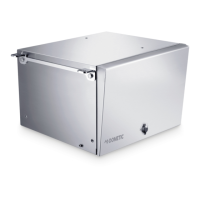
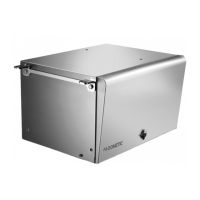
You can secure the generator with the holders supplied in two ways:
External installation (fig. 5, page 5):
External installation has the following benefits: lower space requirement,
fast installation, easy access for maintenance work.
– To ensure the generator is attached securely, use the retaining
bracket (fig. 5 1, page 5) supplied.
– If the air intake opening of the generator is located behind a vehicle
wheel, you need to prevent the wheel from splashing any water into
the generator interior when it rains (e.g. by using a splash guard).
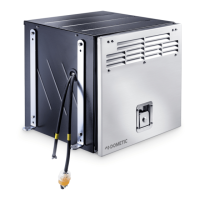
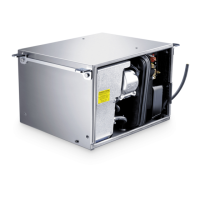
Internal installation (fig. 6, page 5):
For internal installation, you need to prepare a sealed compartment
against the vehicle interior which can also be insulated against sound.
– Attach exhaust and air intake openings to the floor and in front of the
generator cover. The air intake openings must have cross-section of
at least 240 cm
2
.
– You must also fit a seal (AG 128; included in the scope of delivery)
made of fire-retardant rubber with a thickness of at least 5 mm
between the floor of the vehicle and the generator.
– Fix the provided 8 washers between the floor and the vibration
dampers (2 pieces each).
Leave a space of at least 20 mm between the generator hood and sur-
rounding parts so that sufficient space remains for cooling air to pass
through.
8.3 Securing the silencer
Observe the following instructions when installing the exhaust pipe:
Do not create any sharp bends which will inhibit the flow of exhaust
fumes.
Align the manifold (fig. 7 1, page 5) along the housing to ensure greater
damping of vibration.
Use the exhaust pipe extension to extent the exhaust pipe (fig. 7 2,
page 5) (see chapter “Accessories” on page 20).
Secure the extension to the vehicle floor (fig. 7 3, page 5) according to
ADR 42.8.
If cutting the exhaust pipe, wear protective gloves and be careful of sharp
edges.
➤ Secure the silencer (fig. 7 4, page 5) as in one of the alternatives shown
in fig. 8, page 6 to fig. b, page 7.



 To Next Page