4. Regular inspection
66
Others/driving system
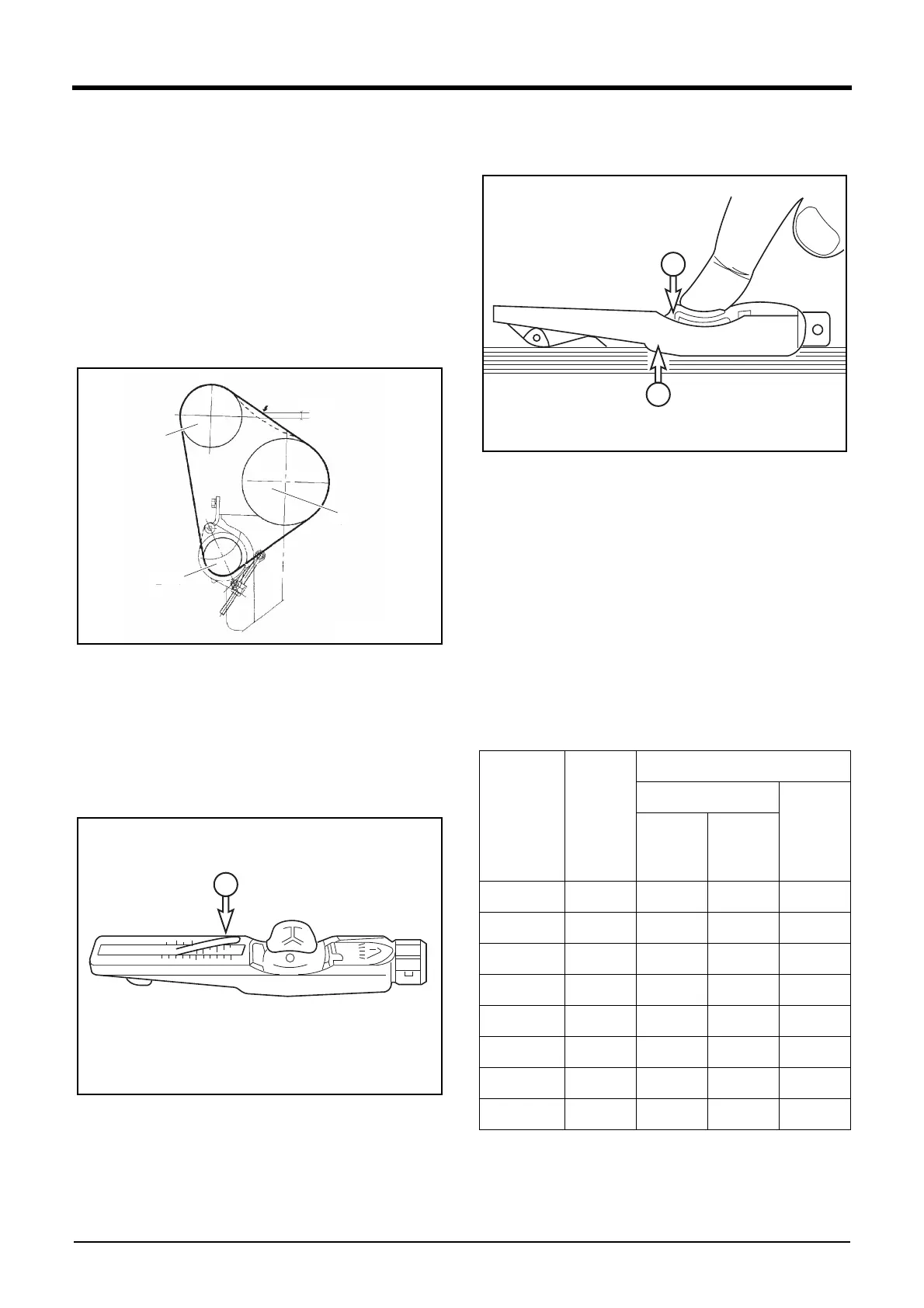
V-Belt
The tension of the V-belts should be checked daily .
1. Change the V-belts if necessary
1) If in the case of a multiple V-belt drive, wear or differing
tensions are found, always replace the complete set of
V-belts.
2. Checking condition
1) Check V-belts for cracks, oil, overheating and wear.
3. Testing by hand
DV2213047A_E
1) For the V-belt tension, when you press the center
between pulleys, if it is pressed by 10~15mm, it is normal.
2) To check the tension of V-belt more accurately, you can
use a V-belt tension gauge.
4. Tension measurement
1) Lower indicator arm (1) into the scale.
DV2213048A
2) Apply tester to belt at a point midway between two
pulleys so that edge of contact surface (2) is flush with the
V-belt.
DV2213049A
3) Slowly depress pad (3) until the spring can be heard to
disengage. This will cause the indicator (1) to move
upwards.
Note) If pressure is maintained after the spring has disen-
gaged a false reading will be obtained.
4) Read the tension value at the point that the top surface of
indicator arm(1) intersects with the scale.
5) Before taking readings makes ensure that the indicator
arm remains in its position.
Note) If the value measured devotes from the setting value
specified, the V-belt tension must be corrected
according to the following table.
Press
Crankshaf
Alternator
Water
Pump
10~15mm
Type
Belt width
(mm)
Tension from a Tension Meter
New belt (kg)
Replace-
ment
required
Upon
installa-
tion
After 10
minute
M 8.5 50 45 40
A 11.8555045
B 15.5757060
C 20.2757060
3V-2 18.8 90~100 70~80 60
3V-4 39.4 180~200 140~160 120
3V-6 60.0 270~300 210~240 180
8pk Micro V 27.61 86 77 40
3
2



 To Next Page