53
5.1 General
The gasoline fuel system used in Everglades boats
sold in the United States is designed to meet or
exceed the emission control standards of the
Environmental Protection Agency (EPA) and the
requirements of the U.S. Coast Guard, the Boating
Industry Association and the American Boat and
Yacht Council in eect at the time of manufacture.
All gasoline fuel systems have been factory in-
spected and pressure tested in accordance with
regulations in eect at the time of manufacture.
This inspection assures that the system is air tight,
leak proof and safe. It is the responsibility of the
purchaser to maintain it in that condition. Make
frequent inspections to assure that no deteriora-
tion or loosening of connections is resulting from
vibration.
DO NOT LET THE ODOR OF GASOLINE GO UNCHECKED.
ANY ODOR OF GASOLINE MUST BE IMMEDIATELY
INVESTIGATED AND STEPS TAKEN TO PROTECT THE BOAT
AND ITS OCCUPANTS UNTIL THE PROBLEM IS CORRECTED.
IF THE ODOR OF GASOLINE IS NOTED, SHUT OFF ALL
ENGINES AND ELECTRICAL EQUIPMENT. INVESTIGATE
AND CORRECT THE SITUATION IMMEDIATELY. HAVE ALL
PASSENGERS PUT ON PERSONAL FLOTATION DEVICES AND
KEEP A FIRE EXTINGUISHER READY UNTIL THE SITUATION
IS RESOLVED.
Fuel Withdrawal Tubes
The fuel withdrawal tubes are positioned in the fuel
tank to achieve optimum fuel usage, fuel line rout-
ing, etc. At certain speeds and hull trim angles,
the fuel supply at the withdrawal tank location can
increase or decrease accordingly. Be extremely
careful when attempting to operate the boat when
low on fuel. Though some fuel may be in the tank,
the relative trim angle of the boat may cause the
fuel to ow away from the withdrawal tubes.
Fuel Gauge
Indicates the amount of fuel in the tank. Due to
the mechanical nature of the fuel sender, varia-
tions in readings during various speeds of opera-
tion may occur. This system is merely a relative
indication of the available fuel supply and not a
calibrated instrument.
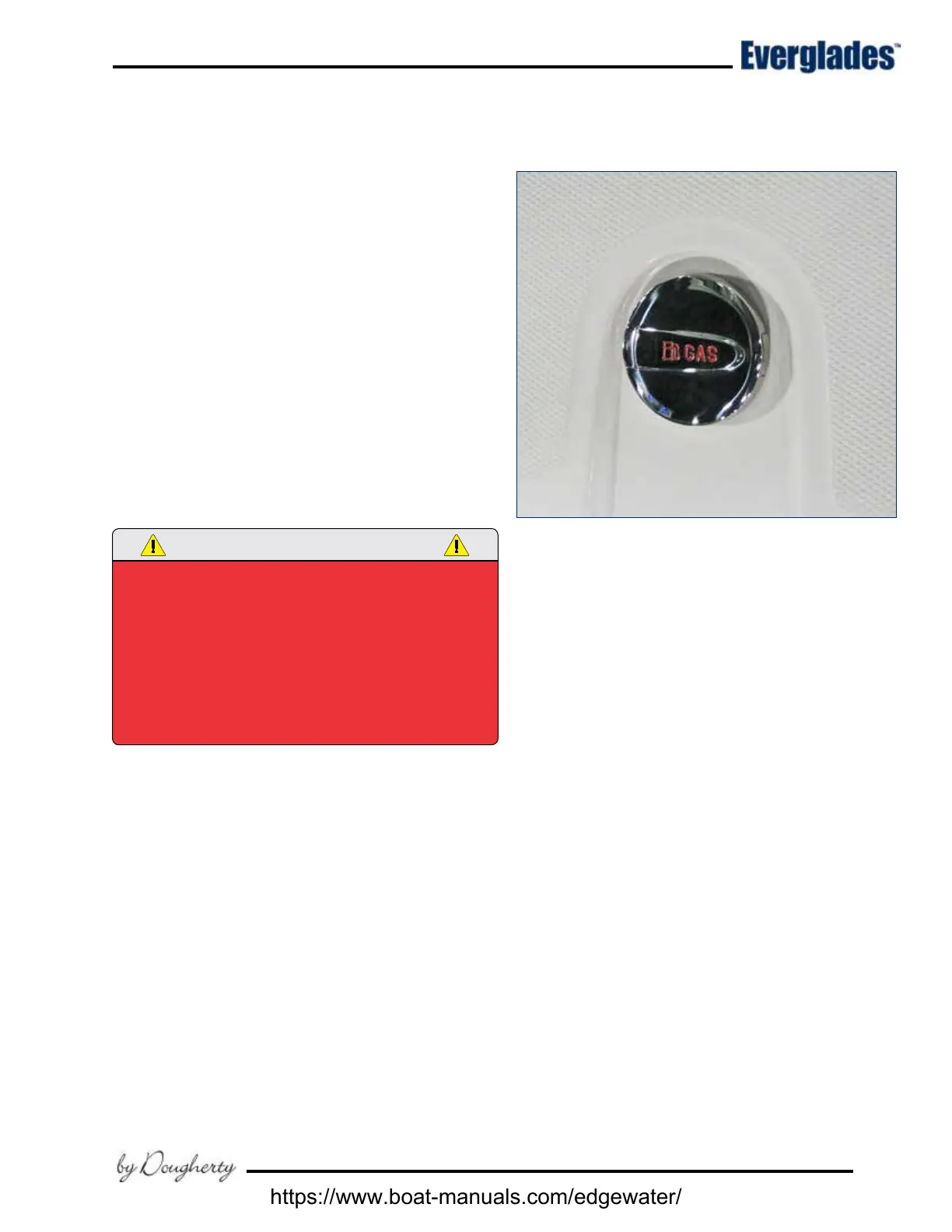
Fuel Fill
The fuel tank is vented through the ll tting and
cap. The system is equipped with a “keyless” fuel
cap located on the port side gunnel that is marked
with a “FUEL PUMP” insignia. The fuel ll cap is
designed to seal out water and allow the fuel tank
to vent to the atmosphere when the cap is closed.
The fuel ll is opened by pressing the release but-
ton on the side of the cap. After fueling, make
sure to close and latch the cap. Be sure to use
the proper type and grade of fuel. Refer to the
engine owner’s manual for additional information.
Fuel Tank Vent
Your boat is equipped with a fuel tank vent system
incorporated into the fuel ll. The fuel ll cap is
designed to seal out water and allow the fuel tank
to vent to the atmosphere when the cap is closed.
While the tank is being lled, air displaced by
the fuel escapes through the vent and fuel ll.
When the tank is full, special valves incorporated
in the vent and ll hoses close and activate the
automatic shuto valve on the marina fuel pump
nozzle to prevent the tank from being overlled
and/or fuel from being ejected from the fuel ll/
vent tting. You should never attempt to “top o”
the tank after the pump shuto has activated.
Chapter 5:
FUEL SYSTEM
Fuel Fill
https://www.boat-manuals.com/edgewater/



 To Next Page