For Your Safety
Strictly follow the Instructions for Use
Any use of the half mask requires full understanding and strict observation of these
instructions. The half mask may only be used for the purposes specified here.
Maintenance
The half mask must be inspected by trained individuals at regular intervals.
The half mask may only be service or repaired by appropriately trained personnel. Only
genuine Dräger parts may be used for maintenance and repair activities. Note the section
entitled “Maintenance intervals”.
Liability for proper function or damage
Liability for proper functioning of the half mask is irrevocably transferred to the owner or
operator to the extent that the half mask is serviced by personnel not employed or authorized
by DrägerService or if it is used in a manner not conforming to its intended use. Dräger cannot
be held responsible for damage due to non-compliance with the above recommendations. The
warranty and liability provisions of the terms of sale and delivery of Dräger are similarly not
modified by the above recommendations.
Dräger Safety AG & Co. KGaA
Markings
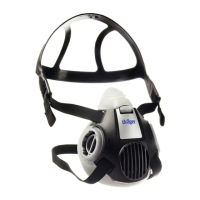
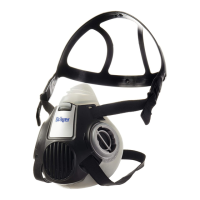
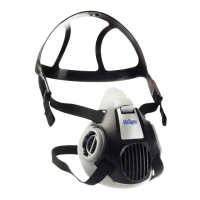
Manufacturer/Product name: Dräger/X-plore 3500
Material of mask body: DrägerFlex/PP = DrägerFlex/polypropylene
Sizes: S = small, M = medium, L = large
What's What? (Refer to Pictogram A)
A1 Filter connectors 2 Head straps 3 Yoke 4 Respiratory filter X-plore
Description / Intended Use
Together, the half mask and two respiratory filters and/ or cartridges form a protective filter
device against breathable particles and against toxic gases and vapors. Use of the respiratory
system depends on the choice of respiratory filters and/ or cartridges.
Service temperature –30
o
C to 60
o
C (–22
o
F to 140
o
F).
Two identical filters and/ or cartridges must always be used.
Conditions for Use
The ambient air must contain at least 19.5 % by volume oxygen. Do not enter unventilated
areas, such as containers, shafts or ducts, when wearing this mask. The type of contaminant
must be known and at an acceptable concentration that warrants the use of an air purifying half
mask respirator system. The user of the protective filter device must have been duly instructed
to its use and limitations, and must be fit and able to use the device as per OSHA 1910.134.
The following must be noted:
— - Instructions for Use of the respiratory filters and/ or cartridges.
Important: Non-compliance with these recommendations and the regulations governing use
of, or failure to use, the protective filter device in contaminated areas may impair the health of
the user and even result in permanent damage or cause death.
Suitable respiratory filters and/ or cartridges
Approved in accordance with 42 CFR Part 84, see approval label.
Does the half mask fit?
Select the appropriate size (See “Order List”). Qualitative or quantitative fit testing is required
to identify the fit factor of the respirator prior to being exposed to hazardous conditions.
Fitting the respiratory filters and/ or cartridges (Refer to Pictogram B)
B Attach two identical respiratory filters and/ or cartridges (1) and lock in place by (2)
turning the respiratory filters and/ or cartridges downwards until a stop is felt.
Turn the respiratory filters and/ or cartridges in the opposite direction to release them.
Putting on the half mask (Refer to Pictograms C, D, E and F)
C Draw the buckles of the head cradle up to the end of the straps.
Pull the bottom straps through completely until the buckles of the head straps are
against the facepiece of the half mask.
Place the bottom straps over your head and around your neck.
D1 Position the facepiece over the mouth and nose.
2 Pull the head cradle and straps over the head and ears.
E Pull the ends of the straps until the half mask rests securely against your face.
Tighten the straps uniformly. If necessary, adjust the straps again until the half mask
rests against your face securely and comfortably.
F The bottom straps can be released by means of the two hooks so that the half mask can
be comfortably parked on your chest.
Test for leaks before use (either) (Refer to Pictograms G and H)
Negative pressure test:
G Seal both respiratory filters and/ or cartridges with your hands and breathe in until a
negative pressure is created. Hold your breath for a moment. The negative pressure
should be maintained. If not, adjust the straps or use a different size of mask.
The half mask may not fit correctly over a beard or facial irregularities – danger of being
exposed to a hazardous chemical!
The half mask must fit tightly and the respiratory filters and/ or cartridges must be fitted
before entering the contaminated area.
Positive pressure test:
H Seal the exhalation valve of the half mask and breathe out gently. The half mask will lift
gently off your face. If the exhaled air leaks out of the mask, take off the half mask and
tighten the straps or use a different mask size.
The half mask may not fit correctly over a beard or facial irregularities – danger of being
exposed to a hazardous chemical!
The half mask must fit tightly and the respiratory filters and/ or cartridges must be fitted
before entering the contaminated area.
Cleaning, disinfection, drying
Cleaning: Cleaning the mask immediately after use helps to prevent premature wear and
assists with proper hygiene and housekeeping. Do not use any organic solvents, such as
acetone, alcohol, naphtha, spirits, trichloroethylene, etc.
Clean all parts with a cloth and lukewarm water containing a mild detergent or a universal
cleaning agent, such as Airkem 33. Rinse thoroughly under running water, maximum
temperature 60
o
C (140
o
F).
Disinfection: Insert all parts in a disinfectant bath, such as Airkem 33. When using other
disinfectants, ensure that they do not cause any damage to rubber or plastic parts. Rinse
thoroughly under running water, maximum temperature 60
o
C (140
o
F).
Drying: Maximum temperature 60
o
C (140
o
F).
Inspection and assembling mask components
Visual examination of the inhalation valve disk
Remove the inhalation valve disk from its post and examine it thoroughy making sure there are
no cracks, dirt, debris, uneven surfaces, or damage. To replace the inhalation valve disk, wrap
the center of the valve disk around the post. The disk should rest evenly on the sealing area
inside the mask body.
Visual examination of the exhalation valve disk (Refer to Pictogram H)
J Remove the yoke from mask body. Hold the valve disk by the edge and remove it carefully.
Examine the valve seat for dirt and damage, and wipe it clean with a disposable tissue if
necessary. To replace the valve, press the examined valve disk into the valve seat until it
engages. The disk should rest on the valve seat uniformly and completely flat.
Visual examination of the mask body
Examine the mask body thoroughly and make sure that there are no cracks, dirt, debris,
uneven surfaces, or damage.
Assembling the half mask
Arrange the straps. Fit the yoke on the mask body.
Insert two identical respiratory filters and/ or cartridges. Check correct functioning and
absence of leaks after assembly and before use with fitted half mask (as described
under “Test for leaks before use”).
Test and Maintenance Intervals
Storage
The half mask must be stored in a clean, dry and dust-free place without being deformed.
Storage temperature: –10
o
C to 55
o
C (14
o
F to 131
o
F).
Relative humidity: maximum 90 %
Keep away from direct light and heat.
Order List
For further spare parts please ask for the spare part list “X-plore 3500 E 1473.000”.
X-plore 3500 half mask (NIOSH 42 CFR Part 84) Instructions for UseenUS (NIOSH)
Work required on the half mask
Maximum intervals
Before use After use
Cleaning and/ or disinfection X
Valve disks and mask body examinations X
Replacement of exhalation valve disk As-needed, at the latest after 4 years
Inspection by wearer X
Leak tests:
Negative pressure test and/or positive pressure test X
Part name and description Order No.
X-plore 3300 – Size: S (Small) R 55 351
X-plore 3300 – Size: M (Medium) R 55 350
X-plore 3300 – Size: L (Large) R 55 352
Inhalation valve disk R 53 309
Exhalation valve disk R 52 541


 To Next Page
 Loading...