FINE-TUNING CG POSITION
►It is well worth spending a little time verifying the proper balance and trim of your glider. Doing so will
ensure the Libelle is a pure joy to fly and reacts predictably to the varying air currents experienced while
soaring. We find it easiest to fine-tune the CG position on the slope in light to moderate lift. This will make it
easy to climb quickly to altitude for the "dive test" described below.
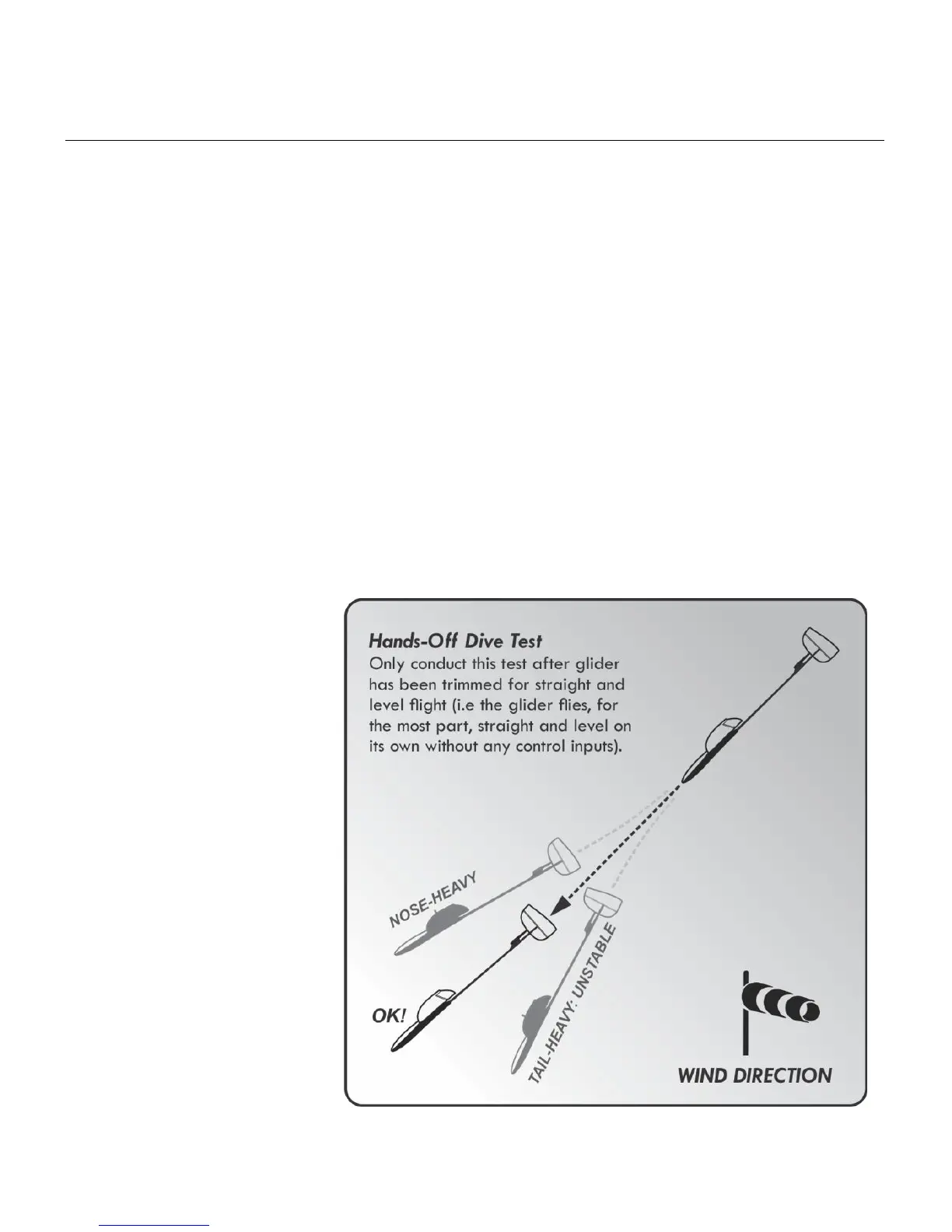
To fine-tune the CG position for optimum performance, first climb to safe altitude, and verify glider is
trimmed for straight and level flight. Proceed to put glider into 45° dive. Allow glider to dive "hands-off"
and see which of the three scenarios holds true for your Libelle:
1. Correct CG Position: If properly balanced and trimmed for level flight, the Libelle will remain in a
straight 45° hands-off dive. Additionally, a well-balanced and trimmed aircraft will fly hands-off in a
straight and level glide for a good while. If instead your glider noses up or down as speed increases, this
is a sign that your CG position is off; read on if this is the case.
2. Nose-Heavy (too forward CG): If the glider noses up as speed increases without any elevator input, the
aircraft is most likely nose-heavy. Solution: Remove a bit of nose-weight and add DOWN elevator trim
until the first scenario above is achieved.
3. Tail-Heavy (too rearward CG): If the glider increases steepness of dive at higher speed (i.e. "tucks
under"), then it is tail-heavy. Oftentimes a tail-heavy glider will be a chore to fly, constantly requiring
pilot input to maintain a smooth flight trajectory. Solution: Add nose-weight and UP elevator trim until the
first scenario above is achieved.
NOTE: In order to achieve
trimmed flight, you will have to
adjust elevator trim slightly each
time you add or remove balance
weight to the nose of the glider.


 To Next Page