24
Small Seeds
Calibration with Disconnected Agitator Shaft
The small seed metering wheel used in Duncan Drills is
especially well suited for sowing small seeds such as rape,
turnips and clover.
Due to the intensive action caused by the agitator the seeds
can adhere to each other, or be damaged, causing irregular
sowing/germination. Therefore it is recommended that
when sowing small seeds, especially oil seeds and thin
shelled seeds, the drive to the agitator is disconnected.
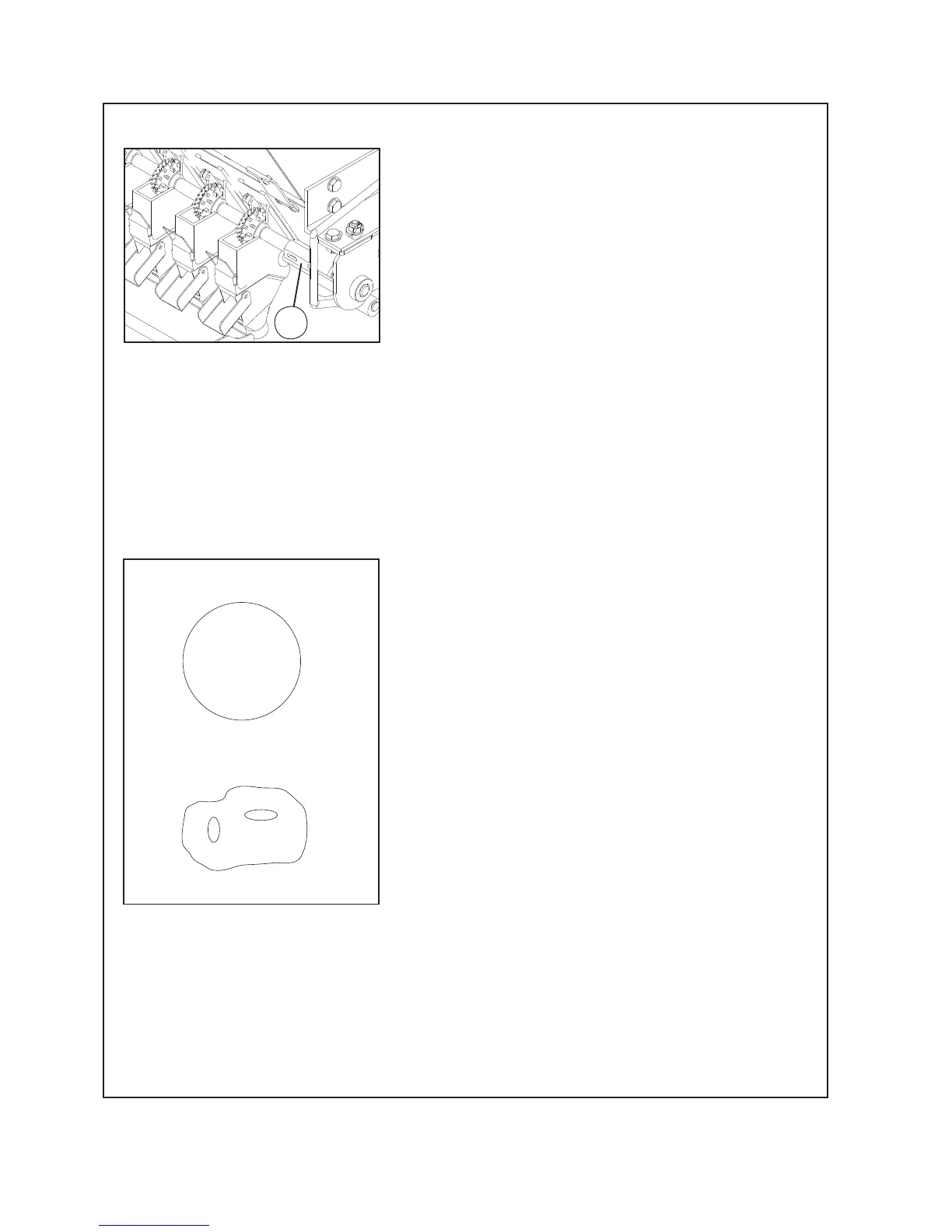
To do this remove the linch pin or bolt. (1).
Deviations between the calibrated and actual seed rate can
occur when residual dressing agent sticks to the bottom
flaps and thus slows the flow of seed. Before beginning the
actual calibration test fill the calibration trays by turning the
crank handle at a high speed around the 90 setting on the
gearbox scale. This will cause an immediate buildup of the
dresssing agent on the flaps. Return the contents of the
calibration trays to the seed box and proceed with the actual
calibration. Due to the residue buildup on the flaps your
calibration will now reflect accurately the required seed rate.
Note - Remember to reconnect the agitator shaft as required
for other seeds otherwise the consistency of seed rate will be
affected.
Sowing Peas
Peas having the size and shape as illustrated in A (e.g.
White Field Peas), can be sown in all Duncan Drills with this
type of metering wheel.
The flap should be set to a gap of at least “3” on the flap
setting lever (Page 18).
With these peas it should not be necessary to run the
agitator shaft.
Peas having the size and shape as illustrated in B (e.g.
Green or Garden Peas), tend to bridge inside the seedbox
and do not flow freely.
This multi-faceted pea requires agitation for sowing.
A
B
1
Agitator shaft disconnected
Agitator shaft connected



 To Next Page