
 Need help?
Do you have a question about the Dynacord Echocord Super 76 and is the answer not in the manual?
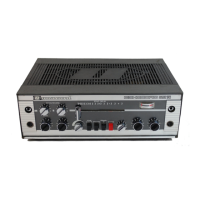
Visual representation of the ECHOCORD SUPER 76 with numbered parts for reference.
Detailed listing and description of all controls and indicators on the front panel.
Identification of components located on the rear panel and within the unit.
Procedure for checking mains voltage and details on fuse types and ratings.
Guidelines for connecting the unit to the mains supply for safety and hum reduction.
Details on universal input jacks for microphones and instruments, including wiring.
Information on the red coupling jack for Dynacord amplifiers and output jacks.
Description of the remote control jack for switching echo/reverberation remotely.
Steps for first-time operation, cover removal, stopper removal, and tape threading.
Adjusting volume, bass, and treble controls for the original input signal.
Adjusting echo/reverb volume, duration, tone, and using specific effect buttons.
How to activate the linear frequency response mode using button (12).
Fine-tuning reverberation duration and mixing torsional/tape reverberation.
Guide for integrating the ECHOCORD SUPER 76 with newer Dynacord amplifier models.
How to use the unit with older Dynacord amplifiers and set echo/reverberation levels.
Identifying causes of hum and methods to eliminate interference between units.
Procedures for cleaning the tape path, heads, and rollers to ensure longevity.
Advice on cabinet cleaning, avoiding damaging agents, and noting lubrication needs.
Details on operating voltages, power consumption, frequency range, and correction.
Specifications for inputs, outputs, coupling jacks, and remote control connections.
Information on echo delay, tape speed, reverberation duration, and tape type.
Lists fuse types, lamp specifications, dimensions, weight, and accessories.
 General
| Number of Heads | 3 |
|---|---|
| Power Supply | 220V AC |
| Type | Tube-based tape echo |
| Tape Speed | 19 cm/s |
| Weight | 12 kg |



 To Next Page
