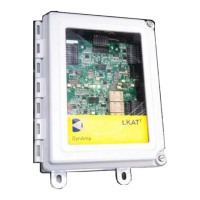
Installation, Operation and Service Manual LKP Series
© 2020 DynAmp, LLC Page 17
041736 N
4.8 METERING UNIT WIRING
Terminate all conductors from the Measuring Head as shown in the interconnection
diagrams in the back of this manual. As an aid to wiring, each conductor is identified by a
numbered sleeve (or imprinted numeral), which corresponds to the correct terminal
destination. You should always use the wire numbers when making connections as wire
colors may vary, or appear different under certain lighting conditions. If the wire ends get
damaged and require re-stripping, use high quality wire strippers and set the strip length to
0.39” (10mm).
Install and connect the output-monitoring devices to the appropriate terminals at the
Metering Unit. If current output is used, remove the factory-installed jumper and connect
the desired current output circuitry, using an adequate wire size. Make sure that the
burden imposed by the wire is not excessive.
If bus current is on, bus ripple or sudden changes in bus current level will induce
significant voltages in the feedback coils. Therefore, the cables must be disconnected
from the Measuring Head while wiring them to the Metering Unit.
Complete the wiring job by connecting the external power lines to terminals TS1-3
(COMMON), TS1-2 (HOT), and TS1-1 (GROUND) in the Metering Unit.
Customer is responsible for supplying an external circuit breaker or fuse with proper
rating as required by local codes for branch circuit protection when wiring the mains
circuit to this Metering Unit. Each Metering Unit must have its own breaker. Use a
wire and breaker or fuse (time delay) sized adequately for the maximum burden of 20
VA/kA of measured current. The wire should have an insulation rating of 600Vac and
80°C minimum temperature rating.
If an external transformer is being used to supply power to the Metering Unit,
consider sizing the transformer to 30VA/kA. Over-sizing the transformer will keep its
temperature rise to a minimum due to the harmonic rich content of the AC current
drawn by the Metering Unit.
4.9 INITIAL SYSTEM CHECKOUT
Recheck all wiring connections against the drawings to ensure proper installation. When
they are satisfactory, turn on the system by first closing the external breaker or disconnect
(if used), and then the Metering Unit circuit breaker. Confirm that the amber POWER lamp
is ON.
With the bus energized, the Metering Unit’s output in use should accurately measure the
bus current. However, it is now necessary to take a complete set of channel voltage
readings. These readings serve two purposes; One, to verify that all channels are
operating properly and two, to aid in magnetic centering of the Measuring Head. With the
bus current operating at its highest operating level, take two sets of readings, the first set
taken immediately (to verify no condition exists that may cause damage to the LKP
Metering Unit), and the second set after a 24-hour period of time (to thermally stabilize the
Measuring Head). Proceed as follows:



 To Next Page
 Loading...