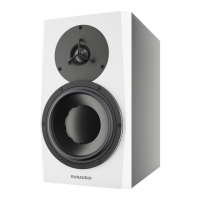
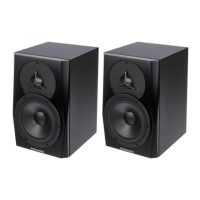
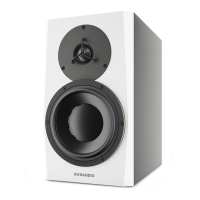
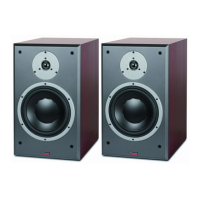
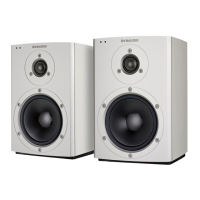
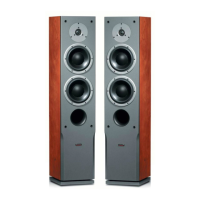
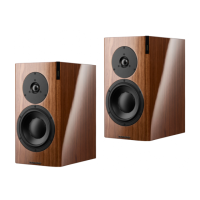
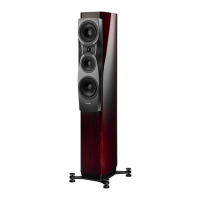
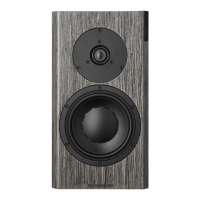
The Dynaudio LYD Series comprises Personal Reference Monitors designed for accurate sound reproduction in various listening environments. These loudspeakers are meticulously constructed by Dynaudio in Denmark, adhering to high standards to ensure optimal performance. The LYD Series speakers are an integral part of a monitoring system, working in conjunction with their placement in the room to deliver precise audio playback.
Function Description:
The Dynaudio LYD Series speakers serve as active studio monitors, meaning they have integrated amplifiers and do not require external amplification. They are designed to provide a neutral and accurate sound reproduction, which is crucial for mixing and mastering audio. The speakers feature analog inputs, including balanced XLR and unbalanced RCA, allowing for versatile connectivity with various audio sources. The integrated Class-D amplifier ensures efficient power delivery and high-quality audio output.
The LYD Series speakers are equipped with several DSP (Digital Signal Processing) settings that allow users to tailor the sound to their specific listening environment and preferences. These settings include Bass Extension, Sound Balance (tilt filters), and Position (boundary effect filters). These features enable users to optimize the speaker's response to compensate for room acoustics and speaker placement, ensuring that mixes translate well to other playback systems like home theaters, car stereos, and headphones.
Usage Features:
The LYD Series offers a range of features designed to enhance usability and sound customization:
- Power ON/OFF Switch: A simple switch to turn the speaker on or off.
- AC Power Input (100-230V): Universal power input for global compatibility.
- Balanced Analog Input (XLR): Professional-grade input for connecting balanced audio sources, minimizing noise and interference.
- Unbalanced Analog Input (RCA): Standard input for connecting unbalanced audio sources.
- Standby Mode Switch: This switch allows users to enable or disable the auto-standby feature. When auto-standby is ON, the speakers will automatically enter a power-saving mode when not in use, and resume normal operation upon detecting an input signal.
- Sensitivity Switch: Adjusts the maximum input voltage (+6 dB, 0 dB, -6 dB), allowing users to optimize the gain staging between their audio mixer/interface and the loudspeaker. This helps prevent overdriving the speakers and ensures a clean signal.
- Bass Extension Switch: Changes the cut-off frequency of the speaker, offering three settings: +10 Hz (greatest low frequency extension, -5 dB output), 0 Hz (normal), and -10 Hz (loudest output with least low frequency extension, +5 dB output). This feature helps users manage the low-frequency response based on room size and proximity to boundaries.
- Sound Balance Switch: Provides three tilt filter settings (Bright, Neutral, Dark) to adjust the overall tonal character of the speaker. These filters can compensate for room anomalies or personal preferences, ensuring a balanced frequency response.
- Bright (20 Hz -1.5 dB, 20 kHz +1.5 dB): Tilts the entire spectrum to emphasize higher frequencies.
- Neutral: Provides a flat, uncolored frequency response.
- Dark (20 Hz +1.5 dB, 20 kHz -1.5 dB): Tilts the entire spectrum to emphasize lower frequencies.
- Position Switch: Activates boundary effect filters (Wall, Free) to compensate for speaker placement relative to room boundaries.
- Wall: Engages a filter to reduce excessive bass when speakers are placed within 50 cm of a back wall.
- Free: Disables the boundary effect filter for optimal performance when speakers are placed further from boundaries.
Positioning and Calibration:
Proper positioning of the LYD Series speakers is critical for achieving the best performance. The manual provides detailed guidance on:
- Acoustic Axis: Identifying the imaginary line passing through the center point of the speaker, used for measuring distance and angle to the listener. LYD 5, 7, and 8 are designed for vertical positioning, while LYD 48 can be used horizontally.
- Room Boundaries: Recommendations for placing speakers away from walls, ceilings, and floors to minimize low-frequency anomalies caused by reflections. The ideal placement is between one-quarter and one-third of the distance between room boundaries.
- Listening Distance: LYD 5, 7, and 8 are near-field monitors, ideally placed between 1 and 2 meters from the listener. LYD 48 can function as both a near-field and mid-field monitor, with an ideal listening distance of 1.5 to 2.5 meters.
- Speakers on the Desk: Guidance for optimal placement on a desk or console, including tilting them to aim at ear level.
- Speaker Stands: Recommendations for using speaker stands, especially when placing speakers at a greater distance, and the potential benefit of a subwoofer for augmenting low-frequency response.
- Listening Angle (Horizontal Angle): Instructions for creating an equilateral triangle between the speakers and the listener, resulting in a 60-degree angle between the speakers. This ensures correct time alignment and accurate stereo imaging.
Listening Tests and Final Tweaks:
The manual emphasizes both subjective and objective listening tests to optimize the speaker setup:
- Reference Material: Encourages users to listen to familiar recorded material, including tracks they know sound good and those with defects, to assess the speaker's neutrality and accuracy.
- Pink Noise and RTA Spectral Analyzer: Recommends using pink noise and an RTA (Real-Time Analyzer) to objectively measure the speaker's frequency response. Dynaudio offers a free "Dynaudio Meter" iOS app with a pink noise source, SPL meter, and RTA spectrum analyzer to assist with calibration.
- DSP Settings Optimization: Guides users on adjusting the Sound Balance and Bass Extension filters based on RTA readings to achieve the flattest possible frequency response.
- First Reflection Treatment: Explains how to identify and treat first reflection points using a mirror and absorptive materials to improve high-frequency response and imaging.
- Bass Trapping: Provides advice on addressing room modes and low-frequency peaks/dips by placing bass traps in corners to smooth out the bass response.
Maintenance Features:
The LYD Series speakers require minimal maintenance:
- Cleaning: Only use a dry cloth for cleaning the apparatus.
- Servicing: All servicing should be referred to qualified service personnel. Users are advised not to open the unit due to the risk of electric shock and the absence of user-serviceable parts inside. Contact a Dynaudio dealer for service.
- Power Cord Protection: Protect the power cord from being walked on or pinched, especially at plugs and where it exits the apparatus.
- Environmental Considerations: Do not expose the equipment to dripping or splashing liquids, and do not place objects filled with liquids on the equipment. Avoid installing near heat sources.
The transducers of the LYD Series speakers will achieve better sound quality after a break-in period, with noticeable improvements in sound quality during the initial hours of use and subtle enhancements over subsequent hours. This ensures that the speakers will continue to perform optimally over time.

 Need help?
 General

 To Next Page