SRM-2120 OPERATION
X7507821400 31
© 10/24 ECHO Incorporated
Blade thrust can occur without warning if the blade snags,
stalls or binds.
Blade thrust is more likely to occur in areas where it is
difficult to see the material being cut.
Push or Pull - Kickout
During normal use, operating a brushcutter with a circular metal blade can
produce sudden strong reaction forces that are difficult to control. Strong
reaction forces can cause a loss of balance or loss of control of the
equipment, resulting in serious injury to operator and bystanders.
Understanding what causes these reactive forces may help you to avoid
them, and can help you to maintain control of the equipment if you
experience a sudden reaction during cutting. Reactive forces occur when
the force being applied by the cutting teeth of a blade meet resistance, and
some of the cutting force is directed back toward the equipment. The
greater the cutting force or the amount of resistance, the greater the
reactive force.
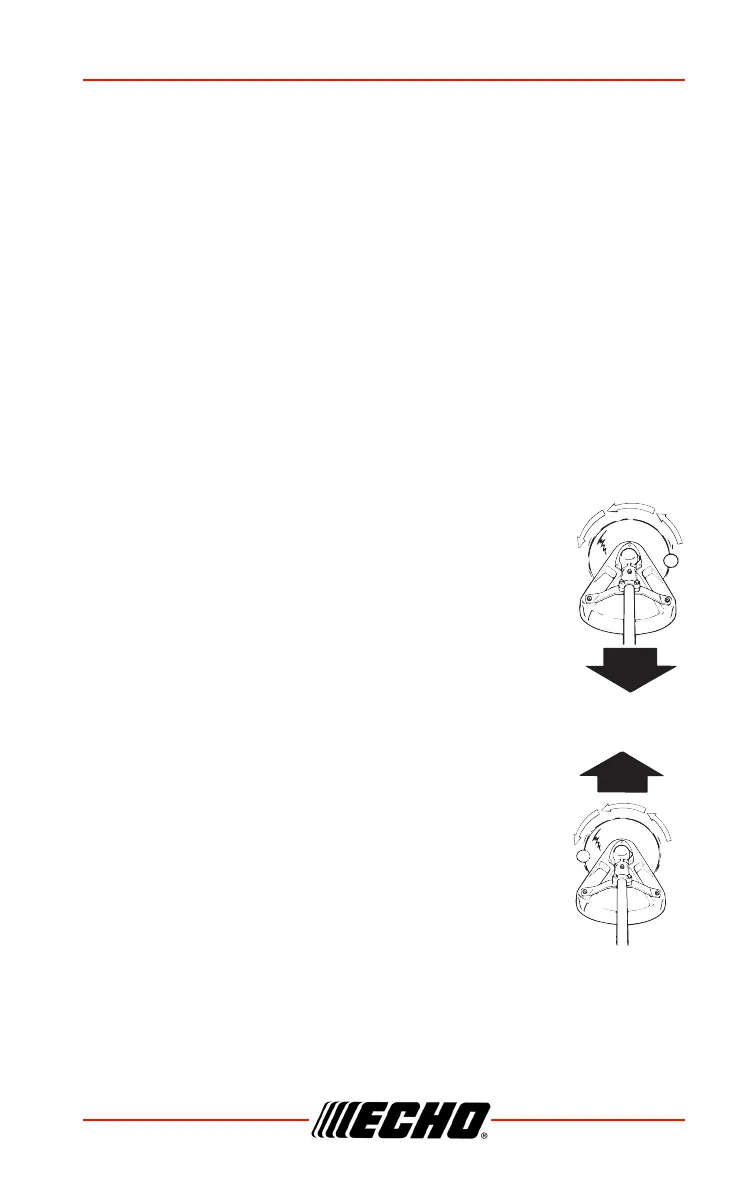
Push and Pull Forces
Push and pull forces are reactive forces that push the
equipment directly toward the operator, or that pull the
equipment directly away from the operator. These forces are
the result of cutting on the sides of the blade. The direction of
the force depends on the side of the blade being used, and
the direction of blade rotation at the point of contact. The
reactive force is in the opposite direction of blade rotation at
the contact point, regardless of where the contact is being
made. These types of reactive forces are also called “Blade
Thrust.”
A blade turning counterclockwise will cause the equipment
to pull away from the operator if the point of cutting
resistance is on the left side of the blade. See illustration. If
the point of cutting resistance is on the right side of the
blade, the equipment will push back toward the operator. In
both examples, the reactive force is in the opposite
direction of blade rotation at the contact point where
resistance occurs.


 To Next Page