USER MANUAL – COLPOSCOPE C100
Page 22 of 32
INMANUUIN161 Rev.2019.04.01 / ENG
4.7 REVISION
Once installation is over and before starting-up the Ecleris Microstar C-100 Colposcope, please
go through the following check list:
Check that the voltage to be used is the same as the one stated on the back of the light
source.
Verify that the electrical network used has its grounding connection in perfect conditions
and that it makes perfect contact with the equipment.
Check that the fuse holder has a fuse installed and that it is the correct one (2 A, 250V for
220 V / 4 A, 250V for 110 V).
Check that the ventilation grid of the light source is completely free, without obstruction.
Ensure an adequate air flow.
Verify that there are no water or liquid sources near the equipment that may damage it,
such as gases or flammable emissions in the environment.
If before connecting the Ecleris Microstar C-100 Colposcope any anomaly is detected,
please contact the technical service department of your local distributor or the closest
ECLERIS office, prior to its use.
5. OPERATION – FUNCTIONS
This section thoroughly describes the equipment functioning.
This system must be used only for medical, paramedical or health professionals.
1) Turn the light source off.
2) Connect the power supply cable to the equipment and the electrical network.
3) Select the lamp you wish to use.
4) Turn the light source on.
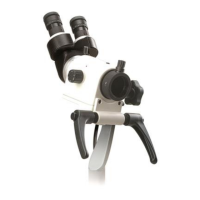
5) Insert the end of the fiber optic cable in the colposcope’s head.
Fans should always be working while the light source is turned on. If for any reason they
do not operate, turn the light source off immediately to avoid lamp failure due to high
temperature.
6) While the colposcope is not being used, the light source should be turned off.
5.1 LIGHT SOURCE
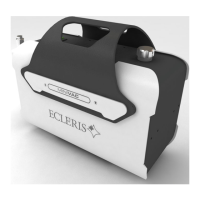
The Ecleris Microstar C-100 Colposcope has an integrated LED (Light-Emitting Diode)
illumination module.
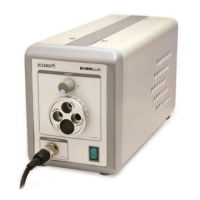
Optionally you can use, the Ecleris HALOLUX 150 – DUO illumination module with two 150 Watts
halogen lamps. Their use is not simultaneous. In case the lamp being used fails during an
intervention, the emergency mechanism allows switching lamps immediately, with no need to
remove the burnt one. This will only be done once the procedure has been finished. Both lamps
have a mechanical diaphragm that can be manually and continually adjusted.
The focal point of the optical system reaches very high temperatures, causing the end of the
fiber optic cable to get hot.
Never touch the inside-end of the fiber optic cable.


 To Next Page