Theory of Operation
Air-to-Fuel Ratio Sensing
The AFRecorder determines an engine's air-to-fuel ratio (AFR) by measuring the
concentrations of O
2
(oxygen), CO (carbon monoxide), and H
2
(hydrogen) in the engine's
exhaust. The concentrations of O
2
, CO, and H
2
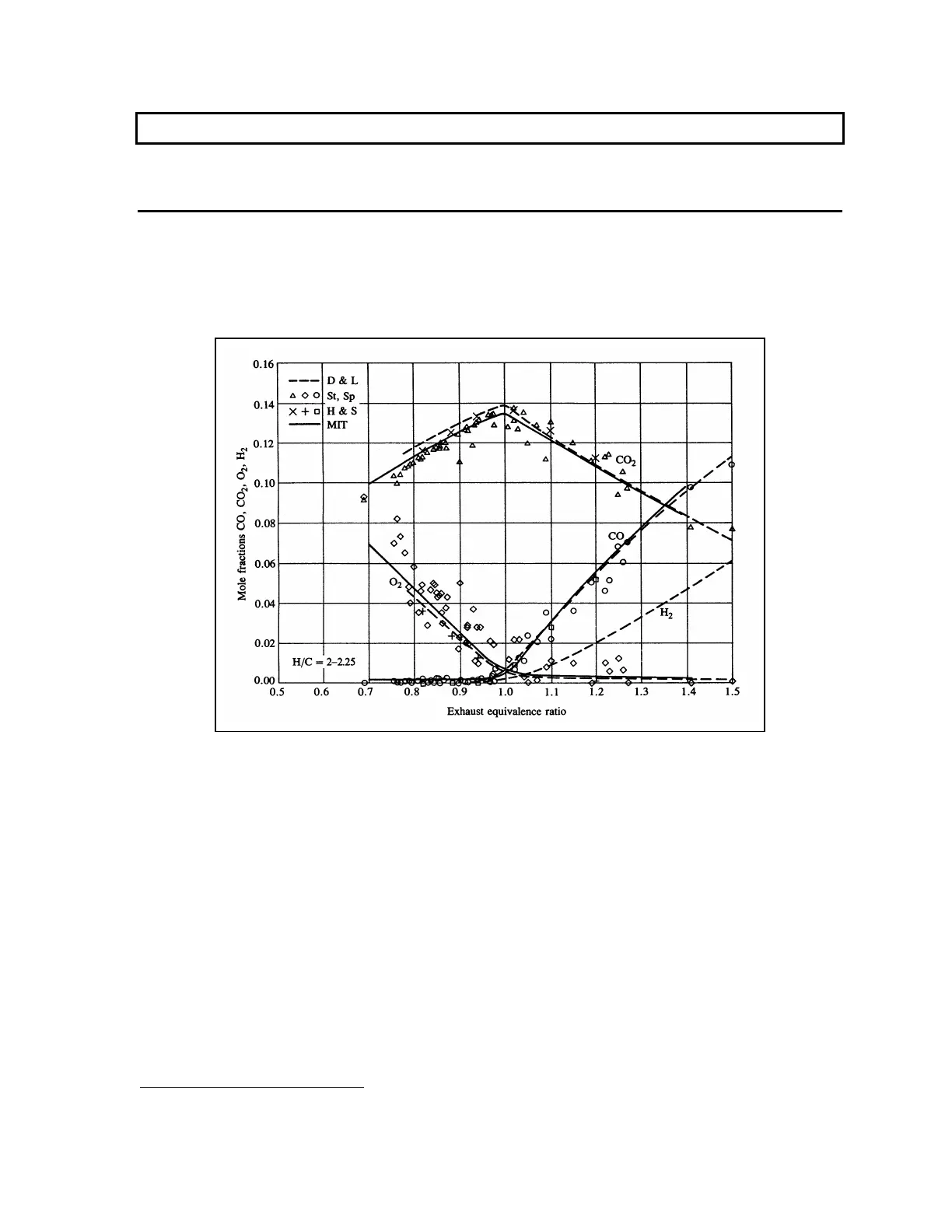
in an engine's exhaust change as a function
of AFR, as shown in Figure 20.
Figure 20: Exhaust Constituents as a Function of Air-to-Fuel Ratio
1
The basic relationships between the concentrations of exhaust constituents (O
2
, CO, H
2
) and
the engine's AFR can be calculated using chemical equilibrium relations and atom balances.
However, the degree to which an engine exactly matches these calculations is dependent on
the degree to which the combustion has approached equilibrium (or "completeness"). This
degree of completeness is engine-dependent and a function of parameters such as valve
timing, compression ratio, and cylinder wall temperature. The accuracy of AFR calculations
based on measurements of concentrations of O
2
, CO, and H
2
are improved with information
as to an engine's degree of combustion completeness.
The AFR sensor's (sometimes called a "UEGO" or "Universal Exhaust Gas Oxygen" sensor)
sensitivities to concentrations of O
2
, CO, and H
2
in an engine's exhaust are defined as Io
2
,
Ico, and Ih
2
respectively. These sensitivities are factory-determined and provided with each
AFR sensor.
Theory of Operation 41
1
From Internal Combustion Engine Fundamentals by J.B. Heywood, McGraw Hill, 1988.



 To Next Page