Froa
Exprcion
Tank
Shaotr
Valvs
Staiffi
Vi6ua1
Flow
MEts
Boila
Drais
IN
OUT
Solaoid
Valve
Flow
Cmtrol
Valve
Prsffi1
Topuahrs
(P/T)
Ports
€
Discbrge
--
I
\a
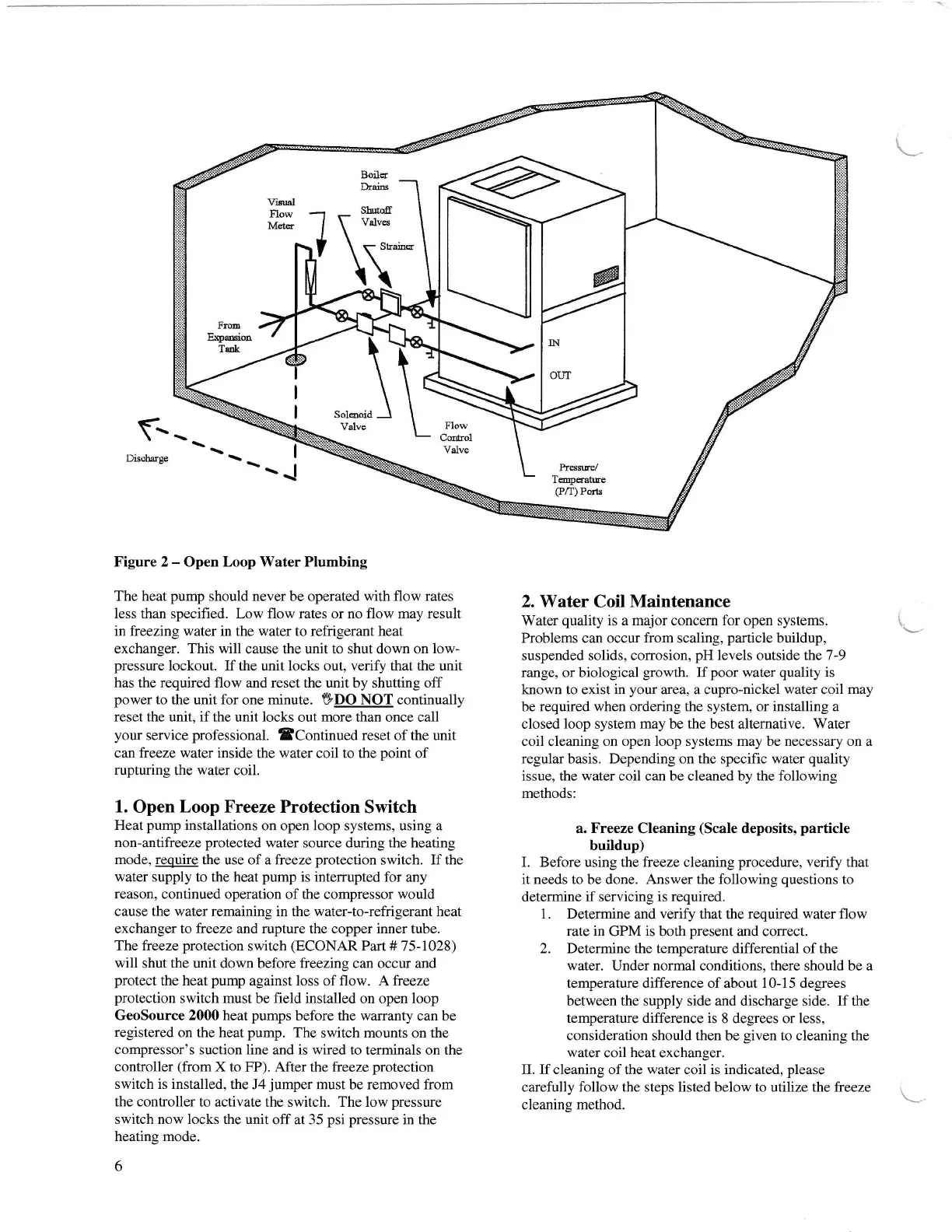
Figure 2
-
Open Loop Water Plumbing
The heat
pump
should never
be operated
with flow rates
less than specified. Low flow rates or no flow may result
in freezing water in the water to refrigerant heat
exchanger. This will
cause the unit to shut down on
low-
pressure
lockout. If the
unit
locks out, verify that the unit
has the required flow and reset the unit by shutting off
power
to the
unit
for
one
minute.
VDO
NOT
continually
reset the unit, if the
unit
locks
out more than once call
your
service
professional.
SContinued reset of the unit
can freeze water inside
the water coil to the
point
of
rupturing
the
water
coil.
1.
Open Loop Freeze Protection
Switch
Heat
pump
installations
on open loop systems, using a
non-antifreeze
protected
water source
during
the heating
mode, requfue
the use of a freeze
protection
switch. If the
water
supply to the heat
pump
is interrupted for any
reason, continued
operation of the compressor
would
cause the water remaining in the water-to-refrigerant heat
exchanger to freeze and rupture the copper inner tube.
The freeze
protection
switch
(ECONAR
Part#75-1028)
will
shut the unit down before freezing can occur and
protect
the heat
pump
against
loss
of flow. Afreeze
protection
switch must
be field installed on open loop
GeoSource 2000 heat
pumps
before the warranty
can be
registered
on the heat
pump.
The switch mounts on the
compressor's suction line
and
is
wired to terminals on the
controller
(from
X to FP). After the freeze
protection
switch is installed,
the J4
jumper
must be removed from
the controller
to activate the switch. The low
pressure
switch now locks
the unit off at 35
psi pressure
in the
heating
mode.
6
2. Water
Coil
Maintenance
Water
quality
is a major
concern
for open systems.
Problems can occur from scaling,
particle
buildup,
suspended solids, corrosion,
pH
levels
outside
the
7
-9
range, or biological
growth.
If
poor
water
quality
is
known to exist ia
your
area, a cupro-nickel water coil
may
be
required when ordering the system, or installing a
closed loop system may be the best altemative. Water
coil cleaning on open loop systems may be necessary on a
regular
basis.
Depending on the
specffic
water
quality
issue,
the
water coil
can be cleaned by
the following
methods:
a.
Freeze
Cleaning
(Scale
deposits,
particle
buildup)
I. Before using the freeze cleaning
procedure,
verify that
it needs to be done. Answer the following
questions
to
determine
if
servicing
is required.
1.
Determhe
and
verify
that the
required
water flow
rate
in GPM
is
both
present
and correct.
2. Determine the temperature differential
of the
water.
Under
normal
conditions,
there
should be a
temperature difference ofabout 10-15 degrees
between the supply side and discharge side. Ifthe
temperature difference is 8 degrees or less,
consideration should then
be
given
to cleaning the
water
coil heat exchanger.
tr. If cleaning of the water coil is indicated, please
carefully follow the steps listed below to utilize
the
freeze
cleaning method.



 To Next Page