EasyManua.ls Logo

ECS H61H2-M16 - User Manual

ECS H61H2-M16
72 pages
Print Icon
To Next Page IconTo Next Page
Loading...
H61H2-M16 USER MANUAL
Preface
Copyright
This publication, including all photographs, illustrations and software, is protected
under international copyright laws, with all rights reserved. Neither this manual, nor
any of the material contained herein, may be reproduced without written consent of
the author.
Version 1.0C
Disclaimer
The information in this document is subject to change without notice. The manufac-
turer makes no representations or warranties with respect to the contents hereof
and specifically disclaims any implied warranties of merchantability or fitness for
any particular purpose. The manufacturer reserves the right to revise this publica-
tion and to make changes from time to time in the content hereof without obligation
of the manufacturer to notify any person of such revision or changes.
Trademark Recognition
Microsoft, MS-DOS and Windows are registered trademarks of Microsoft Corp.
MMX, Pentium, Pentium-II, Pentium-III, Celeron are registered trademarks of Intel
Corporation.
Other product names used in this manual are the properties of their respective owners
and are acknowledged.
Federal Communications Commission (FCC)
This equipment has been tested and found to comply with the limits for a Class B
digital device, pursuant to Part 15 of the FCC Rules. These limits are designed to
provide reasonable protection against harmful interference in a residential instal-
lation. This equipment generates, uses, and can radiate radio frequency energy and,
if not installed and used in accordance with the instructions, may cause harmful
interference to radio communications. However, there is no guarantee that interfer-
ence will not occur in a particular installation. If this equipment does cause harmful
interference to radio or television reception, which can be determined by turning
the equipment off and on, the user is encouraged to try to correct the interference by
one or more of the following measures:
Reorient or relocate the receiving antenna
Increase the separation between the equipment and the receiver
Connect the equipment onto an outlet on a circuit different from that to
which the receiver is connected
Consult the dealer or an experienced radio/TV technician for help
Shielded interconnect cables and a shielded AC power cable must be employed with
this equipment to ensure compliance with the pertinent RF emission limits govern-
ing this device. Changes or modifications not expressly approved by the system’s
manufacturer could void the user’s authority to operate the equipment.

Other manuals for ECS H61H2-M16

Questions and Answers

  • L
    leebrianJul 30, 2025
    How to fix ECS H61H2-M16 Motherboard when it does not power up?
    • J
      Julia RothJul 30, 2025
      If your ECS Motherboard isn't powering up and the fans aren't running, try these steps: Disassemble the PC to remove the VGA adaptor card, DDR memory, LAN, USB and other peripherals including keyboard and mouse. Leave only the motherboard, CPU with CPU cooler and power supply connected. Ensure the power cord is correctly plugged into the wall socket and the PSU switch is turned on. Also, make sure to remove any unused screws or metal objects from inside the PC case to prevent short circuits. Check the CPU FAN connector, the 12V power connector, and the ATX connectors are fully inserted into the motherboard. For Intel platforms, inspect the CPU socket for any bent or damaged pins.
  • J
    Jennifer FlemingAug 3, 2025
    What to do if ECS Motherboard power is on but there is no display?
    • H
      Henry SilvaAug 3, 2025
      If your ECS Motherboard has power and the fans are running, but there's no display, first ensure your monitor is on and properly connected to the PC. Check that the VGA adapter card (if applicable) is correctly inserted. Listen for beep sounds, ensuring the internal PC speaker is connected. If you hear continuous 3 short beeps, it indicates memory not detected. If you hear 1 long beep and 8 short beeps, it indicates VGA not detected.
  • B
    Bryan PattersonAug 7, 2025
    Why does my ECS Motherboard PC suddenly shut down while booting up?
    • L
      Lisa RogersAug 8, 2025
      If your PC suddenly shuts down while booting up, the CPU may be overheating to protect itself. Apply thermal grease onto the CPU heatsink and ensure the CPU fan is well-connected with the CPU heatsink. Check if the CPU fan is working properly while the system is running. You can also try disabling the Smartfan function in the BIOS settings to allow the fan to run at its default speed. Loading Optimized Defaults in BIOS will also disable Smartfan.
  • D
    David GarciaAug 12, 2025
    How to troubleshoot ECS H61H2-M16 start up problems after prolonged use?
    • V
      vhensleyAug 12, 2025
      If you are experiencing start-up problems with your ECS Motherboard after prolonged use, try these steps: Clear the CMOS values using the CLR_CMOS jumper. Check the CPU cooler fan for dust accumulation, and clean or replace it if necessary. Ensure that the 12V power and ATX connectors are fully inserted into the motherboard connectors. Remove the hard drive, optical drive, or DDR memory to identify any faulty components. Also, check for any bulged electrolytic capacitors or abnormal components on the motherboard.
  • J
    Jason WebbAug 16, 2025
    What to do if there is no display on ECS H61H2-M16?
    • P
      Peter BentleyAug 16, 2025
      First, make sure your monitor is turned on and properly connected to your PC. Also, check that the VGA adapter card, if you're using one, is correctly inserted. If you hear continuous 3 short beeps, it indicates that the memory is not detected. If you hear 1 long beep and 8 short beeps, it means the VGA is not detected.
  • B
    Barry CarrollAug 21, 2025
    How to fix ECS Motherboard when it does not power up and the fans are not running?
    • K
      Kevin RodgersAug 21, 2025
      If your ECS Motherboard system doesn't power up and the fans aren't running, try these steps: First, disassemble the PC, removing the VGA adaptor card, DDR memory, LAN, USB, and other peripherals, including the keyboard and mouse, leaving only the motherboard, CPU with CPU cooler, and power supply connected. Ensure the power cord is plugged into the wall socket and the switch on the Power Supply Unit (PSU) is turned “on”. Also, remove any unused screws or metal objects from inside the PC case. Check that the CPU FAN connector and the 12V power connector are connected to the motherboard and that the 12V power & ATX connectors are fully inserted into the motherboard connectors. For Intel platforms, inspect the CPU socket pins for damage or bending.
  • R
    Randall JohnsonAug 26, 2025
    What to do if ECS H61H2-M16 power is on, fans are running but there is no display?
    • C
      Carlos HillAug 26, 2025
      If the power is on and the fans are running on your ECS Motherboard, but there is no display, first ensure that the monitor is turned on and the monitor cable is properly connected to the PC. Next, check that the VGA adapter card (if applicable) is inserted properly. Finally, listen for beep sounds and ensure the internal PC speaker is connected if you are using one.

Summary

Introducing the Motherboard

Motherboard Overview

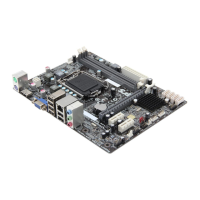
Overview of the H61H2-M16 motherboard and its features, supporting LGA1155 socket CPUs.

Package Contents List

Lists the items included in the motherboard package for user reference.

Technical Specifications

Details the technical specifications of the motherboard, including CPU, chipset, memory, and I/O.

Motherboard Component Identification

Identifies and labels various physical components and connectors on the motherboard.

External I;O Ports Explained

Describes the function and connection for each external input/output port on the motherboard.

Installing the Motherboard

Installation Safety and Precautions

Essential safety guidelines to follow before and during motherboard installation to prevent damage.

Mounting the Motherboard

Step-by-step guide on how to physically mount the motherboard inside a computer case.

Jumper Settings Configuration

Explains how to locate and configure motherboard jumpers, specifically the CLR_CMOS jumper.

CPU and Memory Installation

Detailed instructions on installing the CPU, CPU cooler, and memory modules into their respective slots.

Expansion Card and Device Connectivity

Guides on installing add-on cards, connecting optional devices, SATA drives, and case components.

Front Panel and Internal Headers

Explains the front panel header and other internal connectors for system functionality.

Using BIOS

BIOS Setup Utility Basics

Covers utility introduction, entering setup, resetting defaults, and navigation keys.

Main and Advanced Settings

Explores main system info, CPU, LAN, power management, SATA, USB, and Super IO configurations.

Chipset and System Tuning

Details chipset settings, M.I.B III for clock/memory tuning, and CPU overclocking.

Boot, Security, and Exit Options

Manages boot order, security settings, and exiting BIOS setup.

Using the Motherboard Software

Software Installation Procedures

Guide to installing drivers and utilities via auto-install or manual methods from the support DVD.

ECS Utility Software Suite

Overview of utilities like eSF (Smart Fan), eDLU (Driver Update), and eBLU (BIOS Update).

Trouble Shooting

Initial Assembly Startup Issues

Addresses common issues during first-time PC assembly, including power, display, and shutdown problems.

Post-Use Startup Problem Solutions

Solutions for startup problems that may arise after extended periods of PC usage.

System Maintenance and Troubleshooting Guide

Provides care tips and a flowchart for diagnosing and resolving common PC operational issues.

ECS H61H2-M16 Specifications

General IconGeneral
BrandECS
ModelH61H2-M16
CategoryMotherboard
LanguageEnglish

Related product manuals