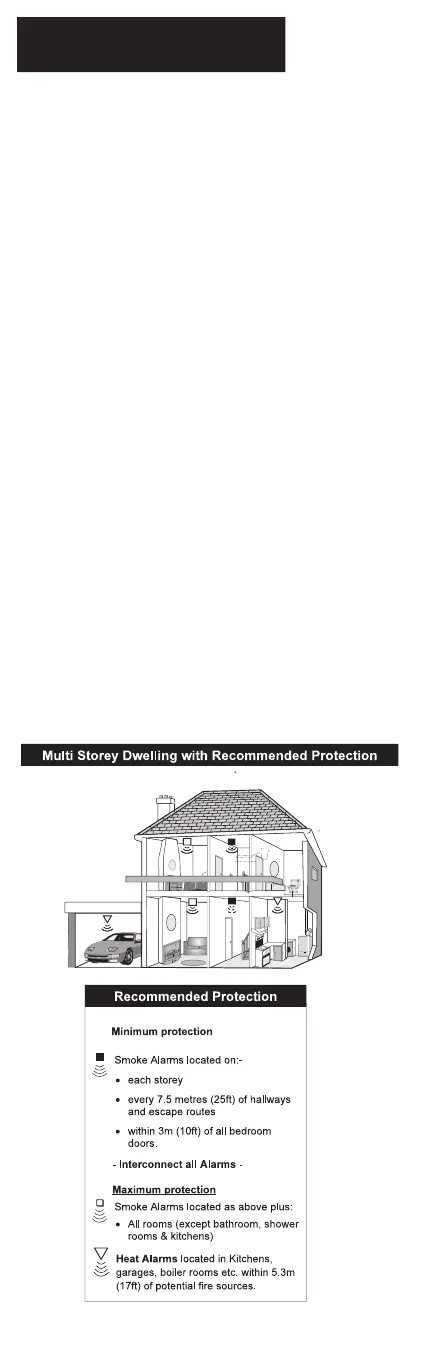
The minimum number of smoke Alarms is set out in the
National Construction Code (NCC) Building Code of
Australia: Volumes 1 and 2, and/or the relevant State or
Territory Building Regulations.
The main reason for fitting Smoke & Heat Alarms in
dwellings is to ensure that when there is a fire, sufficient
early warning is given so that everybody can escape safely.
This may require more smoke Alarms than the minimum
number due to the size or shape of the building.
This means that the fire Alarms should ideally be located
near all potential sources of fires and that the alarm
should be heard throughout the house – particularly in
the bedrooms.
It is also important that nuisance/false alarms are
minimised to ensure the units are not disabled or ignored.
The Australian Standard AS1670.1 gives guidance on:
- how many Alarms to install
- what type of Alarm to use
- where to position Alarms
The above points will depend on the type of dwelling to
be protected and the level of fire risk.
Fire Risk Assessment
The type of system that should be installed depends
on the fire risk. The risk assessment is based on a
combination of probabilities:
- fire occurring
- injury or death to occupant
- system operating correctly with a fire
- early detection and warning to occupants in the event
of a fire.
The greater the risks, the more comprehensive and
reliable systems need to be.
How Many Alarms To Install
10



 To Next Page