General advice
• 10 cm minimum free space between the subwoofer and the wall is required for proper cabling and cooling.
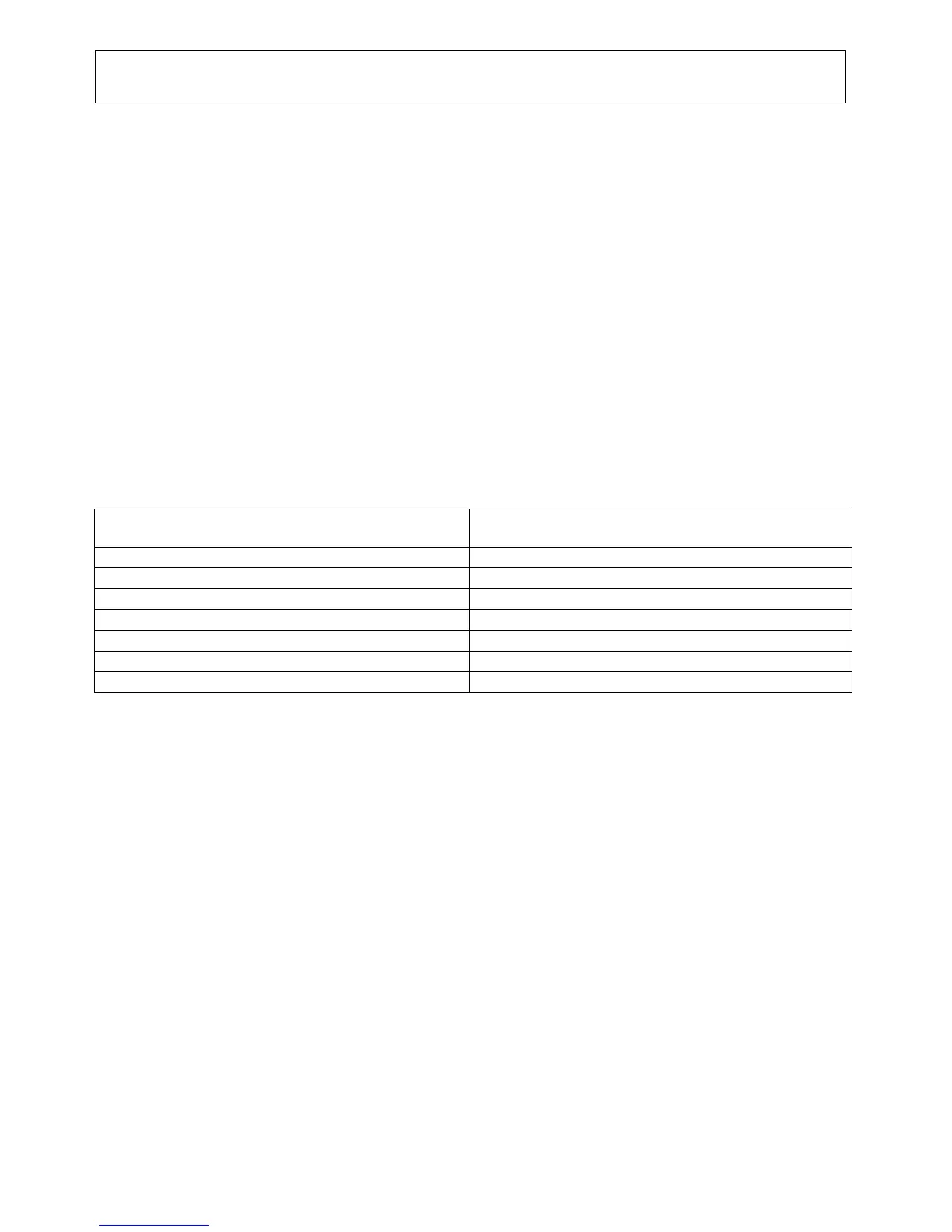
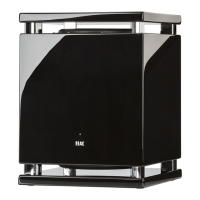
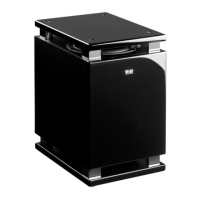
• Some ELAC subwoofers are down-firing or provide a bass diaphragm on the bottom. Therefore, they are
equipped with mounted bottom plates. The plates are realizing the proper distance. If you want to place ob-
jects on the ELAC subwoofer, make sure that they do not slip and that they are protected from vibrations.
Shops for car accessories may sell specific mats that avoid slipping. Mats of rubber or felt should be used
where a loudspeaker is placed on an ELAC subwoofer (not generally recommended).
The influence of room acoustics
‘Low frequencies need space’ - this is an important yet ambiguous statement when applied to subwoofers. For practi-
cal purposes the following facts may be more useful:
The low crossover frequency limit of the ELAC subwoofer at near-maximum levels is below 30Hz, depending on the
product. This corresponds to a sound wave with a length of approx. 10 meters. Nevertheless, low bass can also be
heard in small rooms (extreme example: headphones). However, some peculiarities should be taken into account: In a
closed, box-shaped room less than 7– 8 m in length, the centre of the room should be avoided as a listening position if
you want good bass. Like waves in a bathtub, the energy “rolls” back and forth between both ends of the room and the
alternating pressure build-up is focused at these ends until it overflows. The lowest pressure remains exactly in the
middle which means no low bass. The following table shows the frequency at which this effect is the strongest.
Distance between parallel walls
Frequency of pressure minimum in the middle between the
walls
10 m 17 Hz
8 m 21 Hz
6 m 29 Hz
5 m 34 Hz
4 m 43 Hz
3 m 57 Hz
2.5 m (room height) 68 Hz
The effect appears exactly in the range where a Subwoofer should show its strength. It applies to all parallel boundary
surfaces, even to the floor and ceiling, if these are solidly constructed. The solution is simple: move the listening posi-
tion away from the centre of the room - even a move of only 50 cm is sufficient to hear the low bass again. If the lis-
tener is sitting directly adjacent to a wall, bass reproduction is often too strong. This can be balanced by reducing the
levels at the subwoofer. However, for all higher frequencies and a more natural spatial impression, it is better to move
the listening position away from the walls. According to the acoustic theory of low frequencies in small, closed rooms
the location of the listener and subwoofer can be exchanged without affecting the acoustic results. Thus the best posi-
tion can be easily found by mounting the subwoofer at the potential listening position, walking around in the room to
locate the place where the bass is reproduced most evenly, and then placing the subwoofer there.
Although the theory cannot be relied upon totally and low bass should not be judged alone (without the main speak-
ers), the recommendation to never place the subwoofer/ listener exactly in the middle of the room or centrally in front
of long walls, still holds true. Due to its flexibility, and frequency range, the ELAC subwoofer can take full advantage of
a location near a wall or in a corner. The minimum necessary free rear space for cooling and cabling is 10 cm. A
greater distance from the wall is recommended only if changing the "PHASE" does not result in a better bass repro-
duction - Shifting the subwoofer by 0.5 - 2 m (depending on the crossover frequency) may clarify the situation. Good
bass can be obtained in open rooms and with slightly asymmetric placements. Irregularities in the building, sometimes
even just an open door, may have a surprising and often positive effect.
Under practical conditions the position of the ELAC subwoofer cannot be located by ear and therefore does not need
to be placed exactly between the main speakers. A position on a side wall, even behind the listener, is also possible,
especially with a low crossover frequency. Once optimization is complete, the subwoofer may even be placed out of
sight.
Set-up tips Page 17 of 20


 To Next Page