3-1
PREPARING FOR THE ROAD
PREPARING FOR THE ROAD
Before venturing out on to the road with your
motorhome, it is important that you prepare
correctly.
MOTORHOME WEIGHTS EXPLAINED
Mass in Running Order
The weight of your motorhome as it leaves
the factory, as new with standard fixtures and
fittings, plus an allowance for the driver of
75kgs and the mass of the fuel when the tank
is full, 90% of the water carried in the water
tank and an allowance for the gas bottles.
Maximum Technically Permissible
Laden Mass
The maximum mass the vehicle can be when
fully laden for use on the road.
User Payload
The load margin (payload), this represents
the difference between the Mass in Running
Order and the Maximum Technically
Permissible Laden Mass. It shows the
maximum weight that can be loaded into your
motorhome, covering items such as food,
crockery, cutlery, clothing, bedding, etc.
Loading
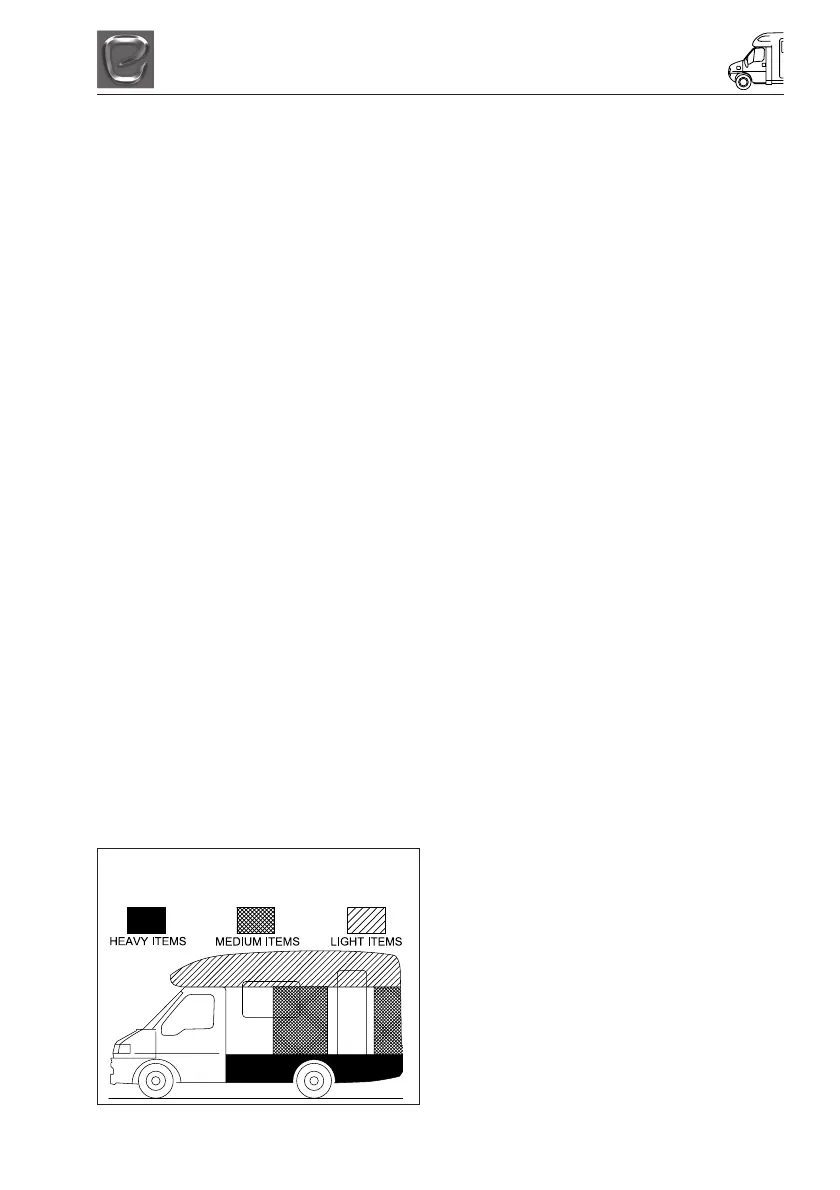
It should be noted that even weight
distribution is a major factor in making your
motorhome an easy and pleasant vehicle to
drive. Care should therefore be taken in
balancing the load, ensuring that heavy items
are well spaced and are in as low a position
as possible, for example, low cupboards and
bed boxes.
Note: Light items are considered as clothing
and bedding. It is not recommended to travel
with tinned items in overhead lockers.
IMPORTANT: Do not exceed maximum
technical permissible laden mass for your
motorhome.
Roof Racks
Some models of motorhomes have, available
as an option, a roof rack and ladder. Care is
needed when using this facility. We
recommend you exercise extreme caution
when loading and unloading.
CAUTION: Do not allow anyone to climb onto
the roof. Do not exceed the stated maximum
load. Items fitted other than standard
equipment will deplete the payload stated in
this handbook.
Roof Loading
All motorhomes have a specially designed
roof rack system fitted or available as an
optional extra. The roof of each motorhome is
strengthened to accommodate the roof rack.
Please note: The roof rack is capable of
withstanding a maximum weight of 12 stone/
76kgs. Static roof loading or top box loading
should be limited to a maximum of 76kgs
including contents, or the limit set by the top
box manufacturer, whichever is the lower
figure.
WARNING: Under NO circumstances walk
on the roof section
Before venturing out on to the road with your
motorhome, it is important that you prepare
correctly.
Roof loads should be evenly distributed and
securely fastened, but care must be taken
not to overtighten straps or ropes to the point
where roof rails or brackets may become
distorted, particularly as during braking and
cornering, forces exerted by straps or ropes
are greatly increased.
It is also worth noting that when carrying
heavy or large objects on the roof, the
vehicles handling may change due to the
resultant displacement of the centre of gravity
and the increased area exposed to the wind.
SENSIBLE LOADING
HOW TO APPORTION WEIGHT



 To Next Page