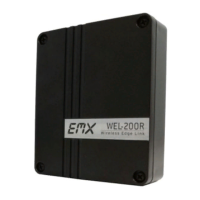
The EMX WEL-200™ Wireless Edge Link system provides a comprehensive wireless solution for integrating sensing edges with gate and door operators, ensuring compliance with 2018 UL325 monitoring standards. This system consists of a WEL-200T transmitter and a WEL-200R receiver.
Function Description
The WEL-200 system is designed to wirelessly connect safety edges to gate and door operators. Each WEL-200T transmitter can operate for up to two years on two AA lithium batteries, providing a long-lasting and reliable power source. The WEL-200R receiver is capable of connecting with up to four transmitters, offering flexibility for various installations. It provides separate relay and pulse outputs for both open and close edge functionalities, allowing for precise control and monitoring of gate or door movements.
The receiver features channel assignment switches, which are used to assign a wireless transmitter to a specific channel. Channel status indicators provide visual feedback on the current status of each channel. A wireless transceiver module facilitates communication with the transmitters. The system includes an open/close direction assignment switch, enabling the assignment of a channel to either an open or close direction output function. A power indicator illuminates when the receiver is powered up, and a status indicator shows the overall system status.
For relay monitoring, the receiver incorporates "Close" and "Open" direction relay termination jumpers. These jumpers allow for the termination of the COM/NO terminals with a 10k resistor when placed in the lower position, which is essential for 10K resistive monitoring methods. The terminal block on the receiver provides various input/output connections, including pulsed outputs for OPEN and CLOSE directions, normally closed and normally open connections for OPEN and CLOSE relays, common connections for both, and power input terminals. An earth ground connection point is also provided for safety.
The transmitter is equipped with a battery compartment for two AA lithium batteries, a transmitter status LED, a terminal block for interfacing with the safety edge, and a connection switch. The transmitter status LED blinks twice every two seconds if not connected to a receiver, and once every two seconds if successfully connected. When the edge is activated, the LED blinks once every second. The connection switch is used to connect or disconnect the transmitter from the receiver.
Usage Features
Installation of the WEL-200R receiver involves mounting it to the exterior of an operator, ideally in direct line-of-sight with the transmitters to avoid obstructions. The enclosure can be secured using machine screws, washers, lock washers, and nuts. After mounting, the cover is removed to access the internal DIP switches. If relay contacts are used for monitoring, the DIP switches for each channel are set to either OPEN or CLOSE direction relay function, depending on the edge's location. For 10K resistive monitoring, jumpers are placed in the 10K position for both OPEN and CLOSE direction relays. Pulse outputs are available for open collector pulse-type monitoring. The appropriate output is then wired to the operator, and power is connected to the terminals.
Connecting the system is a two-step process. First, on the receiver, the desired channel assignment switch is pressed and held until all four channel LEDs activate and the system status LED flashes rapidly, then released. This clears any existing assignments for that channel. Next, on the transmitter, the connection switch is pressed and held. The transmitter's LED will begin flashing rapidly after approximately four seconds. Upon successful connection, the LED will flash once every two seconds. If the transmitter fails to connect, it will return to its initial state, flashing twice every two seconds, and the connection process should be repeated.
Testing the system involves observing the channel status LED. Without activating the edge, the LED should be off. When the edge is activated, the receiver channel status LED will turn on, and the corresponding OPEN/CLOSE direction output will activate. Simultaneously, the transmitter status LED will blink once every second. If this behavior is not observed, the edge wiring/termination and transmitter batteries should be checked.
The cable grip, which provides a NEMA 4X rating, requires specific installation to maintain a watertight seal. It accommodates cables with diameters between 0.181 – 0.312 inches (4.6 – 7.9mm) using the supplied insert. For smaller cables (0.069 – 0.187 inches or 1.8-4.7mm), a separate white insert is provided. Only round cables should be used to ensure a watertight seal. The sealing nut is removed, and the appropriate insert is placed in the body. The sealing nut is then hand-tightened as far as possible, and further tightened with wrenches to 40 in. lbs. to securely hold the cable. If the cable has a different diameter, the cable ingress should be pointed downwards to prevent water penetration.
Maintenance Features
The WEL-200R receiver offers enhanced diagnostic features that simplify installation and maintenance. Feedback is provided for all fault modes, including edge open and short conditions, low battery, and failed transmitters.
The system status LED on the receiver (next to the power LED) can be used to compare flash patterns for troubleshooting. An unassigned channel's LED will flash at the same rate as the status LED.
Channel LED diagnostics provide clear indications of various issues:
- LED is on, regardless of edge state: This indicates that the edge resistance is below normal, or the edge wires are shorted. The solution involves ensuring the edge is terminated with the proper resistance (3k to 12k) and checking wires for damage. The output state in this condition is Relay NO/COM connected, with a pulse output of 0 Hz.
- LED flashes 2x per cycle (0.25 seconds on, 0.25 seconds off): This signifies that the edge resistance is above normal, there's an improper connection, or the wires are damaged. The corrective action is to verify the edge termination resistance (3k to 12k) and check for wire damage. The output state is Relay NO/COM connected, with a pulse output of 0 Hz.
- LED flashes 3x per cycle: This indicates that the transmitter batteries are low. Replacing the batteries with the type listed in the specifications will resolve this. This condition represents normal operation.
- LED flashes 2x (0.5 seconds on, 0.5 seconds off): This suggests that the transmitter batteries are discharged, or the transmitter is damaged/inoperable. The solution is to replace the batteries with the specified type or replace the transmitter if it's damaged. The output state is Relay NO/COM connected, with a pulse output of 0 Hz.
During channel assignment mode, the active channel's LED will turn on for 0.25 seconds, once per cycle. If the edge resistance is above normal due to improper termination or cable damage, the offending channel's LED will turn on for 0.25 seconds, twice per cycle. If the transmitter batteries fall below their ideal operating voltage, the LED for its assigned channel will turn on for 0.25 seconds, three times per cycle. If a transmitter is inactive, its LED will flash in a specific pattern (on for 0.25s, off for 0.25s, on for 0.25s, off for 1.25s).
To remove a connection from a transmitter, the connection button on the transmitter should be held down. The LED will turn on solid for several seconds, then blink twice every two seconds when disconnected. A factory reset can be performed on the receiver by simultaneously pressing channel 1 and 4 switches during power-up, which clears all programmed channels. Channel assignment mode will exit automatically after a successful connection, a 60-second timeout, or if the user manually exits by pressing channel 1 and 4 switches simultaneously for more than 2 seconds.


 To Next Page
 General