There are two ways to measure your exercise intensity. The rst is by evaluating your
perceived exertion level and the second is by monitoring your heart rate. During exercise,
if you cannot maintain a conversation without gasping, you are working too hard. A good
rule of thumb is to work to the point of exhilaration, not exhaustion. If you cannot catch your
breath, it is time to slow down. Always be aware of other warning signs to overexertion.
To monitor your heart rate you can use a pulse monitor or take your pulse with your ngers.
Pulse monitors are convenient tools for monitoring your heart rate. However, these values
are for reference only. You should always listen to your body rst.
You can measure your pulse with your ngers by placing your rst two ngers lightly over
the blood vessel (carotid artery) on your neck located next to your Adam’s apple. Count your
pulse for ten seconds and multiply by six. This gure is your heart rate in beats per minute
(bpm). Compare this number to the Target Heart rate zone for your age group.
WALKING TIPS
Before attempting your rst workout and have consulted with a physician, familiarize
yourself with the console and all the safety controls. It is imperative that the user is
appropriately dressed and is using running shoes while working out. See the Safety
Guidelines section for more information.
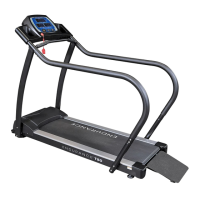
A novice user should hold onto the extended handrails as the treadmill is starting.
Straddle the treadmill as it begins to move and use only one foot to get the rhythm
of how quickly the user needs to walk.
Start at the lowest walking speed and as you become more comfortable, increase
speeds in small increments (0.1 mph at a time) to ensure that the user is in control
of the machine.
Eyes forward and remember to use good posture. Do not look sideways, down or
backwards! There is a tendency to walk in the direction you are looking at.
Use the wheelchair access ramp if mounting onto the treadmill becomes strenuous
on the knees.
Age Target Zone
20 120 ~ 150
25 117 ~ 146
30 114 ~ 142
35 111 ~ 138
40 108 ~ 135
45 105 ~ 131
50 102 ~ 127
55 99 ~ 123
60 96 ~ 120
65 93 ~ 116
70 90 ~ 113
TARGET HEART RATE
TARGET HEART RATE
The most common method for calculating your target
heart rate is to nd your maximum heart rate.
The standard formula for this is:
220 - your age =
MaxiMuM Heart rate.
You DO NOT want to workout at your maximum heart
rate. You want to workout in your target heart rate zone.
Your target heart rate zone is a percentage of your maxi-
mum heart rate. The American Heart Association recom-
mends working out at a target heart rate zone of between
60% - 75% of your maximum heart rate. If you are just
beginning an exercise program, exercise near or below
the lower limit of your target zone.
Lower target Zone LiMit = MaxiMuM Heart rate x 0.60
upper target Zone LiMit = MaxiMuM Heart rate x 0.75
Excercise Tips and Guidelines
27


 To Next Page