
 Need help?
Do you have a question about the enphase IQ Series and is the answer not in the manual?
Follow all safety and assembly instructions when installing Enphase Field Wireable Q Connectors.
Explanation of DANGER, WARNING, and NOTE symbols used in the document.
Detailed DANGER and WARNING statements regarding electric shock, fire, burn risks, and equipment damage.
Guidance on using Enphase Field Wireable Q Connectors with Q Cable or field cable.
Identification of individual parts for the female connector assembly.
Identification of individual parts for the male connector assembly.
Detailed step-by-step instructions for assembling Enphase Field Wireable Q Connectors.
This document provides essential safety instructions and assembly guidelines for Enphase Field Wireable Q Connectors, designed to facilitate connections within an Enphase solar energy system. These connectors are crucial for ensuring a reliable and safe electrical installation, particularly when working with Enphase Q Cable or other field cables.
The primary function of these connectors is to enable flexible and secure electrical connections on the roof, simplifying the wiring process and eliminating the need for complex, fixed wiring solutions. They allow for the creation of various connection types, including male-to-female connections, connections from any open Q Cable connector, and jumper connections for remote parts of the array. Specifically, male connectors are used to connect from a Field Wireable female connector, while female connectors are used to connect from any open Q Cable connector. For cable-to-cable connections, such as creating a jumper to connect to a remote part of the array, female-to-female connections are utilized. Additionally, a mated pair of these connectors can be used to splice two cut ends of cable, offering a robust solution for cable repair or extension.
Safety is paramount when handling these devices. The manual emphasizes several critical warnings and instructions to prevent electric shock, fire, equipment damage, and personal injury. Users are explicitly warned against using Enphase equipment in any manner not specified by the manufacturer, as this could lead to severe consequences. Installation of this equipment inherently carries a risk of electric shock, necessitating the removal of AC power from the Enphase System and disconnecting power from photovoltaics before any servicing or installation. Before making any connections, it is crucial to verify that circuit breakers are in the off position and to double-check all wiring before applying power. Only electrical system components approved for wet locations, including conduit fittings, should be used. Installation, troubleshooting, or replacement of the Enphase Field Wireable Q Connector should only be performed by qualified personnel. Improper use of the connector or its components can result in shock, fire, or explosion, underscoring the need to disconnect all wiring before attempting any maintenance. It is vital to ensure that all AC and DC wiring is correct and free from pinching, shorting, or damage. Users are strictly prohibited from attempting to repair or alter the Enphase Field Wireable Q Connector. Furthermore, conductors must not be damaged; if exposed wires are damaged, the system may not function properly. A critical warning highlights that Enphase male and female connectors must only be mated with their corresponding male/female counterparts to prevent equipment damage.
Beyond electrical safety, the manual also addresses operational and environmental considerations. The product is designed to operate in environments with a maximum ambient temperature of 55°C (131°F). When installing cabling, any loose cables must be secured to minimize tripping hazards. Before installation or use, users must read all instructions and cautionary markings provided in the technical description, on the Enphase System, and on the photovoltaic (PV) equipment. The use of unapproved attachments or accessories can lead to damage or injury. When looping the Enphase Q Cable, loops should not be smaller than 4.75 inches (12 cm) in diameter. All electrical installations must comply with applicable local electrical codes, including the Canadian Electrical Code, part 1; the National Electrical Code (NEC); ANSI requirements; and NFPA 70. To ensure optimal reliability and to meet warranty requirements, the connectors must be installed according to the instructions in this guide. Protection against lightning and resulting voltage surges must also be in accordance with local standards. The connector is considered compliant with UL 6703 only when assembled precisely as specified in the instructions. The cable used with these connectors must meet specific requirements regarding outer insulation diameter, number of conductor strands/size, and wire size.
The assembly process is detailed with clear, step-by-step instructions for both female and male connectors. It begins by taking the connector parts out of the bag and using the nut to mark the cable at 28 mm, then sliding the nut over the cable. The gasket, which is pre-installed inside the cover, is then slid over the cable along with the cover. Attaching the terminals involves stripping the outer jacket to 28 mm and the conductor insulation to 9.5 mm. The open end of each terminal is loaded into the 12 gauge slot of a crimp tool, flush with the edge of the slot. A crucial warning during this step emphasizes that the jacket must extend completely through the gasket when the body is assembled, and the gasket must fully cover the cable jacket to prevent moisture from entering the connector. The end of the terminal is then crimped over the stripped wires, with a strict instruction not to crimp over conductor insulation. After crimping, the terminals are inserted into the connector body, with an audible click indicating proper engagement. The connector body and cover are then assembled, again listening for a click. Finally, the nut is tightened to 7 Nm, with a caution against over-tightening.
Maintenance features are primarily preventative, focusing on correct installation and adherence to safety guidelines to ensure longevity and proper function. The manual implicitly suggests that proper initial assembly, as detailed, is the key "maintenance" to prevent future issues. There are no explicit instructions for ongoing maintenance beyond ensuring the integrity of the wiring and connections. The emphasis is on avoiding damage during installation and operation, rather than on periodic servicing of the connectors themselves. The warning against attempting to repair or alter the connector further reinforces this approach, indicating that these are components designed for reliable, long-term use when installed correctly, and not intended for field repair. The use of only Enphase Field Wireable Q Connectors with Enphase Q Cable is also highlighted as important for preventing equipment failure.
 General
| Type | Microinverter |
|---|---|
| Frequency | 60 Hz |
| Enclosure Rating | IP67 |
| Warranty | 25 years |
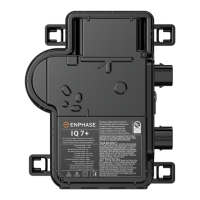
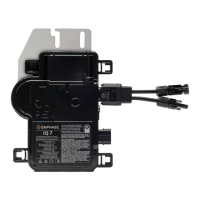
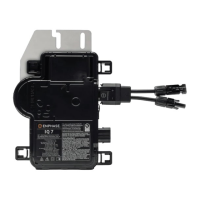
| Model | IQ Series |
| Output Voltage | 240 V (split-phase) |
| Nominal AC Voltage | 240 V |
| Input Voltage Range | Varies by model (e.g., IQ8: 16-48V, IQ8+: 16-48V, IQ8M: 16-48V, IQ8A: 16-48V, IQ8H: 16-48V) |



 To Next Page
