- 85 -
Reduce Fire Risk with a Clean Laser
SECTION 9: CLEANING & MAINTENANCE
Reduce Fire Risk with a Clean Laser
Cleaning the laser is an excellent way to prevent fire with the laser. A buildup of cutting and engraving residue
and debris is dangerous and can create a fire hazard in its own right. Keep your laser system clean and free of
debris. Regularly remove the Vector Cutting Table to clean any small pieces that have fallen through the grid.
For more information on fire safety, see “Fire Warning” on page 5.
Cleaning the Optics
About once a week, or if you notice dust building up, you will need to clean the optics (mirrors and lenses) of your laser. If
smoke, resin, or other contaminants are allowed to accumulate they will reduce the available laser power and may cause
damage to the optics.
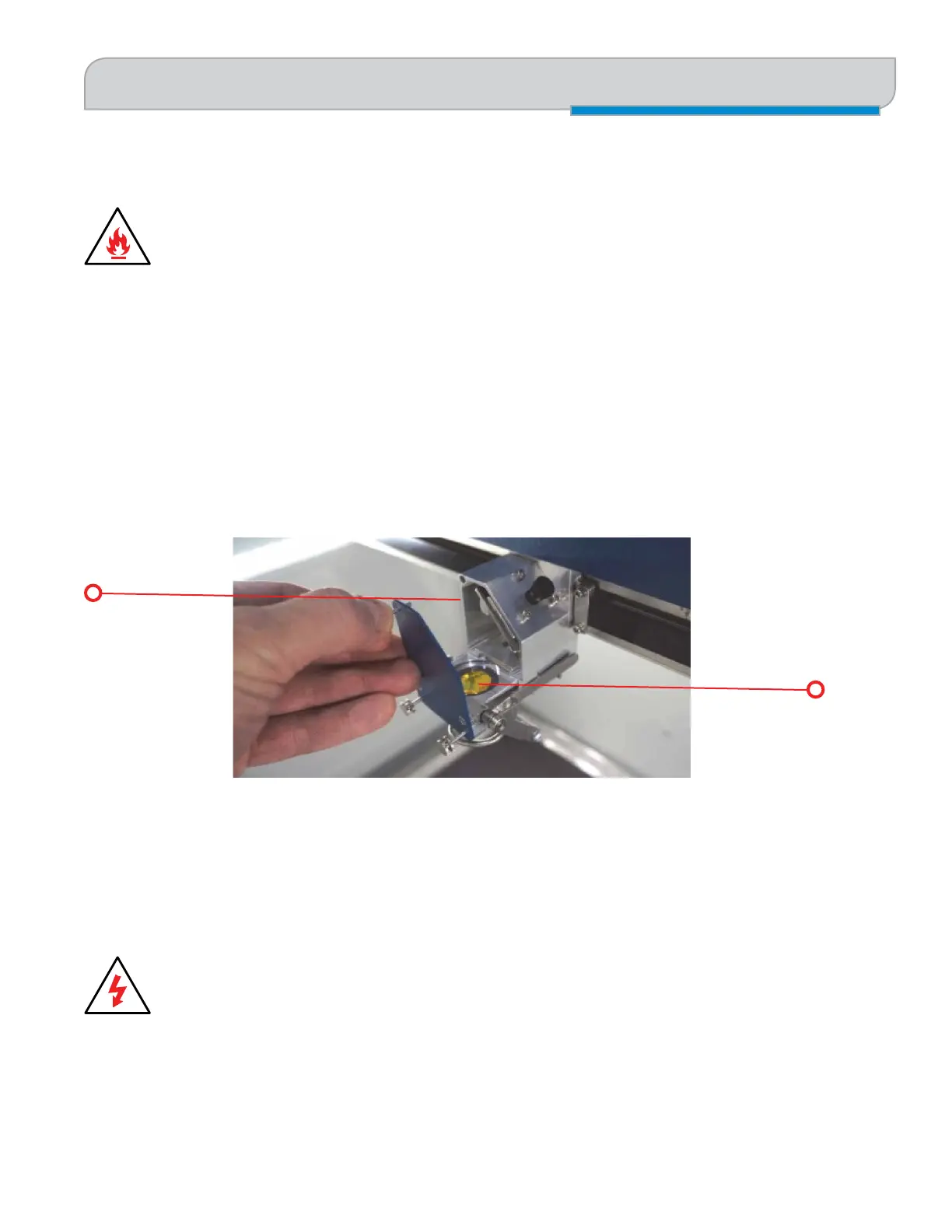
The two optical components most likely to require cleaning are the focus lens and the mirror directly above it. The lens and
mirror are a single assembly, and can be removed from the machine for cleaning by unscrewing the three thumbscrews
on the front lens cover.
To clean the optics, use a high-quality cotton swab moistened with the optics cleaner supplied in the accessory kit. Please
read the label on the bottle carefully.
If you run out of the cleaner supplied by Epilog, Reagent or laboratory grade Acetone can be substituted. Another option
is a 10 to 1 water to white vinegar mixture. This is very good at removing finger prints and other minerals which can be
left behind on the optics. Also, if “Golden Grain” or “Everclear” are available in your area these are also good substitutes
for the optical cleaning solution.
Never use Alcohol or Hardware grade Acetone, they contain impurities which can damage the optics in your
machine.
Wet the swab thoroughly with the solvent, and then blot it against a piece of cotton so that it is no longer soaking-wet.
Then daub the optic gently, rotating the swab after each daub to expose clean cotton to the surface until the optic is free
of visible contamination. At that point, prepare a fresh swab and clean the surface with a gentle zigzag motion across it.
Avoid any hard “scrubbing” of the surface, especially while there are visible particles on it, and try not to use repetitive
circular motions. When you are done, be careful to remove any cotton threads that may have snagged on the mountings.
Mirror
Focus Lens


 To Next Page