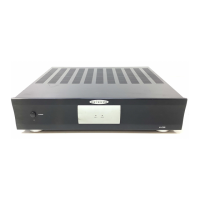
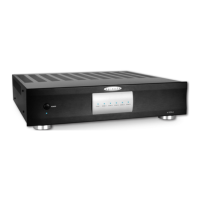
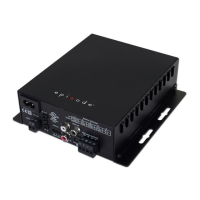
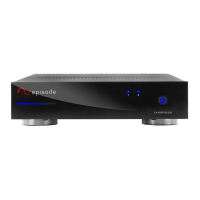
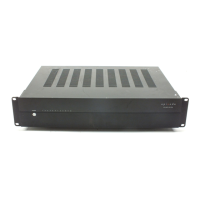
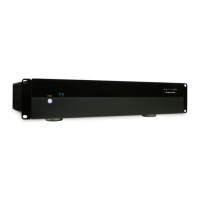
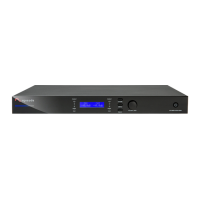
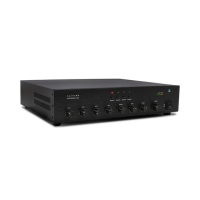
This document is an installation manual for Episode Dynamic Series Amplifiers, specifically covering models EA-DYN-2D-200, EA-DYN-8D-100, EA-DYN-12D-100, and EA-DYN-16D-100. The manual provides detailed instructions and features for these audio amplifiers, designed to deliver high-quality sound in custom audio installations.
Function Description
Episode Dynamic Series Amplifiers are designed to provide efficient, clean power to multiple audio zones, enhancing the listening experience by reproducing the subtle details of music. These amplifiers utilize the latest digital technology, resulting in cool-running performance from a compact and reliable package. They are suitable for various installations, from simple stereo setups to complex multi-zone audio systems. The amplifiers are built with superior quality components to ensure outstanding sound quality and are significantly more efficient than traditional analog designs.
The amplifiers feature multiple stages of protection, where each pair of channels (or zone) is individually protected. This means that if a short circuit occurs in one zone, only the affected channels will shut down, allowing other zones to continue playing. This protection mechanism is indicated by bi-color LEDs on the front and rear panels, simplifying troubleshooting.
Usage Features
Input Flexibility:
The amplifiers offer versatile input options. Each pair of channels can be assigned a dedicated input via the channel Line In connection. Additionally, channels can be configured to play common signals from global inputs. For global connections, odd-numbered channels receive the right channel signal, and even-numbered channels receive the left channel, indicated by the color of the channel Line In jacks (white for odd, red for even). A switch for each channel pair allows selection between the line-in and three global inputs, providing extensive flexibility for demanding custom audio installations.
Gain Control:
Each pair of channels includes its own level adjustment, allowing users to fine-tune the output gain for each zone. This feature enables balancing the output volume across different areas and can also serve as a limit to prevent speakers from playing too loudly, which could cause distortion and potential damage to speakers and the amplifier. Users are advised to set the volume at a level that avoids clipping or distortion at maximum output.
Bridging Mode:
For applications requiring more power in specific areas, the amplifiers support bridging. The power output of adjacent channels can be combined to provide extra power. This is achieved by flipping a single switch. When operating in bridge mode, it is important to maintain an 8-ohm minimum impedance.
Sub Out Feature:
The amplifiers include a low-level Sub Out RCA feature with a crossover at 200Hz. This allows for the creation of a 2.1 system in every room, enabling seamless integration with a subwoofer.
Power Modes:
The power state of the amplifier can be controlled through three different modes:
- 12V Trigger: The amplifier turns on when a +12V DC signal is applied to the Trigger input. This 12V signal is regenerated to the 12V output for triggering additional amplifiers.
- Audio Sensing: The amplifier turns on when a minimal amount of audio signal is detected and powers off after 15 minutes of no audio.
- ON: The amplifier is turned on or off via the front panel power button.
The desired power mode is selected using the Power Mode Switch on the rear of the amplifier. Note that the front panel power button is inoperative when the 12V Trigger or Audio Sense power modes are selected.
Installation-Friendly Connections:
The amplifiers are designed for easy installation. Each pair of speaker outputs features a removable speaker wire connector that can accommodate up to 14-gauge stranded speaker wire. The power cord is also removable, simplifying setup. All global inputs, loop outputs, and individual channel inputs use high-quality RCA connectors.
Rack-Mountable Design:
Each Episode amplifier comes with an accessory package that includes rack ears for mounting the amplifier in a rack. The amplifier's feet can be easily removed for a clean rack installation. It is important to note that the amplifier chassis and rack ears are not designed to support other components stacked on top of the amplifier, as this could cause damage.
Maintenance Features
Troubleshooting:
The manual includes a comprehensive troubleshooting section to help users resolve common issues. Most problems are simple to fix, and the guide provides steps for diagnosing and correcting issues such as no audio output from any or specific channels, hum or buzzing sounds, and the amplifier not turning on. For persistent problems, users are directed to contact technical support.
Phase Verification:
A method for verifying speaker phase is provided to ensure optimal sound quality. Incorrect polarity can lead to a lack of bass and thin or distant-sounding vocals. The manual outlines a simple test involving playing mono music and observing the audio quality, then reversing speaker connections if necessary to achieve the loudest and best-sounding bass with centered and clear vocals.
Ventilation and Placement:
Proper placement and ventilation are crucial for the amplifier's longevity and performance. The manual advises installing the unit in a well-ventilated area with adequate cooling, ensuring that cooling vents on both sides are not blocked. It also recommends avoiding placement on carpeting or similar materials, near heat sources, or in extremely humid or wet locations. For installations with limited airflow (e.g., solid cabinet doors), additional ventilation may be required. A minimum of 3 inches of free air space on either side of the unit is recommended, except for rack mounting.
Connection Guidelines:
The manual emphasizes using high-quality RCA cables with low impedance and shielding for line-level connections. For high-level speaker connections, 14-18 gauge stranded two-conductor loudspeaker wire is recommended. Users are instructed to ensure at least 2 inches of separation for each conductor, strip 1/4 inch of insulation, and connect conductors to the speaker connection while observing correct polarity. All connections and switching should be performed with the amplifier's power switch in the 'Off' position, with the power cord connected last.


 To Next Page
 General