19
6 Operation
6.1 Preparation
6.1.1 Loading the samples
The thermoblock can be loaded with three different types of tubes without needing to be exchanged. It can
accommodate 96 PCR test tubes of 0.2 ml or 77 thin-walled PCR test tubes of 0.5 ml (special tube from
Eppendorf) or 1 microtiter plate (8x12).
To achieve optimal temperature transition, only sample tubes and microtiter plates with a V-shaped base
should be used (see "Ordering information"). Test tubes must fit tightly into the thermoblock and should not
wobble or move in any way. Tubes which are not sufficiently temperature-stable (up to approx. 120
°
C) should
not be used.
In general, this also applies to foils used to seal microtiter plates. However, due to the temperature-controlled
lid heating, it is also possible to use foils which would melt above 100
°
C. In this case, the lid heating can be
set, for example, to 95
°
C.
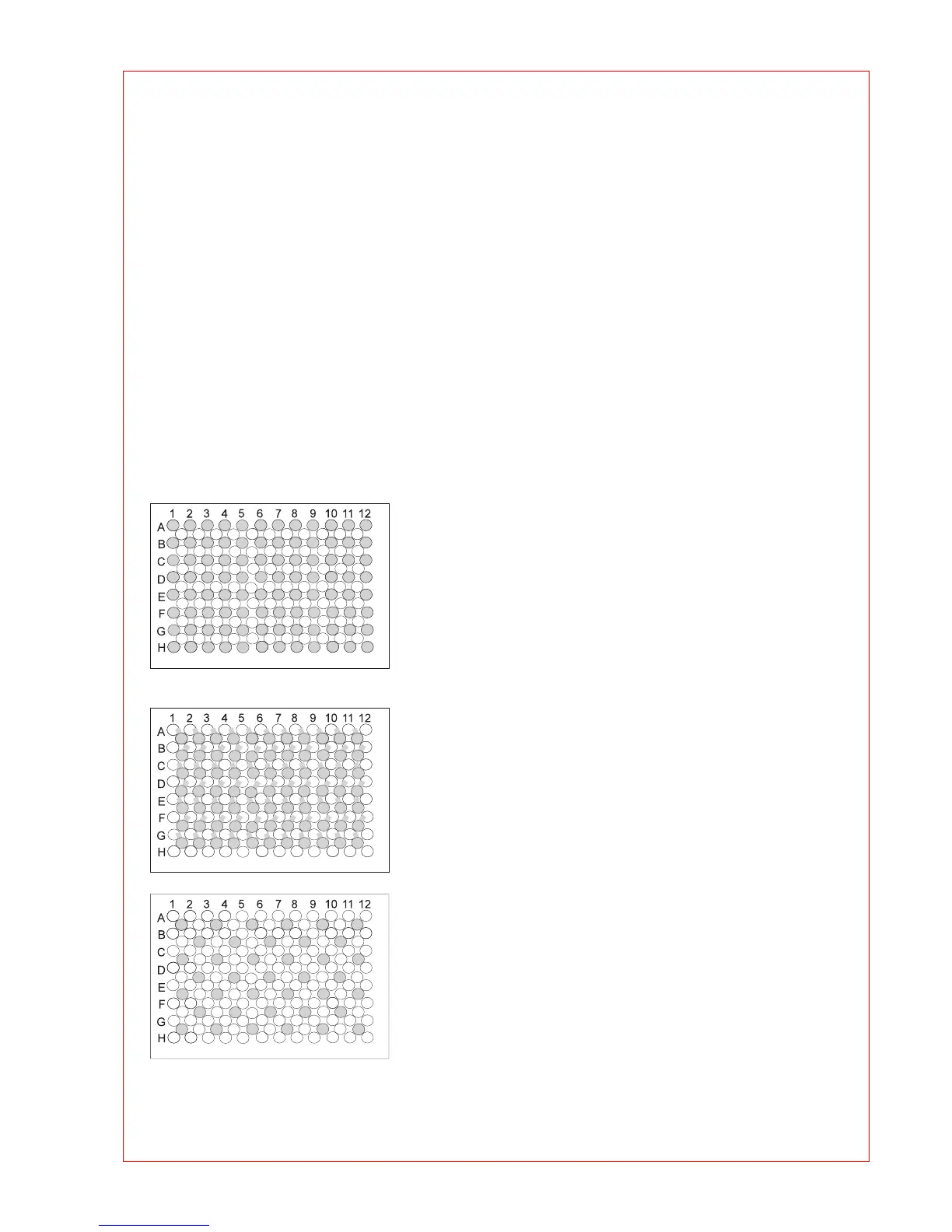
The thermoblock has 96 narrow positions for 0.2 ml test tubes and microtiter plates and 77 wide positions for
0.5 ml test tubes. To enable the maximum possible number of 0.5 ml test tubes to be inserted into the
thermoblock, the tubes must be positioned in rows. In addition, in order to ensure that the heated lid is closed
evenly, it is strongly recommended to position a tube in each corner of the thermoblock. Loading should be
carried out as follows:
96 x 0.2 ml PCR test tubes
or
microtiter plates (8x12)
(PCR plate 96)
77 x 0.5 ml thin-walled PCR test tubes
(special tube from Eppendorf)
39 x 0.5 ml Eppendorf Safe-Lock micro test tubes
0.5 ml test tubes with wide lid
(e.g. 0.5 ml Eppendorf micro test tubes)
should be loaded in a staggered way
in situ
reactions require the
in situ
Adapter. With the aid of the "pegs" on the base, the metal carrier for a
maximum of four glass slides is inserted into the 0.5 ml positions of the thermoblock.
6 Operation



 To Next Page