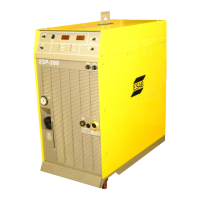
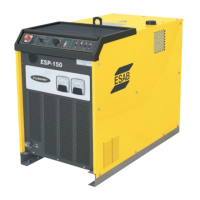
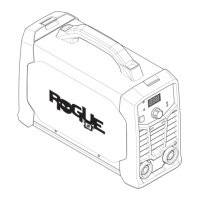
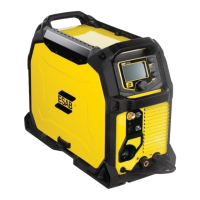
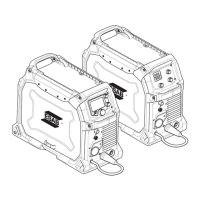
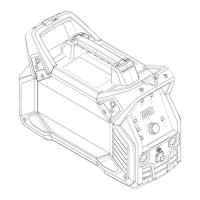
The ESAB EASY-WELD SSR 400/600 is a fully thyristorised MMA (Manual Metal Arc) welding rectifier, designed for robust and reliable welding operations. This instruction manual provides comprehensive guidance for the installation, operation, and maintenance of both the SSR 400 and SSR 600 models, ensuring safe and efficient use of the equipment.
Function Description
The EASY-WELD SSR 400/600 serves as a fully thyristorised MMA welding power source. It converts AC input power into a stable DC output, which is essential for arc welding. The thyristor control allows for precise and stepless adjustment of the welding current, providing excellent arc characteristics and control for various welding applications. The unit is designed to deliver a consistent welding current, making it suitable for a wide range of electrodes and materials. It features an open circuit voltage (OCV) and is capable of operating at different duty cycles, ensuring its suitability for both light and heavy-duty welding tasks. The forced air cooling system helps maintain optimal operating temperatures, contributing to the longevity and reliability of the internal components.
Usage Features
The EASY-WELD SSR 400/600 is engineered for user-friendly operation and offers several features to enhance the welding experience:
- Current Adjustment: The welding current can be adjusted either directly from the front panel of the power source using a current control potentiometer or remotely via an optional Remote Control Unit (RCU). This flexibility allows operators to fine-tune the current settings based on the specific welding requirements and working conditions. For precise current setting, an ammeter is mounted on the front panel.
- Voltage/Current Display: The front panel includes a meter that can display either the output DC welding current or the output DC voltage. A dedicated Amps/Volts switch allows the operator to toggle between these readings, providing immediate feedback on the welding parameters. The meter automatically reverts to displaying amps when the switch is released.
- Remote Control Capability: For applications requiring adjustments from a distance, the unit supports a remote controller. By setting the local/remote switch to "remote," operators can connect the RCU and adjust the welding current conveniently from the operation point, even under load conditions. The RCU's graduations serve as a guideline, with the front panel meter providing accurate output current readings after striking an experimental arc.
- Safety Features: The equipment incorporates safety mechanisms such as an automatic shutdown if the unit is overloaded, indicated by a glowing "WARN LAMP." This feature protects the equipment from damage due to excessive current or duty cycle. The manual emphasizes the importance of proper grounding, insulation, and the use of personal safety equipment to prevent electric shock, arc rays, fumes, and fire hazards.
- Installation Flexibility: The power source is designed for installation in various environments, with recommendations for avoiding moisture, dust, direct sunlight, and rain. It requires adequate ventilation, especially in smaller workspaces, to ensure efficient cooling and safe operation. The unit's robust construction and clear installation guidelines contribute to its adaptability in different industrial settings.
- Electrode Compatibility: The fully thyristorised design ensures compatibility with a broad range of MMA electrodes, allowing operators to select the most appropriate electrode for their specific welding tasks, whether it's for general fabrication, repair, or specialized applications.
Maintenance Features
Regular maintenance and inspection are crucial for ensuring the long-term performance and safety of the EASY-WELD SSR 400/600. The manual outlines a detailed maintenance schedule and specific checks:
- Scheduled Inspections: Inspections should be carried out every 3-6 months, depending on the operational frequency. Key areas to check include the fuse box for loose connections or damage, input and output terminals for proper tightening and insulation, and the line contactor for abrasion at contact points.
- Internal Cleaning: The internal components, particularly inside the power source, should be checked for sedimentation of dust. Dry compressed air is recommended for blowing out accumulated dust, which can impair cooling and lead to overheating.
- Wiring and Cable Integrity: Traces of overheating or damage to cables and wiring should be identified. Damaged sections must be repaired or insulated properly, and severely damaged wires or cables should be replaced to prevent electrical hazards and ensure reliable current flow.
- High Voltage Test & Insulation Resistance Measurement: Special precautions are advised when performing high voltage tests and insulation resistance measurements due to the presence of sensitive thyristors and semiconductor parts. The manual provides a step-by-step procedure, including disconnecting input and output cables, short-circuiting terminals, and removing ground conductors, to prevent damage to the unit during these tests. Only a 500 V DC Megger should be used for insulation resistance measurement.
- Fault Finding Guide: A comprehensive fault-finding table is provided, listing common abnormal conditions, their probable causes, and recommended remedies. This guide helps operators and technicians quickly diagnose and resolve issues such as welding stopping automatically, current adjustment not working, fan malfunction, unstable arc, or erratic welding current output.
- PCB Check Points: The manual includes detailed check points for the Control PCB (ZMAT/D-70M for SSR 400, ZMAT/D-720 for SSR 600) and Firing PCB (ZMAT/D-110). These points specify DC voltage values to be measured with a digital multimeter at various potentiometer positions, aiding in the diagnosis of electronic control issues. These checks should be performed under "NO LOAD" conditions with a stable 415 Volts, 3-phase, 50 Hz AC supply.
- Spares List: A recommended spares list is included, detailing essential components like fuses, PCBs, transformers, SCR modules, and potentiometers, along with suggested quantities for 1-5 units and 5+ units. This ensures that critical parts are readily available for timely repairs, minimizing downtime.
- Weld Defects and Causes: A table outlining common weld defects and their possible causes (e.g., excessive convexity, undercut, porosity, cracks) helps operators understand how operational parameters and techniques influence weld quality, enabling them to adjust their approach for better results.
By adhering to these guidelines, users can ensure the safe, efficient, and extended operation of their ESAB EASY-WELD SSR 400/600 welding rectifier.

 Need help?
 General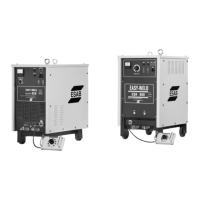

 To Next Page