EasyManua.ls Logo

ESI 250-DA - Understanding Series and Parallel Inductance

ESI 250-DA
75 pages
Print Icon
To Next Page IconTo Next Page
To Previous Page IconTo Previous Page
Loading...
2,
3.
2
SERIES
AND
PARALLEL
INDUCTANCE
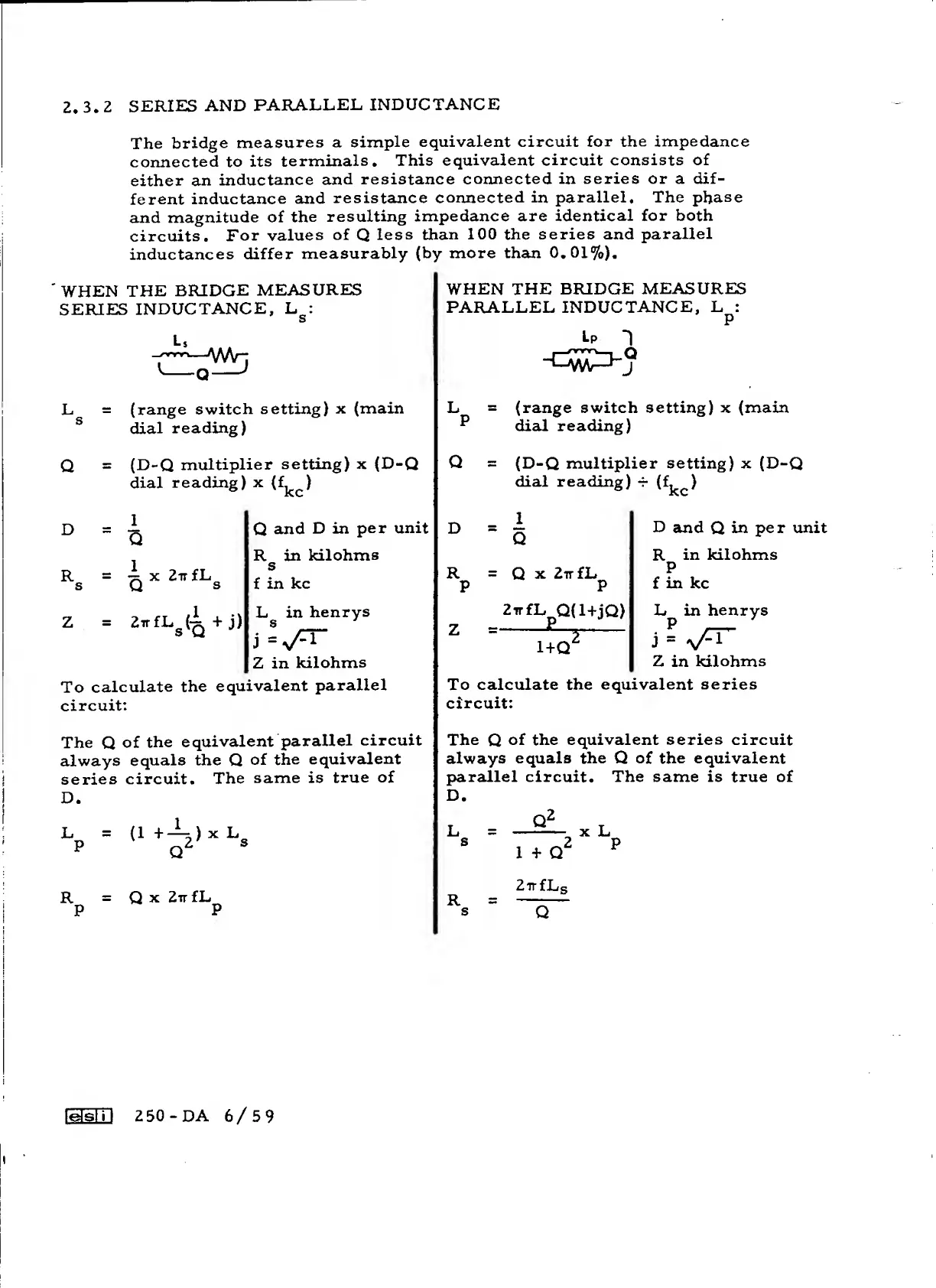
The
bridge
measures
a
simple
equivalent circuit
for the impedance
connected to
its
terminals.
This
equivalent circuit
consists of
either
an
inductance
and
resistance
connected in
series or a dif-
ferent
inductance
auid
resistance
connected in
parallel. The
phase
and
magnitude
of
the
resulting
impedance are
identical
for both
circuits.
For values
of
Q
less than
100
the
series and
parallel
inductances
differ
measurably
(by more than
0.01%),
WHEN
THE
BRIDGE
MEASURES
SERIES
INDUCTANCE,
L^:
Ls
V
Q
J
L
=
(range
switch
setting)
x (main
®
dial
reading
)
Q
=
(D-Q
multiplier
setting) x (D-Q
dial
reading)
x (fj^^)
D
R
I
Z
1
Q
•pz X 2it
fL
Q
s
2irfL^(i
+
j)
Q
and
D in
per unit
R
in
kilohms
s
f
in
kc
L^ in
henrys
Z in
kilohms
To
calculate
the
equivalent
parallel
circuit:
The
Q
of
the
equivalent
parallel
circuit
always
equals the
Q
of the
equivalent
series
circuit.
The
same is
true of
D.
%
=
R
=
Q
X
2ir
fL
P
P
WHEN
THE BRIDGE
MEASURES
IDl
Lp
PARALLEL INDUCTANCE,
L :
P
Q
-
(range switch setting) x (main
dial reading)
(D-Q multiplier setting) x (D-Q
dial reading) *r (fj^^)
D
=
~
R
=
Q
X 2irfL
P
P
2irfL
Q(l+jQ)
T
E_^
1+Q
D
and
Q
in per unit
R
in kilohms
P
f in kc
L in henrys
j
=
Z in
kilohms
To
calculate the
equivalent series
circuit:
The
Q
of the equivalent
series
circuit
always
equals the
Q
of the equivalent
parallel circuit. The same is true of
D.
L
=
X L
*
1
+
q2
p
ZirfLc
R
=
r
lelsl i \
250
-DA
6/5
9

Related product manuals