EasyManua.ls Logo

ESI 250-DA - Considerations for Capacitor Measurements

ESI 250-DA
75 pages
Print Icon
To Next Page IconTo Next Page
To Previous Page IconTo Previous Page
Loading...
2.4.
3
THINGS
TO
WATCH
OUT
FOR
2. 4.
3. 1
LOW
CAPACITANCE
MEASUREMENTS
In
making
low
capacitance
measurements
,
there
are
two
things
to
watch out
for:
1,
Be
careful
to
avoid
hum
pickup.
2,
Keep
the
stray
capacitance
to
a
minimum.
'j’o
minimize
both
effects
y
keep
your
hands
as
far
as
possible
from
the
capacitor
being
measured.
Keep
the
leads
as
short
and
direct
as
possible.
If
extended
leads
are
neces-
sary,
the
lead
from
the
LO
terminal
should
be shielded.
See
section
2.4.6,
"Extended
Leads".
The D
and
Q
readings
on
the
lowest
C
range
will
be
in
error
as
indicated
in the
specifications
because
of
the
residual
capacitance
of
the
range
resistor. If
accurate
D or
Q
readings
are
needed
the
next
highest C
range
can
be
used.
The
C
readings
on
the
low
range
are
accurate.
2. 4.
3. 2
HIGH
CAPACITANCE
MEASUREMENTS
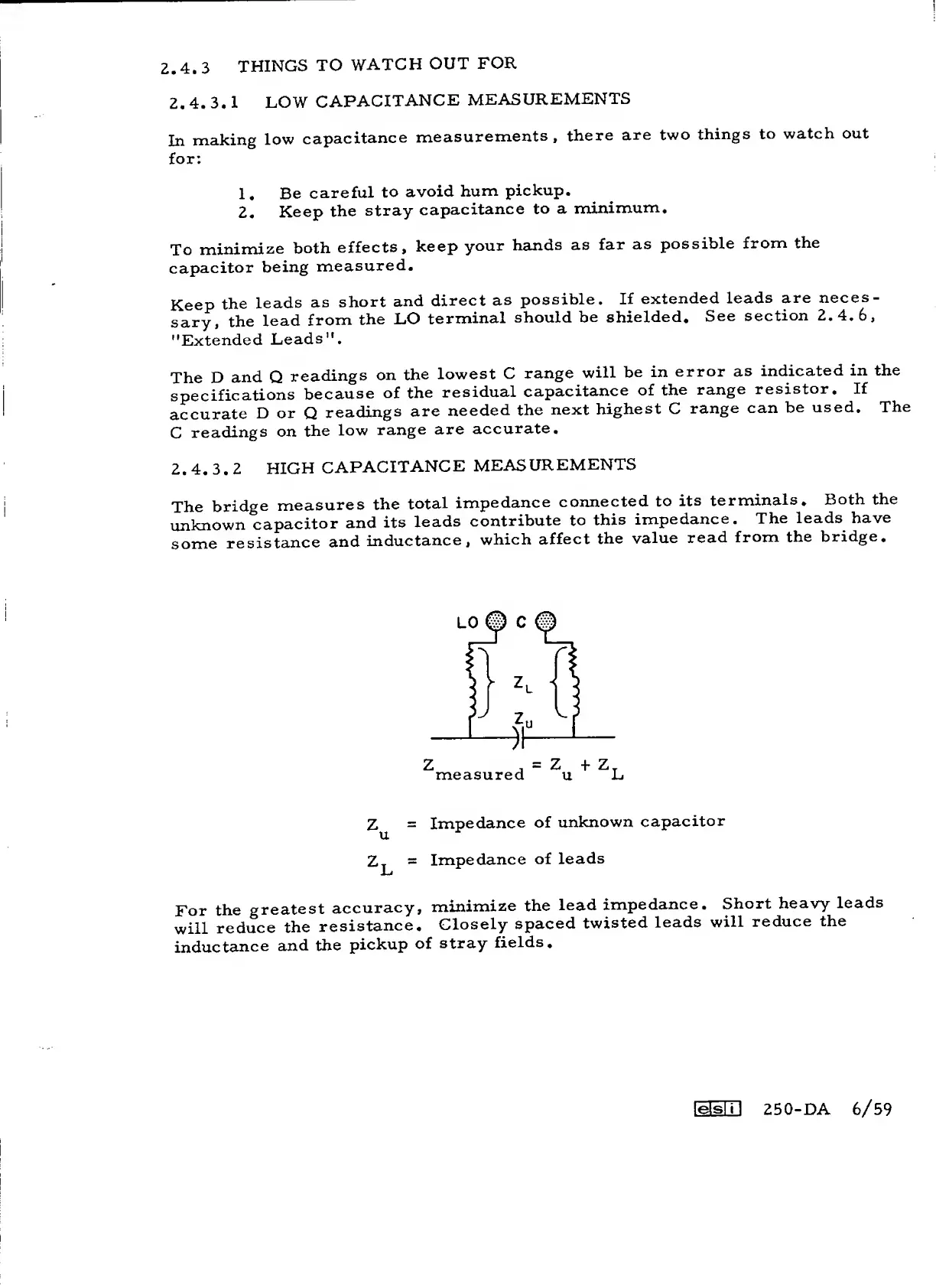
The
bridge
measures
the
total
impedance
connected
to
its
terminals.
Both
the
unknown
capacitor
and
its
leads
contribute
to
this
impedance.
The
leads
have
some
resistance
and
inductance,
which
affect
the
value
read
from
the
bridge.
Z
= Impedance
of
unknown
capacitor
u
Zj
=
Impedance
of
leads
For
the
greatest
accuracy,
minimize
the
lead
impedance.
Short
heavy
leads
will
reduce
the
resistance.
Closely
spaced
twisted
leads
will
reduce
the
inductance
and
the
pickup
of
stray
fields.
leisi
i
I
250-DA
6/59

Related product manuals