EasyManua.ls Logo

ESI 250-DA - Understanding and Resolving Sliding Balance in Capacitance Measurements

ESI 250-DA
75 pages
Print Icon
To Next Page IconTo Next Page
To Previous Page IconTo Previous Page
Loading...
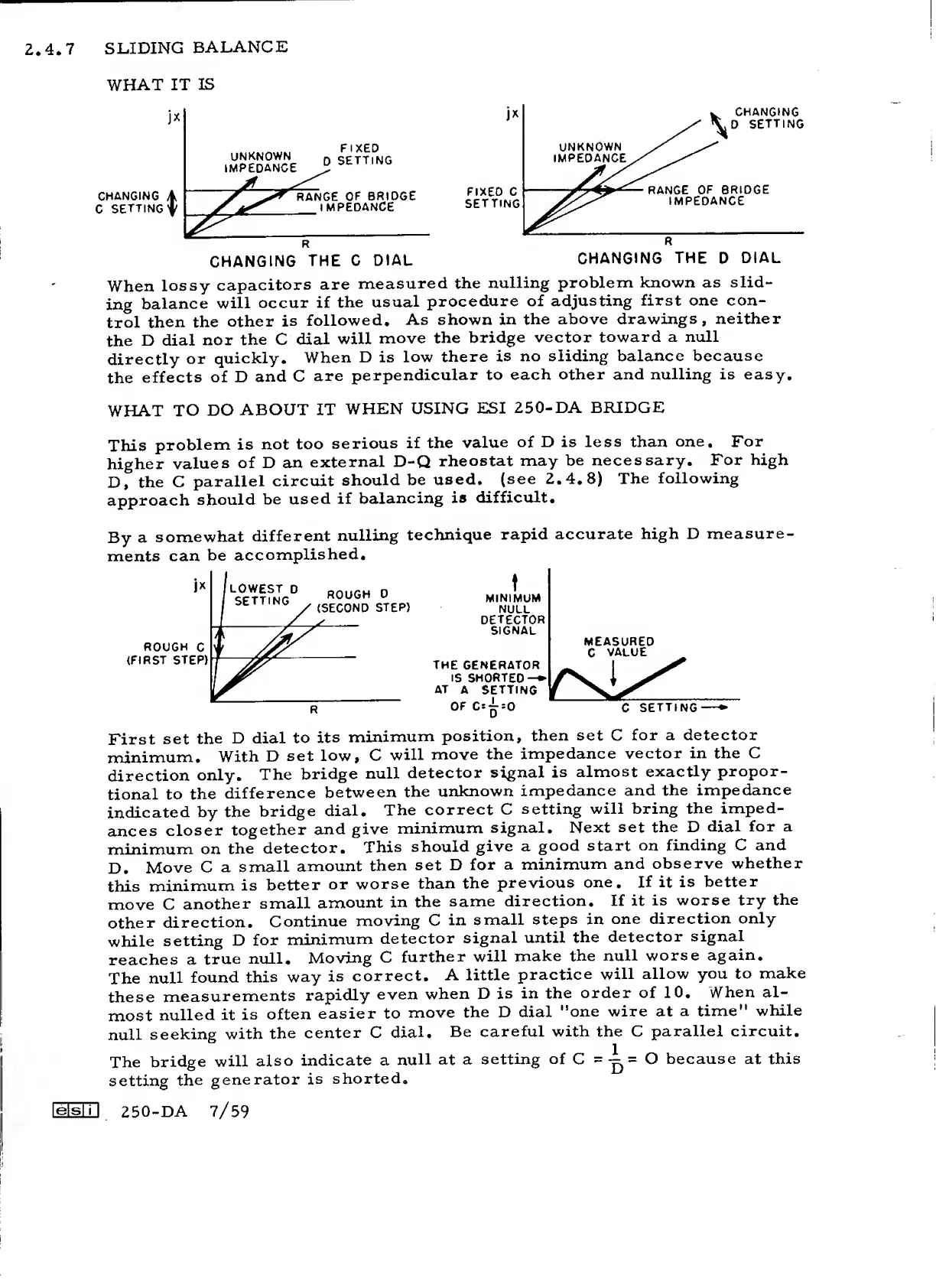
2.4.7
SLIDING
BALANCE
WHAT
IT
IS
u
FIXED
unknown
d
setting
impedance
J;
CHANGING
A
X
RANGE
OF
BRIDGE
C
SETTING
I'
impedance
R
CHANGING
THE
C
DIAL
CHANGING
THE
D
DIAL
When
lossy
capacitors
are
measured
the
nulling problem
known as
slid-
ing
balance
will
occur
if
the
usual
procedure
of
adjusting
first one con-
trol
then
the
other
is
followed.
As shown in
the above
drawings,
neither
the
D dial
nor
the
C
dial
will
move
the
bridge
vector
toward
a null
directly
or
quickly.
When D
is
low there
is
no sliding balance
because
the
effects
of D
and C
are
perpendicular
to each
other and nulling
is easy.
WHAT
TO
DO
ABOUT IT
WHEN
USING
ESI
250- DA BRIDGE
This
problem
is
not
too
serious
if the
value
of
D is less than
one. For
higher
values
of D an
external
D-Q
rheostat
may
be
necessary. For
high
D,
the
C
parallel
circuit
should
be
used,
(see
2.4.8)
The
following
approach
should
be
used
if
balancing
is
difficult.
By a
somewhat
different
nulling
technique
rapid
accurate
high D
measure-
ments
can
be
accomplished.
First
set
the
D dial
to
its
minimum
position,
then set C
for a detector
minimum.
With
D
set
low,
C
will
move
the
impedance
vector
in the C
direction
only.
The
bridge
null
detector
signal
is
almost
exactly
propor-
tional to
the
difference
between
the
unknown
impedance and
the impedance
indicated
by the
bridge
dial.
The
correct
C
setting
will bring
the
imped-
ances
closer
together
and
give
minimum
signal.
Next
set the D
dial
for a
minimum
on
the
detector.
This
should
give a
good start
on finding
C
and
D.
Move C
a
small
amount
then
set D for
a
minimum
and
observe
whether
this
minimum
is
better
or
worse
than
the
previous
one. If it
is
better
move C
another
small
amount
in
the
same
direction.
If it
is worse
try
the
other
direction.
Continue
moving C
in
small
steps in
one
direction
only
while
setting
D
for
minimum
detector
signal until
the
detector
signal
reaches
a
true
null.
Moving
C
further
will
make
the
null
worse
again.
The
null
found
this
way
is
correct.
A
little
practice
will
allow
you to
make
these
measurements
rapidly
even
when D
is
in the
order of 10,
When al-
most
nulled
it
is
often
easier to
move
the
D
dial
"one wire at
a time"
while
null
seeking
with
the
center
C
dial.
Be
careful with the C
parallel circuit.
The
bridge
will
also
indicate
a
null at
a
setting
of
C
=
i
=
O because at
this
setting
the
generator
is
shorted.
felHTI
250-DA
7/59

Related product manuals