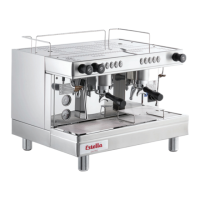
This document is a user manual for Estella CAFFE Espresso Machines, specifically covering models 236ECEM1, 236ECEM2, and 236ECEM3. It provides comprehensive information on the operation, maintenance, and safety of these commercial espresso machines.
Function Description:
The Estella CAFFE Espresso Machines are designed for brewing espresso and dispensing hot water and steam. They feature automatic water refilling, pressure-controlled heating, and programmable output volumes for consistent coffee preparation. The machines are equipped with multiple brewing groups, steam wands, and hot water wands to cater to different operational needs, from single-group to three-group setups. The automatic reverse flushing system facilitates daily cleaning of the brewing groups.
Important Technical Specifications:
The manual details the specifications for three models:
- 236ECEM1 (1 Group):
- Boiler Capacity: 6 Qt.
- Voltage: 110-120V
- Wattage: 2000W
- Weight: 97 Lb.
- Recommended circuit amperage: 20A
- Dimensions (WxDxH): 19½" x 21" x 22"
- 236ECEM2 (2 Group):
- Boiler Capacity: 13 Qt.
- Voltage: 220-240V
- Wattage: 4700W
- Weight: 141 Lb.
- Recommended circuit amperage: 30A
- Dimensions (WxDxH): 27½" x 21" x 22"
- 236ECEM3 (3 Group):
- Boiler Capacity: 19 Qt.
- Voltage: 220-240V
- Wattage: 6500W
- Weight: 179 Lb.
- Recommended circuit amperage: 50A
- Dimensions (WxDxH): 37" x 21" x 22"
All models require a cold water connection and are hardwired (no plug), necessitating installation by a qualified electrician and technician. Water quality is critical for warranty validity and machine longevity, with specific requirements: Total Dissolved Solids (50-125 PPM), Total Hardness (3-5 GPG), pH (6.5-7.5), Free Chlorine (Max 0.5 PPM), and Total Chlorine (Max 0.5 PPM). The machines are NSF and ETL listed, ensuring compliance with safety and sanitation standards.
Usage Features:
- Startup: Before operation, users must confirm the water source is active, turn the power switch to ON, and wait for automatic water replenishment and boiler heating to reach approximately 1.2 bars of pressure. The machine will not operate until the steam pressure gauge is in the green zone.
- Output Volume and Frequency Setup: The machines allow for manual programming of coffee output settings. For multi-cup models, settings made on the farthest right-hand button suite serve as defaults for other groups. Users can program output buttons by pressing and holding until the desired volume is reached, with a continuous flow option available on the fifth button of each group head.
- Brewing: The brewing process involves filling and tamping coffee grounds into the portafilter, securing it to the machine, and then using either preset buttons or the continuous flow button to brew.
- Automatic Reverse Flushing: This feature is recommended daily. It is initiated by simultaneously pressing the first and fifth buttons, starting a 10-cycle cleaning process from the right output system to the left. The process can be stopped prematurely by pressing button 3, or skipped to the next output system.
- Stopping the Machine: After cleaning, all liquids and solids should be removed from the water tray. The machine should be powered off, and the steam knob opened to release steam pressure, preventing system contamination.
Maintenance Features:
- Machine Body: The exterior should be wiped daily with a soft, damp cloth. A mild, non-corrosive cleaning agent can be used, but direct spraying on the machine body should be avoided to prevent corrosion and circuit damage.
- Brewing System: After each brewing cycle, the handle should be removed, and the manual water output button pressed to clear residual coffee grounds. The handle should then be re-fixed without excessive force. Daily reverse flushing of the steam outlet is recommended. For deeper cleaning, the copper plate and filter element should be removed, and a reverse flushing silica plate with detergent used in the filter cup. The manual water output button is used to dissolve and flush detergent, cleaning the gasket and brewer interior. Components should be rinsed and reassembled.
- Filter Basket & Basket Handle: The handle should be rinsed with hot water after each brewing cycle to remove residual oils. For thorough cleaning, the filter basket and handle (excluding plastic parts) can be disassembled and immersed in a cleaning solution (3 tsp detergent in 1 pint hot water) for 24 hours to dissolve coffee oils. All components must be rinsed with clean water and wiped with a soft cloth.
- Steam Tube: After steaming milk, the tube should be wiped with a damp cloth, and a steam burst released to clear residuals. Hardened milk residuals may require disassembling and immersing the tube in hot water for 20 minutes.
- Water Tray & Discharge Trough: The water tray should be removed and washed after stopping the machine. Sediments in the discharge trough should be wiped with a wet cloth, and the discharge tube cleared with hot water. If water discharge is poor, a teaspoon of detergent can be used with hot water to dissolve oils. The drain is for liquids only; solids like coffee grounds should not be put down it.
- Boiler: To extend boiler life during periods of inactivity, the machine should be turned off, and the steam output opened to discharge pressure until the gauge reads zero. The water tray and discharge trough should then be emptied and cleaned. The steam output should remain open until hot water drips from the steam tube after restarting. A service professional should delime the unit every 6 months.
- Filter: The manufacturer recommends replacing the filter element on the resin exchange filter after processing 53 gallons of water (approximately 3,000-4,000 cups of coffee), though this schedule may vary based on water quality.
The manual emphasizes the importance of using a grounded power source, proper installation by qualified personnel, and adherence to maintenance instructions to ensure safety, optimal performance, and warranty validity. Damage caused by frozen water, improper installation, or poor water conditions is not covered under warranty.

 Need help?
 General

 To Next Page