34
Operation
• Never follow directly behind another boat while
pulling skiers. Always stay a safe distance
behind or off the side of other boat trafc. If
the boat you are following stops unexpectedly,
you may not be able to respond quick enough
endangering your skier and occupants of both
boats.
• Never follow behind another boat pulling a
skier for any reason, even if you are not pull-
ing a skier. If the skier you are following falls,
you may not be able to respond quick enough
and could run over the skier.
• When pulling multiple skiers, make sure the
ropes are the same length. Never pull multiple
skiers with tow ropes of different lengths.
• Always make sure to slowly pull the slack out of
the ski rope and wait for the OK from the skier
before advancing the throttle to ensure the
rope is not wrapped around the skier and that
the skier is ready. Never advance the throttle
until the skier provides the ready signal.
• When turning around to pick up a fallen skier,
make sure to look for other boat trafc in the
direction of the turn before you turn the boat.
• Approach a skier in the water from the down-
wind side and be certain to stop the motion
of the boat and your motor before coming in
close proximity to the skier.
• Give immediate attention to a fallen skier. A
fallen skier is very hard to see by other boats
and is extremely vulnerable. When a skier
falls, be prepared to immediately turn the boat
and return to the skier.
• Never leave a fallen skier alone in the water
for any reason and have an observer display
a skier down ag to alert other boaters that
your skier has fallen.
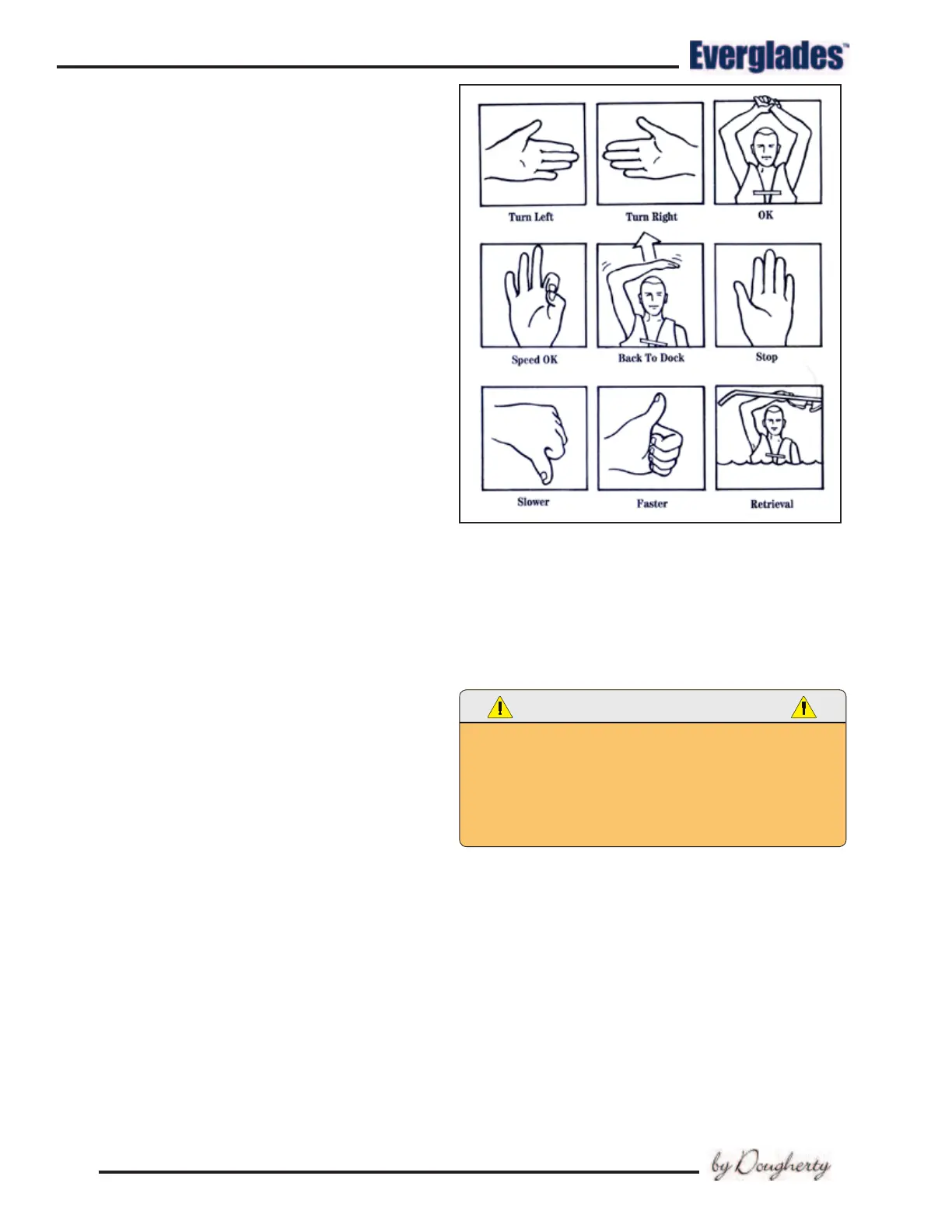
• Agree on hand signals to be used between the
observer and skier to communicate. This is
important to eliminate confusion and ensure
the safety of your skiers, wakeboarders or
tubers. Refer the Hand Signals drawing in this
section for signals that are commonly used
during water sports activities.
• Make sure the observer watches for the skier’s
signal to indicate he or she is OK. If the signal
is not seen immediately, assume the skier is
injured and in need of immediate assistance.
Be prepared to respond quickly.
For additional information on water skiing, includ-
ing hand signals and water skiing manuals, contact
the American Water Skiing Association in Winter
Haven, Florida, 813-324-4341.
MOVING PROPELLERS ARE DANGEROUS. THEY CAN CAUSE
DEATH, LOSS OF LIMBS OR OTHER SEVERE INJURY. DO NOT
USE THE SWIM PLATFORM OR SWIM LADDER WHILE THE
ENGINE IS RUNNING. STOP THE ENGINE IF DIVERS, SWIMMERS
OR SKIERS ARE ATTEMPTING TO BOARD. ALWAYS PROPERLY
STORE THE LADDER BEFORE STARTING THE ENGINE.
2.14 Teak Surng
Teak Surng is a new and dangerous boating
fad that involves an individual holding on to the
swim platform of a vessel while a wake builds up
then lets go to body surf the wave created by the
boat; hence the term “Teak Surng.” This activ-
ity puts that individual directly in the path of the
boat’s exhaust and poisonous carbon monoxide.
Because of the multiple dangers associated with
teak surng and the carbon monoxide problem
in particular, the Coast Guard has issued a safety
alert that strongly advises the public not to en-
Common Hand Signals for Water Sports Activities



 To Next Page