EasyManua.ls Logo

Everglades CC 243 2012 - User Manual

Everglades CC 243 2012
128 pages
Print Icon
To Next Page IconTo Next Page
Loading...
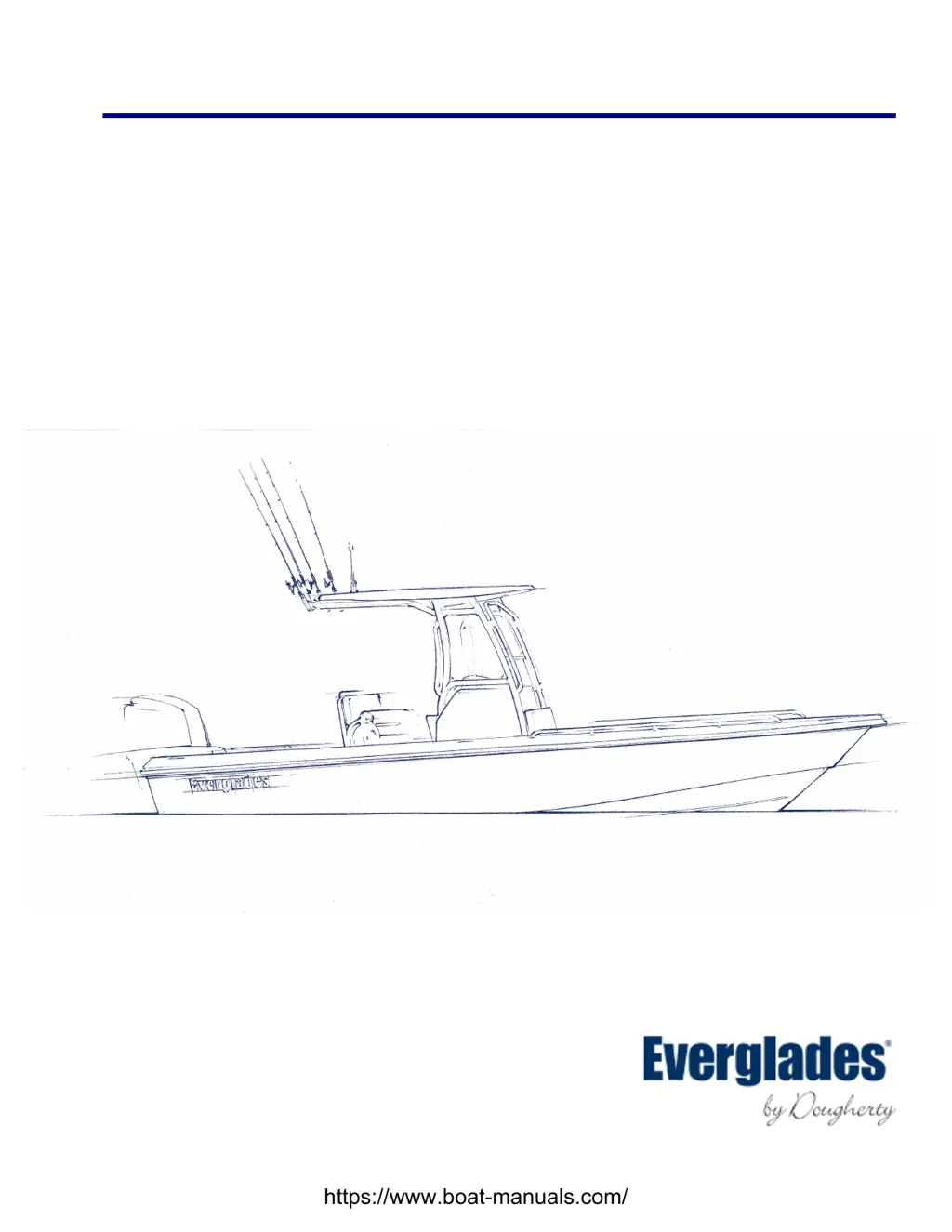
OWNER’S MANUAL
2012
223 CC
243 CC
https://www.boat-manuals.com/

Table of Contents

Questions and Answers

Summary

SAFETY INFORMATION

BOAT INFORMATION

SPECIFICATIONS

223 Center Console Specifications

Details the technical specifications for the 223 Center Console model, including dimensions and capacities.

243 Center Console Specifications

Details the technical specifications for the 243 Center Console model, including dimensions and capacities.

CERTIFICATIONS & SPECIFICATIONS

223 Center Console Export Documentation

Export compliance information for the 223 Center Console model.

243 Center Console Export Documentation

Export compliance information for the 243 Center Console model.

INTRODUCTION & IMPORTANT INFORMATION

OWNER; OPERATOR INFORMATION

Chapter 1: SAFETY EQUIPMENT

1.1 General

General overview of safety equipment and U.S. Coast Guard standards.

1.2 Engine Alarms

Explains the function and response to engine alarm systems.

1.3 Neutral Safety Switch

Details the neutral safety switch for engine starting.

1.4 Engine Stop Switch

Describes the engine stop switch and lanyard safety usage.

1.5 Required Safety Equipment

Lists essential safety equipment mandated by the U.S. Coast Guard.

1.6 Bilge and Fuel Fires

Critical safety procedures for handling bilge and fuel fires.

1.7 First Aid

Outlines first aid responsibilities, kit recommendations, and emergency actions.

1.8 Additional Safety Equipment

Discusses optional but recommended safety equipment.

1.9 Caution and Warning Labels

Identifies common caution and warning labels on the boat.

Chapter 2: OPERATION

2.1 General

Covers pre-operation checks, safety, and general operating responsibilities.

2.2 Rules of the Road

Explains basic navigation rules for crossing, meeting, and overtaking.

2.3 Pre-Cruise Check

Detailed checklist of essential pre-departure inspections for safe operation.

2.4 Operating Your Boat

Guides on starting the engine, safe operation, and understanding boat limitations.

2.5 Docking, Anchoring and Mooring

Covers techniques for safely maneuvering, docking, anchoring, and mooring.

2.6 Controls, Steering or Propulsion System Failure

Outlines procedures for critical system failures during operation.

2.7 Collision

Details immediate actions and inspection requirements following a collision.

2.8 Grounding, Towing and Rendering Assistance

Explains procedures for freeing a grounded vessel and assisting others.

2.9 Flooding or Capsizing

Provides guidance for dealing with boat flooding or capsizing.

2.10 Fishing

Offers brief advice on operating the boat safely while fishing.

2.11 243 Center Console Crow’s Nest (Optional)

Describes the optional Crow's Nest and its safety precautions.

2.12 Man Overboard

Details procedures for recovering a person who has fallen overboard.

2.13 Water Skiing and Wakeboarding

Provides safety precautions for towing water skiers and wakeboarders.

2.14 Teak Surfing

Warns against the dangerous practice of teak surfing.

2.15 Trash Disposal

Outlines regulations and practices for trash and waste disposal.

2.16 Trailering Your Boat

Guides on selecting the correct trailer and safely trailering the boat.

Chapter 3: PROPULSION SYSTEM

3.1 General

Introduction to the outboard engine, oil system, and owner's manual importance.

3.2 Drive System Corrosion

Explains marine growth, galvanic corrosion, and sacrificial anodes.

3.3 Engine Lubrication

Details engine lubrication requirements, oil checks, and recommended types.

3.4 Engine Cooling System

Describes the raw water cooling system and water pump operation.

3.5 Propellers

Explains propeller types, identification, and the importance of repair.

3.6 Performance Issues and Propellers

Discusses how propeller selection affects performance and potential engine damage.

3.7 Engine Instrumentation

Covers gauges and indicators for monitoring engine status.

Chapter 4: HELM CONTROL SYSTEMS

4.1 General

Overview of helm control systems: throttle, steering, and trim tabs.

4.2 Engine Throttle and Shift Controls

Details cable and electronic throttle/shift controls and their operation.

4.3 Neutral Safety Switch

Explains the function of the neutral safety switch and how to test it.

4.4 Engine Power Tilt and Trim

Describes the tilt and trim feature, its operation, and associated precautions.

4.5 Engine Stop Switch

Explains the engine stop switch and lanyard usage for safety.

4.6 Hydraulic Jack Plate (Optional)

Discusses the optional hydraulic jack plate and adjustment precautions.

4.7 Steering System

Details the hydraulic steering system, its components, and operation.

4.8 Trim Tabs

Explains the operation and adjustment of trim tabs for hull attitude control.

4.9 Control Systems Maintenance

Covers periodic inspection and maintenance of control systems, steering, and trim tabs.

Chapter 5: FUEL SYSTEM

5.1 General

Overview of the fuel system design, inspection, and safety precautions.

5.2 Outboard Fuel System

Describes the fuel tank, withdrawal line, and fuel filter maintenance.

5.3 Fueling Instructions

Detailed steps and safety warnings for fueling the boat.

5.4 Fuel System Maintenance

Outlines routine maintenance for fuel system components.

Chapter 6: ELECTRICAL SYSTEM

6.1 General

Introduction to the 12-volt DC electrical system and trolling motor system.

6.2 Boat DC System Overview

Explains the 12-volt DC system, battery setup, and circuit panels.

6.3 Batteries and Battery Switch

Details battery types, selection, and the function of the battery selector switch.

6.4 Switch and Circuit Breaker Panels

Describes ignition and accessory switch panels, their layout, and function.

6.5 36-Volt Trolling Motor System

Explains the 36-volt system for trolling motors, including batteries and charger.

6.6 Bonding System

Describes the bonding system and sacrificial anodes for corrosion protection.

6.7 Electrical System Maintenance

Covers maintenance for the DC electrical system, battery care, and wiring.

Chapter 7: FRESH WATER SYSTEM (OPTIONAL)

7.1 General

Overview of fresh water system components: tank, pump, and lines.

7.2 Fresh Water System Operation

Guides on filling the tank, priming the pump, and system operation.

7.3 Fresh Water System Maintenance

Details routine maintenance for the fresh water system, including strainer and pump care.

Chapter 8: RAW WATER SYSTEM

8.1 General

Introduces raw water systems, pump mounting, and seacock valve operation.

8.2 Raw Water System Operation

Explains the operation of the raw water pump and strainer maintenance.

8.3 Baitwell

Describes the baitwell system, pump activation, and water level control.

8.4 Raw Water System Maintenance

Outlines routine maintenance for the raw water system, including hose and valve checks.

Chapter 9: DRAINAGE SYSTEMS

9.1 General

Explains how water drains from the boat via thru-hull fittings.

9.2 Cockpit Sole Drains

Describes the scupper drains in the cockpit and their check valves.

9.3 Hardtop Drains

Mentions drain holes in the hardtop frame to prevent water trapping.

9.4 Bilge Drainage

Explains the bilge pump system, manual and automatic activation.

9.5 Fishbox, Baitwell and Storage Compartment Drains

Details drainage for fishboxes, baitwells, and storage compartments.

9.6 Cockpit and Anchor Locker Drains

Covers drainage for cup holders and the anchor locker.

9.7 Drainage System Maintenance

Provides essential periodic maintenance for all drainage systems.

Chapter 10: VENTILATION SYSTEM

10.1 243 Center Console Head Compartment Ventilation

Describes ventilation for the head compartment, including door and vent operation.

10.2 Windshield Ventilation

Explains how to lower the windshield for ventilation and visibility.

10.3 Maintenance

Outlines maintenance procedures for windshield tracks, knobs, and gaskets.

Chapter 11: EXTERIOR EQUIPMENT

11.1 Deck

Covers deck hardware, cleats, and the anchor/rope locker.

11.2 Hull

Discusses the hull structure, engine mounting, and optional jack plate.

11.3 Cockpit Features

Describes various cockpit features like hatches, seats, and access plates.

11.4 223 Center Console Leaning Post and Console

Details the leaning post, console features, and storage compartments.

11.5 243 Center Console Aluminum Leaning Post

Explains the aluminum leaning post, its seating options, and cooler integration.

11.6 Bimini Top (Optional)

Provides instructions for installing and securing the optional Bimini top.

11.7 Hardtop

Describes the standard hardtop, its components, and mounting capabilities.

11.8 243 Center Console Crow’s Nest (Optional)

Details the optional Crow's Nest, its access ladder, and safety precautions.

Chapter 12: INTERIOR EQUIPMENT

12.1 223 Center Console Storage Compartment

Describes the console storage compartment, its access, and ventilation.

12.2 243 Center Console Head Compartment

Covers the head compartment's portable toilet, storage, ventilation, and access hatches.

12.3 Portable Marine Head

Explains the operation, maintenance, and winterizing of the portable marine head.

Chapter 13: ROUTINE MAINTENANCE

13.1 Exterior Hull and Deck

Details hull cleaning, bottom painting, anode maintenance, and stainless steel care.

13.2 Upholstery, Canvas and Enclosures

Guides on cleaning vinyl upholstery, canvas, and enclosures.

13.3 Interior

Covers cleaning of interior surfaces like cabin, woodwork, and countertops.

13.4 Bilge, Pumps and Components

Outlines maintenance for the bilge, pumps, and associated components.

13.5 Drainage System

Provides essential periodic maintenance for all drainage systems.

Chapter 14: SEASONAL MAINTENANCE

14.1 Storage and Lay-up

Details procedures for preparing the boat for storage, including fuel and water systems.

14.2 Winterizing

Provides step-by-step instructions for winterizing all boat systems.

14.3 Recommissioning

Guides on recommissioning the boat after storage and before launching.

Appendix A: SCHEMATICS

Appendix B: GLOSSARY OF TERMS

Appendix C: MAINTENANCE LOG

Maintenance Schedule and Log

Appendix D: BOATING ACCIDENT REPORT

Appendix E: FLOAT PLAN

Appendix F: TROUBLESHOOTING GUIDE

CONTROL SYSTEMS

Lists common problems and solutions for steering and control systems.

PERFORMANCE PROBLEMS

Addresses issues related to sluggish performance, lost speed, and vibration.

ENGINE PROBLEMS

Covers common engine issues like overheating, charging, and RPM problems.

ACCESSORY PROBLEMS

Provides solutions for problems with pumps, switches, and other boat accessories.

Everglades CC 243 2012 Specifications

General IconGeneral
BrandEverglades
ModelCC 243 2012
CategoryBoat
LanguageEnglish

Related product manuals