R410A 60Hz EER 2.36 Series Service Manual
2.Vacuum Dry and Leakage Checking
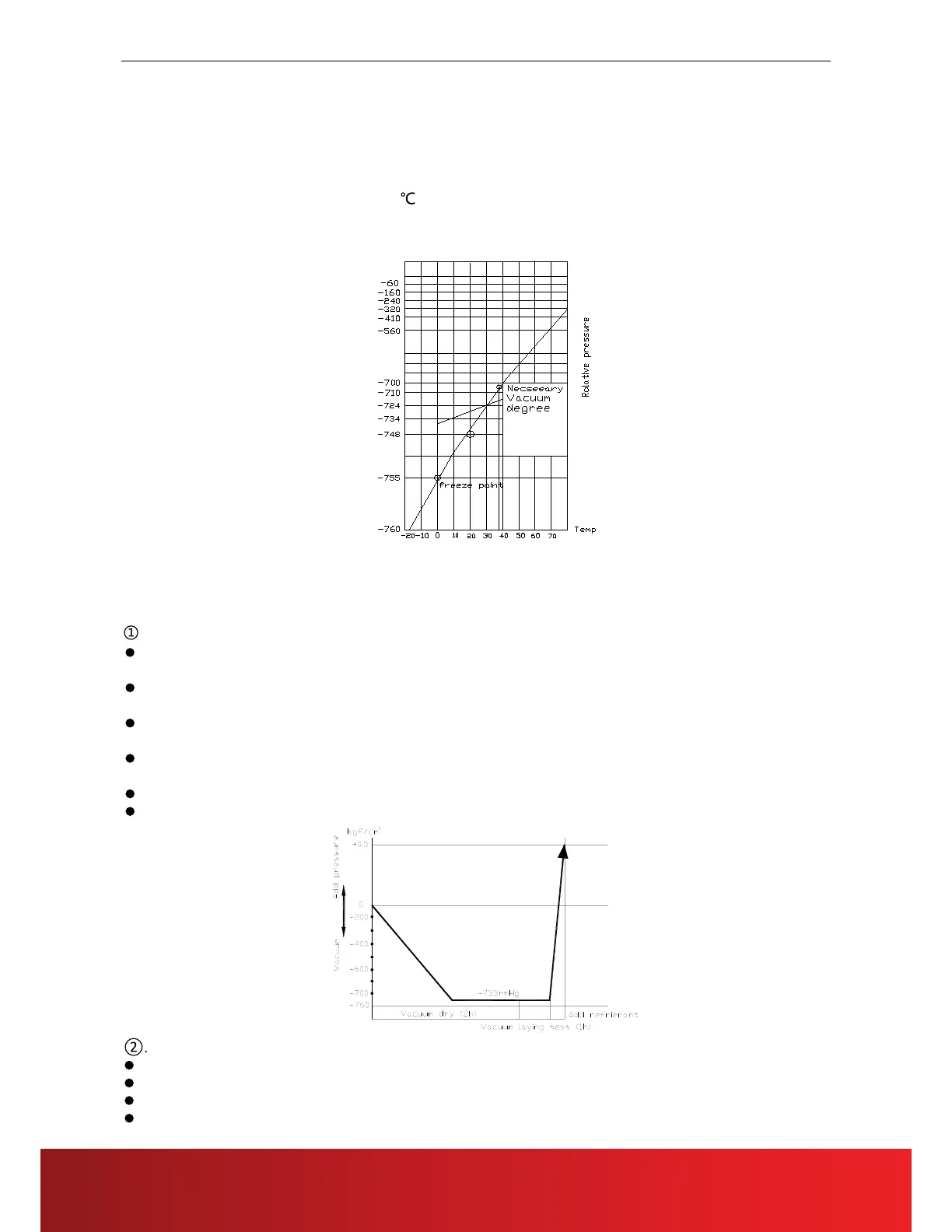
2.1 Vacuum Dry: use vacuum pump to change the moisture (liquid) into steam (gas) in the pipe and
discharge it out of the pipe to make the pipe dry. Under one atmospheric pressure, the boiling point
of water(steam temperature) is 100
. Use vacuum pump to make the pressure in the pipe near
vacuum state, the boiling point of water falls relatively. When it falls under outdoor temperature, the
moisture in the pipe will be vaporized.
2.2 Vacuum dry procedure
There are two methods of vacuum dry due to different construction environment: common vacuum dry,
special vacuum dry.
. Common vacuum dry procedure
Vacuum dry (for the first time)---connect the all-purpose detector to the inlet of liquid pipe and gas
pipe, and run the vacuum pump more than two hours (the vacuum pump should be below -755mmHg)
If the pump can’t achieve below -755mmHg after pumping 2 hours, moisture or leakage point will still
exist in the pipe. At this time, it should be pumped 1 hour more.
If the pump can’t achieve -755mmHg after pumping 3 hours, please check if there are some leakage
points.
Vacuum placement test: place 1 hour when it achieves -755mmHg, pass if the vacuum watch shows
no rising. If it rises, it shows there’s moisture or leakage point.
Vacuuming from liquid pipe and gas pipe at the same time.
Sketch map of common vacuum dry procedure.
Special vacuum dry procedure
This vacuum dry method is used in the following conditions:
There’s moisture when flushing the refrigerant pipe.
Rainwater may enter into the pipe.
Vacuum dry for the first time ······ 2h pumping



 To Next Page