Opera ng Your
Barbecue
The propane gas supply cylinder to be used must be constructed and marked in accordance with the specifica
ons for LP-gas
cylinders of the Naonal Standard of the Transportaon of Dangerous Goods Commission of Canada for Cylinders, Spheres and
O
Tubes (CAN/CSA-B139).
nly cylinders marked ‘’propane’’ must be used. Use only 1-pound
(16.4 oz) cylinders equipped with a cylinder
connec
on device compa ble with the connec on for outdoor
cooking appliances.
The propane cylinder must be arranged for vapour withdrawal. If the appliance is not in use, the gas cylinder must be
disconnected. Storage of an appliance indoors is permissible ONLY if the cylinder is disconnected and removed from the
appliance. Cylinders must be stored outdoors out of the reach of children and must not be stored in a building, garage, or any
other enclosed area. Your cy
linder must never be stored where temperatures can reach over 51.7°C (125°F) . Before connec ng, be sure
t
hat there is no debris caught in the head of the gas cylinder, the head of the regulator valve, or in the head of the burner or
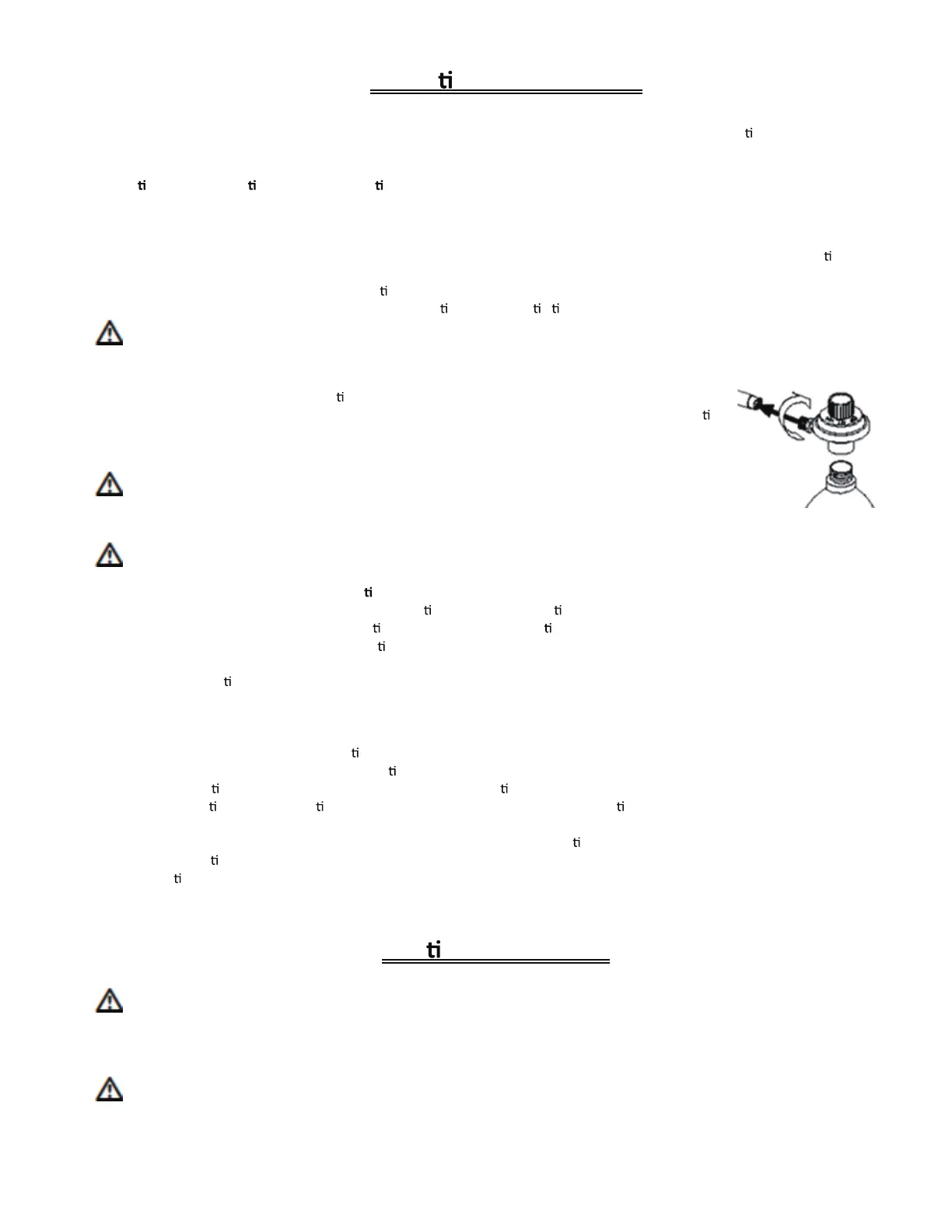
burner ports. Connect regulator valve and hand-
ghten firmly. Disconnect the propane cylinder from the regulator valve when
the grill is not in use. DO NOT obstruct the flow of combus
on air and ven la on air to the grill.
DANGER
A fire causing death or serious injury may occur if the following are not followed exactly:
Never store or use gasoline or other vola
le substances in the vicinity of this barbecue.
Never store a spare propane cylinder in the vicinity of this barbecue, or in the vicinity of another poten
al
heat
source.
Never refill a disposable cylinder.
WARNING
Don’t store spare gas cylinder in or near barbecue.
DANGER
To prevent fire or explosion hazard when tes
ng for a leak:
1. Always perform the leak test (see below) before ligh
ng the grill and each me the cylinder is connected for use.
2. Do not smoke or allow other sources of igni
on in the area while conduc ng a leak test.
3. Conduct the leak test outdoors in a well-ven
lated area.
4. Do not use matches, lighters or a flame to check for leaks.
5. Do not use grill un
l all leaks have been stopped. If you are unable to stop a leak, disconnect the
propane supply, call for gas
appliance service or your local propane gas supplier.
Checking for Leaks
1. Make 60–90 mL (2–3 oz) of tesng solu
on by mixing one part liquid dishwashing soap with three parts water.
2. Make sure control knobs are in the “OFF” posi
on.
3. Spray some solu
on on the tank valve up to the regulator connec on.
4. Inspect the solu
on at the connec ons for bubbles. If no bubbles appear, the connec
on is secure.
5. If bubbles appear, you have a leak. Go to step 6.
6. Disconnect the regulator from the tank and reconnect. Make sure the connec
on is secured.
7. Retest with solu
on.
8. If you con
nue to see bubbles, replace the cylinder.
Ligh ng Grill Burners
DANGER


 To Next Page
 Loading...