Need help?
Do you have a question about the EVGA X99 FTW and is the answer not in the manual?
Describes PCI-E 3.0, power management functions, and expansion slot configurations.
Step-by-step instructions for safely installing the CPU into the socket.
Instructions on how to install the CPU cooling solution.
Guide for properly installing DDR4 memory modules into the motherboard slots.
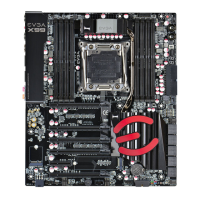
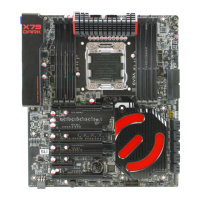
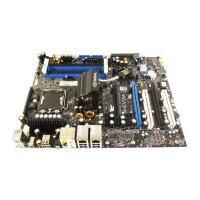
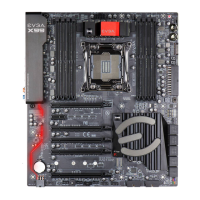
The EVGA X99 FTW is a high-performance motherboard designed for enthusiasts and users seeking robust functionality and overclocking capabilities. It supports Intel's Haswell-E/Broadwell-E CPU family and features a quad-channel DDR4 architecture, allowing for significant memory capacity and speed. The motherboard is built with an advanced 8-phase Digital VRM and a CPU socket with enhanced gold content, all resting on an 8-layer Hybrid Black PCB, ensuring stability across various applications.
Beyond its overclocking prowess, the X99 FTW is fully equipped to support a wide range of peripherals and functions. It offers 4-way SLI support without the need for additional PLX chips, providing ample graphics expansion. Connectivity options include two Intel Gigabit LAN ports and Intel AIC with Thunderbolt support. The design incorporates right-angle power connectors and PCI-E disable switches, enhancing ease of use and cable management within a system build.
The motherboard's BIOS has been revamped with a user-friendly GUI, focusing on overclocking and overall functionality in a streamlined package, catering to modern enthusiast needs.
The EVGA X99 FTW motherboard is designed for installation into a PC case and requires several separately purchased components to become a fully functional system. These essential components include an Intel Socket 2011-3 Processor, DDR4 System Memory, a CPU Cooling Device, a PCI Express Graphics Card, a Power Supply, a Hard Drive or SSD, a Keyboard/Mouse, a Monitor, and optionally, an Optical Drive. The kit itself provides the motherboard and all necessary connecting cables for installation. When replacing an existing motherboard, a fresh installation of an operating system is typically required, even if the storage drive already contains one.
The motherboard features an EATX form factor, measuring 12 inches by 10.375 inches (305x264mm). It supports Intel Socket 2011-3 Processors and is compatible with Windows 8 and 7 operating systems, leveraging the Intel X99 chipset. For system memory, it supports quad-channel DDR4 up to 3000MHz+ (OC) and up to 128GB of DDR4 memory.
USB connectivity includes eight USB 2.0 ports (six external, two internal) from the Intel X99 PCH, supporting hot-plugging and wake-up from S1 and S3 modes, with a transmission rate of up to 480 Mbps. Additionally, there are six USB 3.0 ports (four external, two internal) from the Intel X99 PCH, offering transfer speeds up to 5Gbps and backward compatibility with USB 2.0 and USB 1.1.
For storage, the Intel X99 PCH Controller provides six SATA 3/6G (600 MB/s) data transfer rate ports, with support for RAID 0, RAID 1, RAID 5, and RAID 10, as well as hot-plugging. An additional four SATA3/6G AHCI Only ports are also available. Onboard LAN is handled by one Intel i217 Gigabit Ethernet PHY and one Intel i210 Gigabit Ethernet MAC, supporting 10/100/1000 Mb/sec Ethernet and Ethernet Teaming.
Audio capabilities are provided by Realtek Audio (ALC1150), supporting 8-channel (7.1) audio and optical output. The motherboard also features PCI-E 3.0 support, which includes low power consumption and power management features. Power functions support ACPI (Advanced Configuration and Power Interface), including S0 (normal), S1 (power on suspend), S3 (suspend to RAM), S4 (suspend to disk - OS dependent), and S5 (soft - off).
Expansion slots include five PCI-E 16x slots (configurable as 2x16/8, 3x8, 4x8) and one PCI-E 4x slot. The PCI-E lane distribution varies based on the processor type: for a 40-lane processor, PE1 is x16 (x8 if PE2 is used), PE2 is x8, PE3 is x8, PE4 is x16 (x8 if PE3 is used), PE5 is x4 (Gen 2 only, 4 lanes pulled from PCH), and PE6 is x8. For a 28-lane processor, PE1 is x16 (x8 if PE2), PE2 is x8, PE3 is not functional, PE4 is x8, PE5 is x4 (Gen 2 only, 4 lanes pulled from PCH), and PE6 is x4.
The rear panel connectors include USB 2.0, USB 3.0, BIOS/CMOS Reset button, Intel i217 NIC, Intel i210 NIC, Optical Out, and Analog Audio Output Jacks. The audio port breakdown supports 2/2.1, 4.0/4.1, 5.1 (6 Channel), and 7.1 (8 Channel) configurations, with specific functions for Line In, Line Out/Speaker Out, Mic In, Front Speaker/Speaker+Sub Out, Rear Speaker Out, Center/Voice channel, and Side channel (7.1 only, configurable via Realtek Software).
When installing the CPU, extreme caution is advised to avoid damaging any pins in the CPU socket. The processor should only be held by its edges, and the bottom should not be touched. The installation process involves unhooking both the left and right socket levers by pushing them down and towards the socket, gently pressing the left lever to lift the load plate, opening the load plate, aligning the CPU notches with the socket, lowering the processor straight down, lowering the load plate onto the CPU, pressing the right socket lever to lock it, and carefully locking the left lever back into place. It is recommended to store the CPU socket cover after removal, especially if the motherboard needs to be transported or if the CPU is ever removed, to protect the socket.
For installing DDR4 DIMMs, the X99 FTW has eight 288-pin slots supporting 2GB, 4GB, 8GB, and 16GB DIMMs. At least one memory slot must be populated for normal operation. The Intel X99 chipset supports quad-channel memory up to 128GB of DDR4 at speeds up to 3000MHz+ (OC). It is crucial to populate an odd slot (1, 3, 5, 7) first, as the board will not boot if only even slots (2, 4, 6, 8) are populated. To install DIMMs, unlock a slot by pressing the module clips outward, align the memory module with the slot (noting the single gap near the center), and insert it vertically until the plastic clips automatically lock it into the connector.
The memory controller on most Haswell-E and Broadwell-E CPUs defaults to 2133MHz. To achieve higher memory speeds (above 2133MHz+), manual adjustments to memory timings, frequency, and voltages, or CPU overclocking, may be necessary. Users should refer to memory manufacturer specifications for recommended timings and can visit the EVGA forums for overclocking support.
The motherboard package includes an I/O Shield to protect internal components from dust and foreign objects, and to aid in proper airflow within the chassis. An optional I/O Cover can be attached to the PCB to cover the I/O area. The included Installation CD contains necessary drivers and software for setup, and the User Manual provides detailed instructions.
 General
| Socket | LGA 2011-v3 |
|---|---|
| Chipset | Intel X99 |
| Form Factor | ATX |
| Memory Slots | 8 |
| Max Memory Support | 128GB |
| Memory Type | DDR4 |
| PCIe 3.0 x16 Slots | 4 |
| USB 2.0 Ports | 4 |
| SATA 6Gb/s Ports | 10 |
| M.2 Slots | 1 |
| Networking | Gigabit Ethernet |
| Audio | Realtek ALC1150 |
| RAID Support | 0, 1, 5, 10 |
| Multi-GPU Support | 4-Way SLI/Crossfire |

 To Next Page