Need help?
Do you have a question about the Evoqua IONPURE IP-LXM04 and is the answer not in the manual?
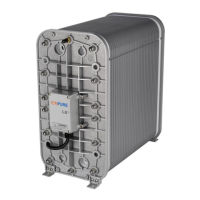
Provides an overview of the LX CEDI modules, their sizes, and flow rates.
Explains how to use the manual and general notes.
Details safety warnings and precautions during module installation.
Lists critical precautions to follow during module operation.
Outlines essential steps for safely shutting down the LX module.
Lists the necessary tools for LX module installation.
Provides instructions for safely unpacking and moving LX modules.
Details requirements for electrical and plumbing connections.
Specifies the conditions required for LX module operation.
Defines environmental conditions, space needs, and orientation for LX modules.
Details DC electrical needs and feed water quality specifications.
Specifies the requirements for module drain connections.
References flow rates and pressure drop information.
Confirms pre-installation requirements are met before installing the module.
Guides on checking and adjusting tie bar nut torque for the module.
Provides a step-by-step procedure for tightening tie-bar nuts.
Details how to configure water connections and use fittings.
Explains the sealing mechanism for EU, X, Z modules with BSP Male threads.
Explains the sealing mechanism for HI modules with BSP Female threads.
Details how to make electrical connections to the LX module.
Highlights critical safety precautions for electrical connections.
Discusses design considerations for RO/CEDI systems involving LX modules.
Instructions for testing feed water quality against LX requirements.
Guidance on determining the necessary DC current for module operation.
Procedures for testing system interlocks before startup.
Step-by-step guide for starting up the LX modules.
Lists minimum reject flow rates for different LX module sizes.
Explains water recovery calculations and considerations.
Provides an example calculation for water recovery.
Provides an example calculation for reject flow.
Provides general guidelines for module maintenance.
Emphasizes the importance and use of operating data log sheets.
Details periodic maintenance tasks to be performed every six months.
Outlines approved methods for cleaning and sanitizing LX modules.
Identifies indicators that suggest the need for cleaning or sanitization.
Provides guidelines for constructing a Clean-In-Place (CIP) system.
Lists essential safety precautions when using cleaning chemicals.
Describes the standard procedure for cleaning and sanitizing modules.
Steps to prepare the LX system for chemical cleaning or sanitization.
Details the actual cleaning process.
Steps for returning the LX module to service after cleaning.
Provides recipes for various cleaning solutions.
Specifies the recommended grades for chemicals used in cleaning.
Recommends grades for Hydrochloric Acid, Sodium Chloride, NaOH, Percarbonate, and Peracetic Acid.
Details the procedure for Hot Water Sanitization (HWS).
First phase of HWS: introducing hot water.
Second phase of HWS: maintaining the temperature.
Third phase of HWS: returning the module to service.
Provides a diagnostic guide for troubleshooting LX modules.
Steps for shutting down the LX system for off-line periods.
Procedures for restarting the LX module after a shutdown period.
Information regarding rebuilding or repairing LX modules.
Guidelines for the proper disposal of LX modules.
Tabulated data on LX module dimensions and weights.
Presents typical flow rates, pressure drops, and performance data for LX modules.
Technical drawing showing layout and elevation for EU, X, Z modules.
Technical drawing showing layout and elevation for HI modules.
Diagram illustrating the LX module junction box and wiring.
List of adapter part numbers and their specifications for LX modules.
Details materials used in LX modules and relevant approvals.
Continuation of materials and approvals for LX modules.
Explanations and definitions for footnotes in Appendix D.
 General
| Model | IONPURE IP-LXM04 |
|---|---|
| Category | Control Unit |
| Type | Electrodeionization Module |
| Flow Rate | Up to 4 m3/hr |
| Resistivity | Up to 18 MOhm-cm |
| Inlet Water Quality | RO permeate or equivalent |
| Operating Pressure | Up to 6 bar |
| Operating Temperature | 5 - 40 °C |

 To Next Page