6
Pressing the workpiece being cut off against the saw
blade will create a binding condition and kickback.
d) Align the fence to be parallel with the saw
blade. A misaligned fence will pinch the workpiece
against the saw blade and create kickback.
e) Use a featherboard to guide the workpiece
against the table and fence when making non-
through cuts such as rabbeting, dadoing or
resawing cuts. A featherboard helps to control the
workpiece in the event of a kickback.
f) Use extra caution when making a cut into
blind areas of assembled workpieces. The
protruding saw blade may cut objects that can cause
kickback.
g) Support large panels to minimise the risk
of saw blade pinching and kickback. Large panels
tend to sag under their own weight. Support(s) must
be placed under all portions of the panel overhanging
the table top.
h) Use extra caution when cutting a
workpiece that is twisted, knotted, warped or does
not have a straight edge to guide it with a mitre
gauge or along the fence. A warped, knotted, or
twisted workpiece is unstable and causes
misalignment of the kerf with the saw blade, binding
and kickback.
i) Never cut more than one workpiece,
stacked vertically or horizontally. The saw blade
could pick up one or more pieces and cause kickback.
j) When restarting the saw with the saw blade
in the workpiece, centre the saw blade in the kerf
so that the saw teeth are not engaged in the
material. If the saw blade binds, it may lift up the
workpiece and cause kickback when the saw is
restarted.
k) Keep saw blades clean, sharp, and with
sufficient set. Never use warped saw blades or
saw blades with cracked or broken teeth. Sharp
and properly set saw blades minimise binding, stalling
and kickback.
4) Table saw operating procedure warnings
a) Turn off the table saw and disconnect the
power cord when removing the table insert,
changing the saw blade or making adjustments to
the riving knife, antikickback device or saw blade
guard, and when the machine is left unattended.
Precautionary measures will avoid accidents.
b) Never leave the table saw running
unattended. Turn it off and don’t leave the tool
until it comes to a complete stop. An unattended
running saw is an uncontrolled hazard.
c) Locate the table saw in a well-lit and level
area where you can maintain good footing and
balance. It should be installed in an area that
provides enough room to easily handle the size of
your workpiece. Cramped, dark areas, and uneven
slippery floors invite accidents.
d) Frequently clean and remove sawdust
from under the saw table and/or the dust collection
device. Accumulated sawdust is combustible and may
self-ignite.
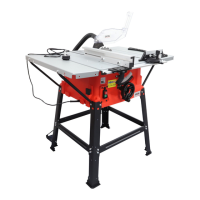
e) The table saw must be secured. A table saw
that is not properly secured may move or tip over.
f) Remove tools, wood scraps, etc. from the
table before the table saw is turned on.
Distraction or a potential jam can be dangerous.
g) Always use saw blades with correct size
and shape (diamond versus round) of arbour
holes. Saw blades that do not match the mounting
hardware of the saw will run off-centre, causing loss of
control.
h) Never use damaged or incorrect saw blade
mounting means such as flanges, saw blade
washers, bolts or nuts. These mounting means were
specially designed for your saw, for safe operation and
optimum performance.
i) Never stand on the table saw, do not use it
as a stepping stool. Serious injury could occur if the
tool is tipped or if the cutting tool is accidentally
contacted.


 To Next Page
 Loading...