
 Need help?
Do you have a question about the Extech Instruments 380260 and is the answer not in the manual?
Congratulations on purchasing the Extech Insulation Tester/Megohmmeter Model 380260.
Essential safety guidelines for using the meter, including de-energizing circuits and avoiding contact with live conductors.
Explanation of symbols used on the meter, such as caution and dangerous voltage indicators.
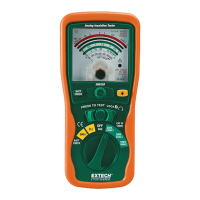
Identifies the main components of the meter, including the LCD display, buttons, and rotary switch.
Instructions for connecting the red and black test leads to the correct input terminals.
Procedure to verify the integrity and functionality of the test leads before use.
Detailed steps for performing insulation resistance tests (Megohmmeter function).
Enables hands-free operation by locking the test function and providing audible feedback.
Important considerations and interpretations for insulation resistance (Megohmmeter) tests.
Procedure for measuring AC and DC voltages using the meter.
Instructions for measuring resistance, including a warning about AC voltage presence.
Procedure for checking continuity and low resistance values with audible indication.
Details the automatic power-off feature to conserve battery life.
Explains how to freeze the current reading on the display.
Instructions for activating the display backlight.
Guidance on how to test devices that use a line cord, including double-insulated tools.
Procedure for testing AC motors, including wiring connections and component checks.
Steps for testing DC motors, focusing on brush rigging, field coils, and armature.
Instructions for testing cable insulation resistance to ground and between conductors.
Detailed specifications for insulation resistance measurement ranges, accuracy, and terminal voltage.
Specifications for AC voltage measurement, including range, resolution, accuracy, and overload protection.
Specifications for DC voltage measurement, including range, resolution, accuracy, and overload protection.
Specifications for resistance measurement, including range, resolution, accuracy, and maximum open circuit voltage.
Comprehensive specifications covering display, sampling rate, fuse, dimensions, weight, and approvals.
Step-by-step instructions for replacing the meter's batteries when the low battery symbol appears.
Guidelines for cleaning the instrument case using a dry cloth, avoiding solvents or abrasives.
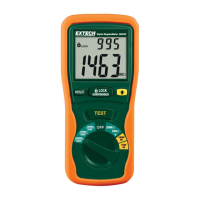
The Extech Model 380260 is a versatile Digital Megohmmeter and Insulation Tester, designed for professional use in various electrical testing applications. This instrument provides comprehensive capabilities for measuring insulation resistance, continuity, and AC/DC voltage, making it an essential tool for electricians, technicians, and maintenance personnel. Its robust design and user-friendly interface ensure reliable performance and ease of operation in diverse environments.
The primary function of the Model 380260 is to perform insulation resistance measurements, often referred to as megohmmeter tests. This is crucial for assessing the integrity of electrical insulation in cables, motors, transformers, and other electrical equipment. By applying a high DC voltage and measuring the resulting leakage current, the meter determines the resistance of the insulation. The device offers multiple test voltage positions (250V, 500V, and 1000V) to accommodate different testing requirements and standards. When conducting insulation tests, the meter displays the applied test voltage and the measured resistance in MΩ. A key safety feature is the warning against performing insulation resistance measurements if AC voltage is present on the device under test, emphasizing the importance of de-energizing and isolating circuits before testing. The meter also incorporates a discharge function, automatically discharging the circuit after an insulation test, and advises keeping the test leads connected until the display shows 0 volts to ensure complete discharge.
Beyond insulation testing, the Model 380260 also functions as a continuity tester and a voltage meter. For continuity measurements, the user can select the 200Ω range. This mode is useful for checking the continuity of circuits and identifying breaks in wires. An audible tone sounds when the resistance of a circuit is less than approximately 40Ω, providing a quick and clear indication of continuity. The meter also allows for resistance measurements in the 200kΩ range, which can be used for general resistance checks, though it explicitly warns against using this mode to check diodes or if AC voltage is present.
The device is also capable of measuring both AC and DC voltages. Users can select the appropriate ACV or DCV position on the rotary switch to measure voltages up to 750V AC and 1000V DC. This feature adds to the meter's versatility, allowing it to perform basic voltage checks in addition to its specialized insulation testing functions.
Several usage features enhance the functionality and convenience of the Model 380260. The large LCD with dual display allows for clear and simultaneous viewing of multiple readings, such as the applied test voltage and the measured resistance during insulation tests. The meter includes a "Hold" button, which freezes the current reading on the display, making it easier to record measurements, especially in situations where the display might be difficult to view directly. For hands-free operation, the device features a "Lock" function. By simultaneously pressing the "TEST" and "LOCK" keys, the meter enters a continuous test mode, indicated by a "LOCK" icon on the display and a beeper sounding every 2 seconds. This is particularly useful for extended insulation tests or when the user needs to focus on other tasks while the test is running. The "LOCK" function can be disabled by pressing the "LOCK" key again. Additionally, a backlight button is provided to illuminate the display, improving visibility in dimly lit environments. The backlight automatically turns off after 15 seconds to conserve battery life.
Safety is a paramount consideration in the design and operation of the Model 380260. The manual provides clear safety guidelines, including the necessity of de-energizing and isolating circuits before testing, exercising caution around bare conductors, and ensuring test leads are in good working order. The meter is protected throughout by double or reinforced insulation, indicated by the relevant international safety symbol. It also carries the "CE" approval and is rated for CAT III-1000V, signifying its suitability for use in various electrical environments with high transient overvoltages.
The meter incorporates an "Auto Power Off" feature to conserve battery life. If left inactive for approximately 15 minutes, the meter will automatically power down. To reactivate it, the user simply needs to turn the rotary switch to the "OFF" position and then to the desired function.
Maintenance of the Model 380260 is straightforward, primarily involving battery replacement. The meter is powered by six 1.5V 'AA' batteries. A low battery symbol appears on the LCD when the battery voltage is low, indicating that replacement is necessary. The process involves turning off the meter, removing test leads, unsnapping the tilt stand, removing four Phillips head screws to access the battery compartment, replacing the batteries while observing polarity, and then reassembling the cover and tilt stand. The manual also includes important information regarding the legal disposal of used batteries in accordance with EU Battery ordinances, emphasizing that they should not be disposed of in household garbage but returned to collection points. For cleaning, the case can be periodically wiped with a dry cloth, with a warning against using solvents or abrasives.
The Model 380260 is designed for a wide range of applications, including testing power tools, small appliances, AC motors, DC motors, and cables. For power tools and small appliances, the meter's leads are connected to the device's housing and the lines of the power cord. When testing AC motors, the motor must be disconnected from the line, and if a motor-starter is present, it should be held in the ON position. The manual provides detailed diagrams and instructions for connecting the meter to various components of AC and DC motors, including brush rigging, field coils, and armatures, to identify weaknesses in insulation. For cable testing, the procedure involves disconnecting the cable from the line and other equipment, then checking each conductor to ground/lead sheath and between conductors in pairs. These application-specific instructions highlight the meter's utility in diagnostic and maintenance tasks for electrical systems.
In summary, the Extech Model 380260 is a comprehensive and reliable insulation tester/megohmmeter that combines essential electrical testing functions with user-friendly features and robust safety measures. Its ability to perform insulation resistance, continuity, and voltage measurements, coupled with features like data hold, test lock, and backlight, makes it an invaluable tool for professionals requiring accurate and safe electrical diagnostics. Regular maintenance, particularly battery replacement, ensures its continued performance and longevity.
 General
| Model | 380260 |
|---|---|
| Category | Test Equipment |
| Frequency Response | 31.5Hz to 8kHz |
| Power Supply | 9V battery |
| Resolution | 0.1°F/°C |
| Weighting Networks | A |
| Time Weighting | Fast |


 To Next Page