
 Need help?
Do you have a question about the Extech Instruments PH220 and is the answer not in the manual?
Details the technical specifications, ranges, and accuracy of the pH meter.
Explains the components and readings shown on the meter's LCD screen.
Step-by-step guide for calibrating the pH meter using buffer solutions.
Describes the indicator for when the meter needs recalibration.
Explains how the meter automatically adjusts readings based on temperature.
Details the auto power-off feature for battery conservation.
Instructions on how to save measurement data to the meter's memory.
Guide on how to retrieve previously stored measurement readings.
Procedure for deleting all stored measurement data from the meter.
Guidelines for proper storage of the pH electrode to maintain performance.
Methods for cleaning the pH electrode to ensure accurate measurements.
Common electrode issues and their recommended solutions for the pH meter.
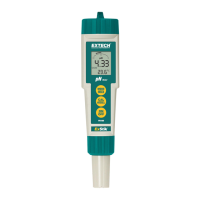
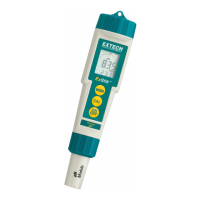
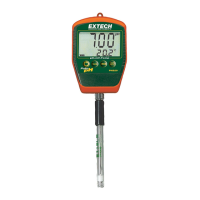
The Extech PH220 is a waterproof palm pH meter designed for field use, offering simultaneous display of pH and temperature. This microprocessor-based device features tactile push-buttons for ease of operation and is powered by a 9-volt alkaline battery. Its robust design includes a rubber holster with a magnetic backing, allowing for convenient mounting during use. The meter also incorporates a built-in memory capable of storing up to 25 readings, supporting STORE, RECALL, and CLEAR functionalities.
The primary function of the PH220 is to measure pH and temperature. It provides dual LCD display for simultaneous readings, ensuring that users can monitor both parameters at a glance. The meter is equipped with automatic temperature compensation (ATC), which is crucial because the millivolt output of a pH electrode varies with temperature. The PH220 automatically adjusts for these variations using its built-in thermometer, ensuring accurate pH readings even when the solution temperature deviates from room temperature. The temperature of the solution is always displayed on the lower LCD line.
The PH220 supports pH calibration, which is essential for maintaining accuracy over time as pH electrodes degrade. Calibration is performed using standard buffer solutions (pH 4.00, pH 7.00, and pH 10.00) at room temperature. The instrument allows for 1, 2, or 3-point calibration, with the pH 7.00 buffer always used first, followed by pH 4.00 or pH 10.00 depending on the expected measurement range. The meter automatically recognizes the buffer solutions during calibration. If a calibration has not been performed after 15 ON/OFF cycles, a 'CAL' icon will appear as a reminder, though this does not affect the meter's operation until a new calibration is performed.
The device also features an automatic power-off function to conserve battery life, which activates after 10 minutes of inactivity. This feature can be disabled or enabled by the user. Each time the meter is turned off, the auto power-off feature resets to the enabled mode.
To begin measuring pH, the electrode must first be connected to the meter. The device is turned on using the ON/OFF button, and after a brief self-test ('SLF tSt'), the user can select pH mode using the MODE button. The unit of measure for temperature can be changed by pressing and holding the MODE button for 2 seconds. Before and between samples, electrodes should always be rinsed with distilled or de-ionized water to remove any traces of previous solutions. Once the electrode is placed in the solution, a 30-second period is recommended for the electrode and ATC to reach thermal equilibrium. The pH reading will then stabilize on the main display. An 'HHH' icon indicates an out-of-range reading or a disconnected electrode.
The PH220's memory function allows users to store up to 25 measurement readings, which are retained even after the instrument is turned off. To store a reading, the user takes a measurement and then momentarily presses the STORE/RECALL button. The reading will be held on the display, indicated by 'HOLD' and 'STORE' icons, and the storage location will briefly appear. Pressing the STORE/RECALL button again releases the 'hold' feature. When all 25 storage locations are filled, the instrument begins overwriting the oldest data.
Recalling stored readings involves pressing and holding the STORE/RECALL button until a number appears on the main display, indicating the most recent storage location. After 1 second, the stored reading appears with the 'RECALL' icon. Users can scroll through stored readings (most recent first) by pressing the STORE/RECALL button. To exit recall mode, the STORE/RECALL button is pressed and held until 'End' appears. If no readings are in memory, 'End' will display when recall mode is attempted. Stored readings can be erased by simultaneously pressing and holding the STORE/RECALL and CAL buttons for 4 seconds, after which 'CLr' will appear.
The instrument also allows for a temperature offset adjustment of ±9°F (±5°C). This is done by simultaneously pressing and holding the CAL, MODE, and STORE/RECALL buttons for 6 seconds. The main display will show the current offset, and the lower display will show 't_O'. The CAL button decreases the offset value, while the MODE button increases it. Pressing and holding the STORE/RECALL button for 2 seconds saves the adjustment and exits the mode.
Proper maintenance of the pH electrode is crucial for optimizing measurement accuracy and extending its lifespan. Electrodes should always be rinsed to remove any traces of storage solution, process medium, or previous test solution.
For storage, the electrode should be kept in a soaker bottle or wetting cap filled with pH4 buffer. It is critical never to store an electrode in distilled or deionized water, as this can cause the fill solution to migrate out of the electrode.
Electrode cleaning methods depend on the type of coating accumulated over time. Soft coatings can be removed by vigorous stirring or using a squirt bottle. Organic chemical coatings (hard coatings) require chemical removal. Mechanical cleaning of the bulb should only be considered in extreme cases.
The manual also provides a comprehensive troubleshooting guide for common electrode issues. For example, a clogged junction, which can lead to long response times or reading drift, can be remedied by soaking the electrode in 4.07 M Potassium Chloride (KCl) at 140°F (60°C) for 30 minutes. Strong alkaline measurements or a deteriorated gel layer might require soaking in 0.1 M HCl overnight or replacing the electrode. Protein coatings can be addressed by soaking in 1 gm Pepsin dissolved in 100ml of 0.1 m HCl for 30 minutes. Oil, paint, dyes, or suspended solids on the sensor require alternating rinses with a materials solvent and pH 7.00 buffer. Dehydrated membranes, often resulting from long-term storage without wetting, can be rehydrated by soaking the electrode tip in a wetting cap filled with 1ml of pH 7.00 buffer for 24 to 48 hours. Static charge can be resolved by rinsing the electrode in pH 7.00 buffer and blotting, avoiding wiping. Cracked or broken bulbs necessitate electrode replacement. For samples with low ionic strength (e.g., distilled, de-ionized, boiled, or lake water), adding 1 drop (50uL) of SAT. KCl per 50 ml of sample can help stabilize erratic LCD displays without altering the pH.
Battery replacement is necessary when all 'fill bars' in the battery icon are depleted. This involves disconnecting the electrode, removing the protective jacket, prying open the battery compartment using a screwdriver or coin, replacing the 9V battery, and then reinserting the compartment and protective holster. The battery compartment is labeled to ensure correct orientation.
 General
| pH Range | 0.00 to 14.00 pH |
|---|---|
| pH Resolution | 0.01 pH |
| ATC | Yes |
| Data Hold | Yes |
| Temperature Resolution | 0.1°C |
| Display | LCD |
| Probe Type | pH electrode |
| Temperature Accuracy | ±1°C |
| Power Supply | Four AAA batteries |


 To Next Page
