Advanced Function Instruction
7-43
FUN 63 P
→HEX
CONVERSION OF ASCII CODE TO HEXADECIMAL VALUE
FUN 63 P
→HEX
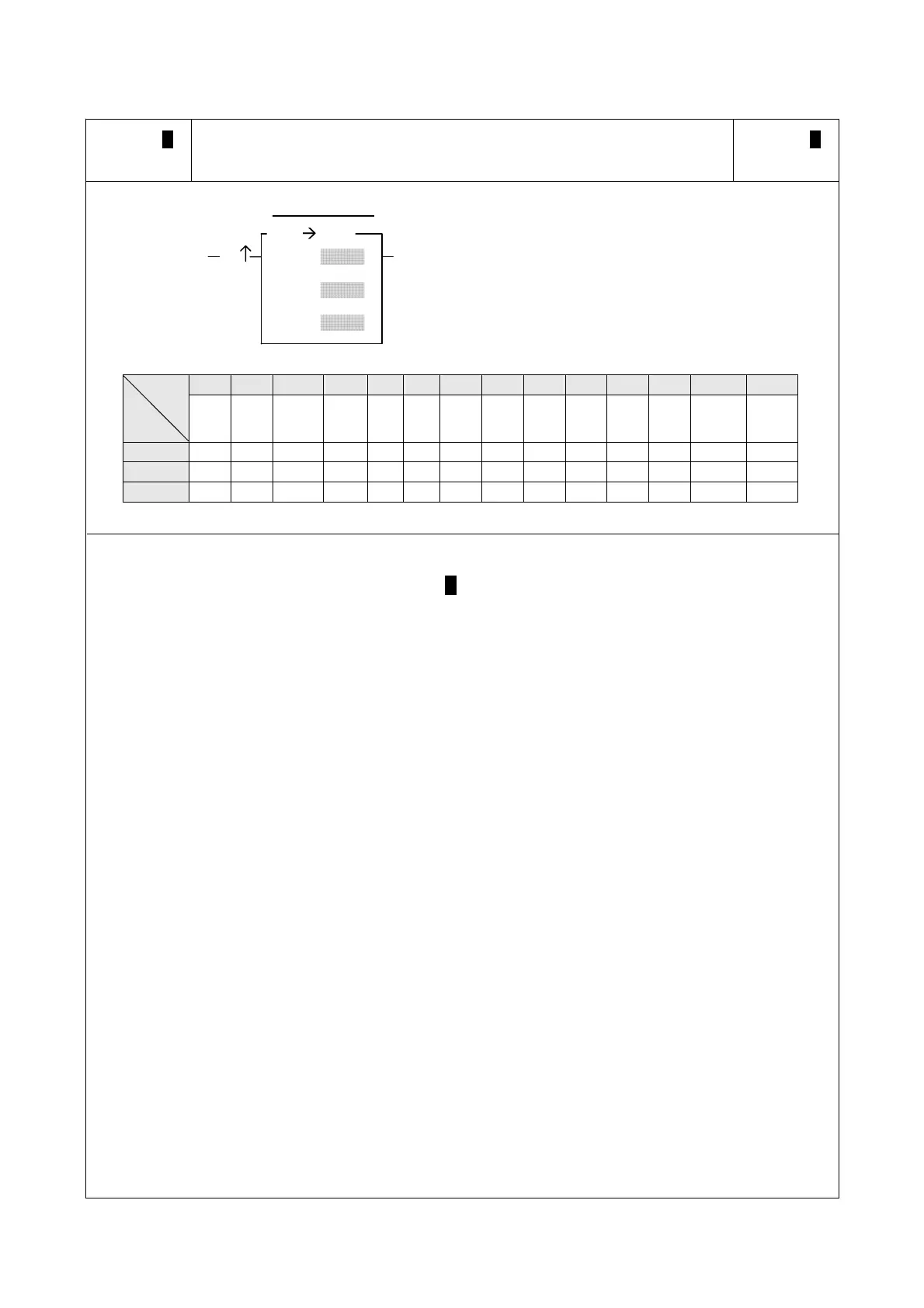
S :
ENConversion control
Ladder symbol
63P. HEX
N :
ERR
D :
S : Starting source register.
N :
Number of ASCII codes to be converted to
hexadecimal values.
D :
The starting register that stores the result
(hexadecimal value).
S, N, D, can associate with V, Z, P0~P9 to do the
indirect addressing application.
WX WY WM WS TMR CTR HR IR OR SR ROR DR K XR
Range
Ope-
rand
WX0
∣
WX240
WY0
∣
WY240
WM0
∣
WM1896
WS0
∣
WS984
T0
∣
T255
C0
∣
C255
R0
∣
R3839
R3840
∣
R3903
R3904
∣
R3967
R3968
∣
R4167
R5000
∣
R8071
D0
∣
D4095
16-bit
+number
V、Z
P0~P9
S ○ ○ ○ ○ ○ ○ ○ ○ ○ ○ ○ ○ ○
N ○ ○ ○ ○ ○ ○ ○ ○ ○ ○ ○ ○ 1~511 ○
D ○ ○ ○ ○ ○ ○ ○ ○* ○* ○ ○
z When conversion control “EN” =1 or “EN↑” ( P instruction) changes from 0→1, it will convert the N
successive hexadecimal ASCII character(‘0’~’9’,’A’~’F’) convey by 16 bit registers (Low Byte is effective) into
hexadecimal value, and store the result into the register starting with D. Every 4 ASCII code is stored in one
register. The nibbles of register, which does not involve in the conversion of ASCII code will remain
unchanged.
z The conversion will not be performed when N is 0 or greater than 511.
z When there is ASCII error (neither 30H~39H nor 41H~46H), the output “ERR” is ON.
z The main purpose of this instruction is to convert the hexadecimal ASCII character (‘0’~’9’,’A’~’F’), which is
received by communication port1 or communication port2 from the external ASCII peripherals, to the
hexadecimal values that the CPU can process directly.



 To Next Page