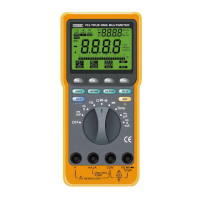
4.1.2 Measuring AC Volts
Follow these steps to measure AC volts.
1. Set function and range switch to the desired AC V range.
If you do not know the value of the vo
l
tage to be measured,
always start with the highest range and redu
c
e the setting as
required to obtain a satisfactory reading.
2. Plug the red test lead into the “VΩHz Cap” input terminal and
the black lead into the “COM” input terminal of the instrument..
3. Disconnect the power from the circuit to be tested.
4.
Connect the test leads to the circuit to be tested.
5. Reapply power to the circuit, the measured voltage will appear
on the display of the instrument.
6. Disconnect power to the circuit before removing the test leads
from the circuit.
Three-Phase AC Volts
This Meter is designed to pr
i
mari
l
y measure household AC
voltage. When measuring THREE-PHASE circuits line-to-line, the
value of the voltage is actually higher than the rated line-to-ground
3-phase voltage. It is very important that you do not exceed the
maximum AC (RMS) rating of this Meter, 750V AC. To find the
RMS voltage line-to-line on a 3-phase power line, multiply the
rated line-to-ground voltage by the square root of 3 (approx.
1.732).
For example, if you connect this Meter to a 480 volts 3-phase
line(i.e. 480V line-to-ground), the total available voltage line-to-line
is about 832V AC (≒480V x 1.732). Severe damage and a
dangerous shock hazard could result because this exceeds the
rating of this Meter.
20 21
4.2 Measuring Resistance (Ohms)
CAUTION!
TURN OFF POWER AND DISCHARGE ALL CAPACITORS ON
CIRCUIT TO BE TESTED BEFORE ATTEMPTING INCIRCUIT
RESISTANCE MEASUREMENTS. FAILURE TO DO SO MAY
END UP IN EQUIPMENT (AND/OR INSTRUMENT) DAMAGE.
THE RESISTANCE MEASURING CIRCUIT APPLIES A KNOWN
VALUE OF CONSTANT CURRENT THROUGH THE UNKNOWN
RESISTANCE AND THEN ME
A
SURES THE VOLTAGE
DEVELOPED ACROSS IT. THEREFORE, REMOVE ALL
POWER TO THE CIRCUIT UNDER TEST
W
HEN MAKING
RESISTANCE MEASUREMENTS. IF ANY VOLTAGE IS
PRESENT IN THE TEST CIRCUIT, AN ERRONEOUS READING
WILL RESULT. THIS METER MAY BE DAMAGED IF VOLTAGE
IN EXCESS OF 600V AC IS PRESENT.
NOTE: When measuring critically low ohm values, touch tips
of test leads together and record the reading. Subtract
this reading from any additional measurement to
obtain the most accurate value.



 To Next Page